

New Global Report on Food Crises, 2026

April 26, 2026

The 2026 Global Report on Food Crises (GRFC), jointly published on April 24 by the Food and Agriculture Organization (FAO), the World Food Programme (WFP), and the Global Network Against Food Crises, estimates that some 35.5 million children were acutely malnourished across 23 nutrition crisis countries.  “This tenth edition… reveals an alarming reality: hunger is increasingly being used as a weapon of war.”  

Ending hunger is a test of our shared humanity. It is a test we cannot fail.” the U.N. Secretary-General wrote in the Foreword.

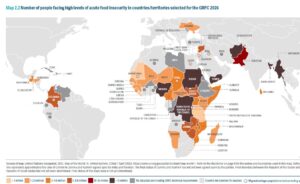
In 2025, approximately 266 million people across 47 countries and territories faced crises or acute food insecurity, requiring urgent humanitarian assistance.  The report discusses rates of malnutrition based on medical clinic screening in Gaza and western Sudan, including El Fasher and Kadugli.   Much of the rest of the Sudan is also seen as at risk.

The Global Network Against Food Crises itself is described as an alliance including the UN, EU, Germany’s BMZ, UK FCDO, Ireland, g7+, and other governmental/non-governmental agencies.

Comparing reports over the years, the trajectory from 2020 to 2025 is stark.  In 2020, approximately 155 million people faced high levels of acute food insecurity) across 55 countries, already a sharp rise from 105 million in 2016.  By 2025, that figure stood at 266 million across 47 countries, though the 2026 report explicitly cautions that the apparent drop from the 2023 peak of 282 million partly reflects reduced country coverage rather than genuine improvement. The share of the analyzed population in acute food insecurity nearly doubled from about 11 percent in 2016 to nearly 23 percent in 2025, and had already crossed 21 percent by 2020.

In 2019 and 2020, David Beasley, as the Executive Director of the World Food Programme (WFP), highlighted the risk of multiple concurrent famines, while the organization was awarded the Nobel Peace Prize in 2020.  Beasley delivered the Nobel lecture where he called for action to prevent widespread starvation.    In 2020, the primary crisis concentration was already in a familiar set of countries, Afghanistan, the Democratic Republic of the Congo, Nigeria, the Sudan, Syria, and Yemen, which the 2026 report notes have been among the ten largest food crises for most of the decade.

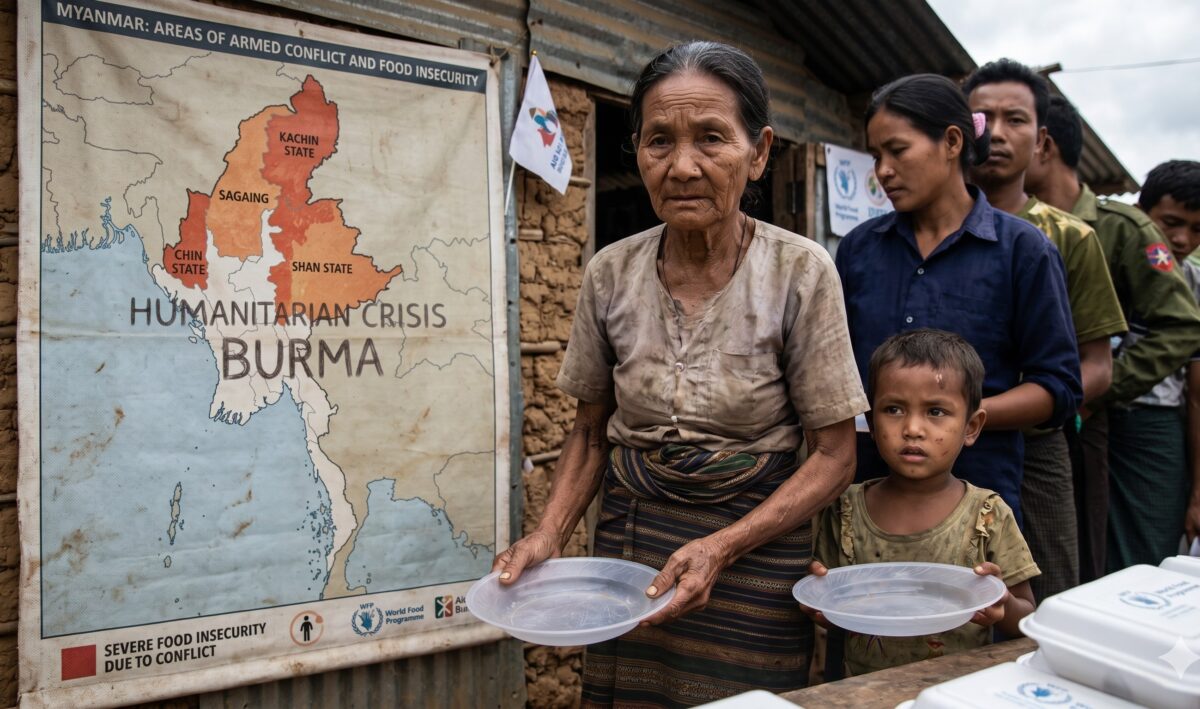
Myanmar [Burma] and South Sudan were newly classified as very severe nutrition crises in 2026, categories they did not hold in the earlier period.

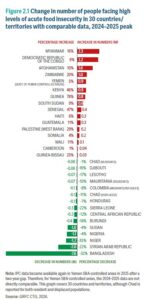
Meanwhile, some populations showed meaningful improvement. Bangladesh saw a significant 32 percent decrease in acutely food-insecure people between 2024 and 2025, and Syria reduced its share from 39 to 29 percent of the population — though both remained at alarming absolute levels.

The report covers various causes of malnutrition, including war and climate. Weather extremes had grown enormously as a driver — from 15 countries affecting 15.7 million people in 2020 to 16 countries affecting 87.5 million people in 2025, a roughly five-fold increase in affected population. The 2023–2024 El Niño, described as one of the strongest on record, drove much of this, devastating Southern Africa in particular.

The report and its annexes reviewed methods.  For instance, WFP conducted 800,000 survey interviews in 2025, a 30 percent reduction from 1.1 million the prior year. FAO’s Data in Emergencies surveys fell 31 percent, from about 170,000 to 118,000 interviews.  An ongoing Acute Food Insecurity Trends Study was specifically designed to correct for temporal, methodological, population, and spatial omission biases that make year-to-year comparisons unreliable. This work was not yet in place for the 2020 edition. Additionally, the 2026 report notes specific methodology changes in individual countries — for instance, Zimbabwe’s IPC methodology changed between periods, and Uganda shifted from FEWS NET to IPC classification, adding 3.3 million people to Phase 3 counts simply through the methodological switch.

Access the report:

https://openknowledge.fao.org/server/api/core/bitstreams/86067cbb-9396-4e7d-8d19-e60ad00d2f73/content

Technical notes:  https://www.fightfoodcrises.net/sites/default/files/resource/file/2026_GRFC_APP_TECHNOTES.pdf

https://www.fightfoodcrises.net/global-report-food-crises

https://reliefweb.int/report/world/2026-joint-analysis-global-report-food-crises

Past reports:

https://www.fightfoodcrises.net/knowledge-hub/search?f%5B0%5D=series%3A39

Key U.N. Updates Show Alarming Hunger Trends

Recent UN annual reports and updates about global hunger highlight several important issues and trends as we move into 2026:

WFP will prioritize feeding 110 million in 2026 despite larger need: Declines in global humanitarian funding are forcing WFP to prioritize food assistance to roughly one-third of those in need. In 2026, the agency aims to reach 110 million of the most vulnerable at an estimated cost of $13 billion, but current funding forecasts indicate WFP may only receive close to half that goal. (Source: here)

318 Million People Acutely Food Insecure: WFP also tried to explain updated statistics about hunger such as “Across 68 countries where WFP operates and data is available, it is estimated that 318 million people will be acutely food insecure in 2025.” (Source: here)

Malnutrition in Darfur: There are no WFP humanitarian partners left on ground and no verified reports that any community kitchens are operating, and WFP assisted around half a million people in the Tawila in November. Across Darfur we have consistently reached around two million people per month – half of whom are in North Darfur, in areas surrounding El Fasher.” (Source: here)

Myanmar faces rising displacement and unacceptable hunger levels in 2026: The people of Myanmar already face dire levels of hunger; a place where mothers cannot afford enough food to sustain their health, and malnutrition has become a new reality for thousands of children. More than 400,000 young children and mothers with acute malnutrition are surviving on nutrient-deprived diets of plain rice or watery porridge.  “Conflict and deprivation are converging to strip away people’s basic means of survival, yet the world isn’t paying attention,” said Michael Dunford, WFP Country Director in Myanmar. “This is one of the worst hunger crises on the planet, and one of the least funded. We cannot allow this level of suffering to remain invisible. The scale of need is far outpacing our ability to respond.” (Source: here)

Drought conditions are intensifying in Somalia: UN OCHA finds that Because of funding shortfalls, the number of people receiving emergency food assistance in Somalia has plummeted from 1.1 million in August to just 350,000 in November. Puntland authorities report that 89 supplementary feeding sites and 198 health and stabilization centers are experiencing severe shortages of supplies. Forecasts indicate the situation could worsen further. In a forecast covering 13 to 18 November, the FAO Somalia Water and Land Information Management (SWALIM) program projected that dry conditions will persist across much of Somalia, with isolated light rains in southern regions. Central and northern regions will remain mostly dry and hot.   The drought comes in the midst an already dire humanitarian situation. At least 4.4 million people—more than one-fifth of Somalia’s population—are projected to face high levels of acute food insecurity between October and December. An estimated 1.85 million children under 5 are expected to suffer acute malnutrition through July 2026. (Source: here)

Surging conflicts, rising hunger, global funding cuts, and collapsing basic services are driving humanitarian needs for children to extreme levels worldwide: UNICEF’s Dec. 10 annual Humanitarian Action for Children 2026 (HAC) appeal launched asking for US$7.66 billion is urgently required to provide life-saving assistance to 73 million children – including 37 million girls and over 9 million children with disabilities,  across 133 countries and territories next year.  Global humanitarian funding has deteriorated dramatically in 2025. Announced and anticipated funding cuts by donor governments are already limiting UNICEF’s ability to reach millions of children in dire need. Severe shortfalls in 2024 and 2025 are forcing UNICEF to make impossible choices. Across UNICEF’s nutrition programming alone, a 72 per cent funding gap in 2025 forced cuts in 20 priority countries – reducing planned targets from more than 42 million to over 27 million women and children. (Source: here)

FAO’s new Global Emergency and Resilience Appeal seeks $2.5 billion to support 100 million people in 54 countries: FAO’s December Global Emergency and Resilience Appeal for 2026 finds that acute food insecurity has tripled since 2016, even with high levels of humanitarian funding. The current model simply does not keep pace with today’s realities” the Director-General said. “Supporting farmers to maintain production is critical to ensure food availability. When farmers can keep producing, communities stabilize and the path to resilience becomes real.”  Around 80 percent of people facing acute food insecurity live in rural areas, relying on farming, herding, fishing or forestry. Yet only 5 percent of humanitarian food-sector funding supports agricultural livelihoods—a persistent imbalance that traps families in a cycle of crisis and dependence. Strengthening local food production improves food availability, supports markets, creates jobs, and stabilizes communities—especially in countries such as Sudan, South Sudan, Afghanistan and the Democratic Republic of the Congo. (Source: here)

Gaza Humanitarian Food Aid – A Report by Senators Van Hollen & Merkley

A detailed report by U.S. Senators Chris Van Hollen (Maryland) and Jeff Merkley (Oregon) resulting from a fact-finding CODEL mission to Israel, Gaza’s border, the West Bank, Jordan, and Egypt is a review of their observations of destruction and forced displacement.  (Van Hollen, Merkley Report Following  2025 CODEL to Gaza Border, Israel, West Bank, Jordan, and Egypt, released Sept 11, 2025)

The two Senators begin their report observing that “In Israel, we met with families whose loved ones were taken hostage during Hamas’s heinous terrorist attack on Israel on October 7, 2023. We also returned to Kfar Aza, an Israeli kibbutz near the border with Gaza that we had previously visited in the summer of 2023. What we remembered as a vibrant community had become the site of one of the worst massacres on October 7th, with 80 people killed and 19 taken hostage.”

The Senators assert that U.S. complicity and international inaction have enabled a humanitarian crisis as a form of collective punishment against Palestinians. The Senators’ analysis is that collective punishment has replaced Israel’s initial military goal of defeating Hamas, extending suffering to the civilian population through the destruction of homes, hospitals, schools, and essential services: 92% of homes, 92% of schools, 94% of hospitals, and 86% of water/sanitation facilities have been destroyed or rendered unusable.

The report argues that Israel’s strategy combines the systematic devastation of Gaza’s civilian infrastructure—over 90% of homes, schools, hospitals, and water systems destroyed—with the weaponization of food and aid to render Gaza uninhabitable.

The authors observe that over 87% of Gaza’s territory is under military zones or evacuation orders, especially Gaza City where food access is minimal.

The Senators reference warnings of famine and that 132,000 children under five are at risk of food insecurity. NGOs reported instances of “starvation ketoacidosis”, an indication of weight loss.  As a result of patchy distribution of aid, northern Gaza appears to have more children who are malnourished than southern Gaza.

1.9 million people (90% of Gaza’s population) have been displaced, many multiple times.

Much of the Senators’ report is about the tight delivery of limited aid from outside Gaza.  Israel’s rejection of UNRWA’s role in aid delivery left 6,000 trucks of food and medicine warehoused and at risk of expiry.   They criticize Israel’s restrictions on entry points, permitting only Kerem Shalom and Zikim to operate irregularly, while Rafah remains closed.   The Jordan Corridor and Egypt aid crossing routes face high rejection rates (e.g., 68% for Egypt in August 2025), delaying non-food essentials like shelter and medicine, which disproportionately affect displaced families and the elderly ahead of winter.

Meanwhile, new customs and screening rules at Ashdod Port and along the Jordan Corridor drastically slowed aid shipments, reducing throughput to less than 10% of capacity.  Drawing on interviews with the World Food Programme (WFP):  “We were told by WFP officials that following the resumption of aid delivery to Gaza after the blockade was lifted, the Israeli government changed its screening practices and customs policies, resulting in the deliberate and unnecessary slowdown of the flow of food into Gaza.  WFP is only able to screen between 20 to 30 containers a day, whereas before these new requirements were put in place, they were able to screen over a hundred a day. The new screening procedures take about 3 to 5 hours per container, and they must physically check each pallet inside the container before the whole container is cleared.”

The authors expressed concern that new lead aid agency, the Gaza Humanitarian Foundation (GHF), operates only four distribution sites, primarily in southern Gaza Established on May 26, 2025, amid the blockade’s end, the GHF replaced the UN’s extensive network with just four sites (three in southern Gaza, none in the north), leading to deadly chaos. Over 1,300 Palestinians have reportedly been killed near these sites amid chaotic food distributions.  Doctors Without Borders (MSF) called this “orchestrated killing,” with 1,380 casualties (including 174 gunshot wounds to women and children) treated at nearby clinics over seven weeks.

Van Hollen and Merkley write that the current method of aid distribution has devolved into “the rule of the strongest,” where only the most physically able individuals can access assistance.

Israeli authorities have not protected humanitarian convoys from settler attacks, while bureaucratic barriers, including arbitrary “security concerns” and banned “dual-use” lists—further impede deliveries. Items such as water filters, tents, and even peanut butter have been prohibited. The report notes that there are “two sets of laws” for aid delivery at the Kerem Shalom crossing, with GHF trucks having access to a paved, orderly loading platform while UN trucks must use uneven dirt and gravel, making their cargo less secure.  Further, they report, “One of the major problems since the start of the war in Gaza has been that the Israeli government has never published, nor provided to humanitarian organizations, a definitive list of what items are permitted or prohibited. Humanitarian groups we met with on the ground stressed that this lack of transparency has created enormous uncertainty and delays.”

Report Recommendations

The Senators call for:

  •     An immediate ceasefire by both warring factions and hostage release by Hamas.
  •     Unrestricted humanitarian access, including increasing the crossings in Kerem Shalom, Zikim, Kissufim, Gate 96, Rafah. They recommend aid agencies flood Gaza with sufficient humanitarian assistance to restore orderly distributions and lower prices, urgently address shelter needs before winter, and focus on protecting vulnerable populations.
  •     Protection of aid workers and journalists, working inside Gaza. Allow international journalists unfettered access to Gaza to provide independent verification and reporting on conditions; at the same time, push back politically and diplomatically against attempts to dismantle, deregister, or muzzle humanitarian and human rights organizations working in Gaza.

For the full report, see:  www.vanhollen.senate.gov/imo/media/doc/van_hollen_merkley_report_following_2025_codel_to_gaza_border_israel_west_bank_jordan_and_egypt.pdf

Their press presentation can be seen at:  https://www.youtube.com/watch?v=qQBx9SDi2wU

by Steve Hansch, Hunter Notes, Editor, WHES  Board

Status of McGovern-Dole School Feeding Unclear

In May 2025, the U.S. Department of Agriculture (USDA) cancelled most of its existing foreign assistance programs, including those involving overseas school feedings.  These projects are referred to as “McGovern-Dole” that were projected for the future.

The overall program, named after former senators George McGovern and Bob Dole, has provided life-saving meals in a school setting to over 31 million of the world’s most vulnerable children and has been one of America’s signature child nutrition and food security programs.  In 2022, the program fed nutritious school meals to more than 2.7 million food-insecure children during the school year, while training teachers and rehabilitating schools, in Africa, Asia and Latin America.

All of these school feeding projects were implemented by non-governmental organizations (NGOs) and/or the World Food Programme.  The recent, May 2025 cancellations occured abruptly, as NGOs were preparing to design and compete for new awards in more countries.  No rationale from the U.S. Administration was given, despite Congressional questions to USDA.  The Trump Administration has further deleted the program from its FY2026 budget request.  Currently, American NGOs, such as World Vision, Save the Children, Project Concern and Counterpart International are challenged by the loss sudden and unexpected loss of support.

Catholic Relief Services (CRS), one such NGO, announced how these terminations leave school-age children in the lurch:  “Beginning in July, more than 780,000 children across 11 countries will be left without their school meal, as 11 out of CRS’ 13 projects have been terminated—deepening the crises of hunger, malnutrition and poverty that already threaten their ability to learn, grow and thrive. …. In 2024, evaluations of our work highlighted increased literacy rates, economic growth and reduced absences due to hunger and illness. … A recent study in Guatemala and Honduras revealed that 76% of respondents cited three major benefits of USDA’s McGovern Dole School Feeding program that reduce migration: increased access to education, improved agricultural production and a stronger local economy.”

Civileats reports that “the canceled grants will mean less demand for U.S. farmer commodities, even as other trade policies are pinching growers.  And it will contribute to shrinking the United States’ soft-power influence around the world.”

McGovern-Dole school feeding programs have been seen as a way to encourage young girls to attend schools in settings where many girls find it difficult.

Evaluations of school feeding programs are common, such as by WFP, USDA, and NGOs.  A meta-analysis commissioned by the U.S. government in 2020 found that the effect of take-home rations on school participation is positive for all school children and is the same for girls as for boys, while the effect of in-school meals on school attendance is larger for girls than for boys.

Globally, an estimated 350-400 million children receive school feeding each year.  In years past, reviews by the World Bank and the respected International Food Policy Research Institute (IFPRI) recognized the benefits of school feeding in terms of nutrition, educational gains, women’s empowerment, and long-term development.  In 2009, the World Bank published Rethinking School Feeding: Social Safety Nets, Child Development, and the Education Sector, cast school feeding as part of safety nets and as long-term investments.  In 2021, the World Bank and WFP launched an initiative that evaluated the efficacy of school feeding programs via experimental impact evaluations in countries like Burundi, Guatemala, Jordan, Malawi, and The Gambia.  Results from 2024 found that school meals, benefited an estimated 418 million children globally, enhanced educational outcomes (e.g., enrollment and retention) and acted as social safety nets during shocks.

Senators Bob Dole (Republican) and George McGovern (Democrat), who sponsored the enabling legislation for this school feeding aid, were both nominees of their respective parties for U.S. President, and both served in Europe during World War II.  Senator McGovern flew 35 precarious missions as a pilot during 1944-1945 from Italy over Germany and after the war flew food aid for the recovery of Europe.

Senator Dole championed humanitarian causes abroad.  He played a key role in mobilizing Senate support for Bosnia and Herzegovina from 1992 to 1996, pressuring the Clinton administration and NATO to address the Bosnian War.  Senator McGovern served as the first Director of the U.S. Food for Peace Program before becoming a Senator.  During that time, he worked with the White House to create the U.N. World Food Programme, which was approved by the U.N. General Assembly in 1961 and launched in 1963.

Update: However, on May 12, 2025 USDA announced a call for Fiscal Year 2025 applications for McGovern Dole programming.  The priority countries listed are: Benin, Burkina Faso, Cote d’Ivoire, Honduras, Mozambique, Pakistan, Senegal, and Sierra Leone.

– S. Hansch, WHES Board


This article was updated and corrected on Nov 11, 2025 to note the status of this program remains unclear and that a new funding opportunity was announced. This is a developing issue.


WORLD FOOD PROGRAM speaks on Feeding those in need

In this video interview by PBS.org, David Beasley, former Governor of South Carolina, and the outgoing Executive Director of the UN World Food Program (WFP) speaks about his organization’s feeding those in greatest need.  From March 21, 2023.

WFP is providing food aid to 160 million persons, and the hunger needs continue to grow.  Beasley says in the interview:  “I do think the problems we’re facing around the world are quite extraordinary. But, as I tell them, look, there’s $400 trillion worth of wealth around the planet today, and your charity is not the long-term solution. But we are in a crisis mode right now, and we need your help.  But, number two, I need your engagement. Work with us to end hunger around the world.”