
Status of McGovern-Dole School Feeding Unclear

In May 2025, the U.S. Department of Agriculture (USDA) cancelled most of its existing foreign assistance programs, including those involving overseas school feedings.  These projects are referred to as “McGovern-Dole” that were projected for the future.

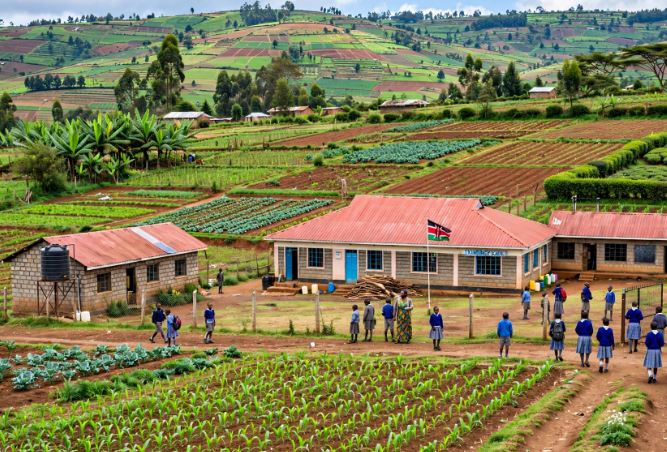
The overall program, named after former senators George McGovern and Bob Dole, has provided life-saving meals in a school setting to over 31 million of the world’s most vulnerable children and has been one of America’s signature child nutrition and food security programs.  In 2022, the program fed nutritious school meals to more than 2.7 million food-insecure children during the school year, while training teachers and rehabilitating schools, in Africa, Asia and Latin America.

All of these school feeding projects were implemented by non-governmental organizations (NGOs) and/or the World Food Programme.  The recent, May 2025 cancellations occured abruptly, as NGOs were preparing to design and compete for new awards in more countries.  No rationale from the U.S. Administration was given, despite Congressional questions to USDA.  The Trump Administration has further deleted the program from its FY2026 budget request.  Currently, American NGOs, such as World Vision, Save the Children, Project Concern and Counterpart International are challenged by the loss sudden and unexpected loss of support.

Catholic Relief Services (CRS), one such NGO, announced how these terminations leave school-age children in the lurch:  “Beginning in July, more than 780,000 children across 11 countries will be left without their school meal, as 11 out of CRS’ 13 projects have been terminated—deepening the crises of hunger, malnutrition and poverty that already threaten their ability to learn, grow and thrive. …. In 2024, evaluations of our work highlighted increased literacy rates, economic growth and reduced absences due to hunger and illness. … A recent study in Guatemala and Honduras revealed that 76% of respondents cited three major benefits of USDA’s McGovern Dole School Feeding program that reduce migration: increased access to education, improved agricultural production and a stronger local economy.”

Civileats reports that “the canceled grants will mean less demand for U.S. farmer commodities, even as other trade policies are pinching growers.  And it will contribute to shrinking the United States’ soft-power influence around the world.”

McGovern-Dole school feeding programs have been seen as a way to encourage young girls to attend schools in settings where many girls find it difficult.

Evaluations of school feeding programs are common, such as by WFP, USDA, and NGOs.  A meta-analysis commissioned by the U.S. government in 2020 found that the effect of take-home rations on school participation is positive for all school children and is the same for girls as for boys, while the effect of in-school meals on school attendance is larger for girls than for boys.

Globally, an estimated 350-400 million children receive school feeding each year.  In years past, reviews by the World Bank and the respected International Food Policy Research Institute (IFPRI) recognized the benefits of school feeding in terms of nutrition, educational gains, women’s empowerment, and long-term development.  In 2009, the World Bank published Rethinking School Feeding: Social Safety Nets, Child Development, and the Education Sector, cast school feeding as part of safety nets and as long-term investments.  In 2021, the World Bank and WFP launched an initiative that evaluated the efficacy of school feeding programs via experimental impact evaluations in countries like Burundi, Guatemala, Jordan, Malawi, and The Gambia.  Results from 2024 found that school meals, benefited an estimated 418 million children globally, enhanced educational outcomes (e.g., enrollment and retention) and acted as social safety nets during shocks.

Senators Bob Dole (Republican) and George McGovern (Democrat), who sponsored the enabling legislation for this school feeding aid, were both nominees of their respective parties for U.S. President, and both served in Europe during World War II.  Senator McGovern flew 35 precarious missions as a pilot during 1944-1945 from Italy over Germany and after the war flew food aid for the recovery of Europe.

Senator Dole championed humanitarian causes abroad.  He played a key role in mobilizing Senate support for Bosnia and Herzegovina from 1992 to 1996, pressuring the Clinton administration and NATO to address the Bosnian War.  Senator McGovern served as the first Director of the U.S. Food for Peace Program before becoming a Senator.  During that time, he worked with the White House to create the U.N. World Food Programme, which was approved by the U.N. General Assembly in 1961 and launched in 1963.

Update: However, on May 12, 2025 USDA announced a call for Fiscal Year 2025 applications for McGovern Dole programming.  The priority countries listed are: Benin, Burkina Faso, Cote d’Ivoire, Honduras, Mozambique, Pakistan, Senegal, and Sierra Leone.

– S. Hansch, WHES Board


This article was updated and corrected on Nov 11, 2025 to note the status of this program remains unclear and that a new funding opportunity was announced. This is a developing issue.


The Razor’s Edge: Embezzlement, Corruption and Development in Ethiopia, a Novel (2022)

For anyone interested in learning what development work overseas entails and what work is like, there may be no better introduction than Robert Gurevich’s novel, The Razor’s Edge.  Thinly modeled on his own experiences in Africa, with his protagonist, writing in the first person, caught between the US Government’s Agency for International Development (USAID) and non-governmental organization work, primarily in basic education for kids.  The book follows the adventures of a westerner hired to lead an NGO’s (KAP) education program of schools, collaborating with parent-teacher associations, and building on models that have worked.

One reviewer on Amazon agrees:  “Any development worker contemplating taking a senior foreign posting, especially with an NGO, on a government-funded education project could benefit from reading this book.” The 2002 story is an easy read at 298 pages, with the subtitle “Embezzlement, Corruption and Development in Ethiopia, a Novel”. 

He starts the book as the new project director of a USAID-overseen project supporting 2,500 primary schools in Ethiopia.  The journey of the protagonist has formed experiences at each stage of his project work, from being proposed to USAID through to meeting staff, implementation, accounting, responding to evaluations of his program, and controversies that have arisen over the years which include observing staff turnover and allegations of fraud.  The author repeatedly debates how to interact with USAID – the main funder — regarding his choices, presentations, and reporting USAID is likely to accept or reject.  Though budgets are not discussed, key realities of development programs are milestones, timelines, and scaling.

Hunger and malnutrition enter the plot when there is a poor harvest, to which the NGO and their donors respond with school feeding. School feeding has been a large part of aid programming for decades, particularly as an incentive for girls to attend school.  Late in the book, Ethiopia suffers a drought, for which USAID provides new resources to KAP (“a large emergency grant”) to support school feeding programs to encourage children to continue attending school, help them have the strength to travel to school and nutrition to help pay attention and learn in the classroom. The protagonist observes USAID efficiently sought to “utilize an already existing project for addressing this emergency quickly.

In the telling, hot, cooked meals (i.e., “wet food”) were provided. “With wet food, we know for sure that the food is consumed by the child and not taken by an older family member at home.  By eating the meal at school , this makes all the children continue to attend.”

Other insights about the challenges of aid work appear in each chapter, such as “the major problem has been the use of cash payments to schools, along with lax scrutiny.  I am recommending each beneficiary school be required to open an account with the nearest bank, credit union… into which project funds can be deposited.”

Two choices families face are:  “For children to continue their schooling beyond the four grades offered in the village school, they would need to move to a town with a primary school offering eight grades, and, later, a secondary school.  These children would need to live with someone.” or “Parents need the labor of children during certain times of year, keeping them out of school at these times. But when the children fall behind their classmates, they become embarrassed and drop out.”

The author is an anthropologist, specializing in education, working in consultancies for USAID and the Peace Corps, Chairman and Member of the Board of Directors for the USAID-funded Sustainable Agriculture and Natural Resource Management Collaborative Research Support Program. Among other technical achievements, in 2015 he evaluated the USG’s education portfolio in Yemen.

In his way, Gurevich pays homage to the 1944 novel of the same name by Somerset Maugham where the protagonist, also, travels far and wide seeking to discover transcendent liberation from human suffering.  It took its title from the ancient Upanishads verse “The sharp edge of a razor is difficult to pass over; thus, the wise say the path to Salvation is hard.”

https://www.amazon.com/Razors-Edge-Embezzlement-Corruption-Development/dp/1950444295