
HOPE in Gaza

Project HOPE is the recipient of a donation by the World Hunger Education Service (WHES), a non-profit dedicated to educating the public about solving hunger which selected Project Hope to highlight and affirm its excellent work providing recovery foods for malnourished children in Gaza.

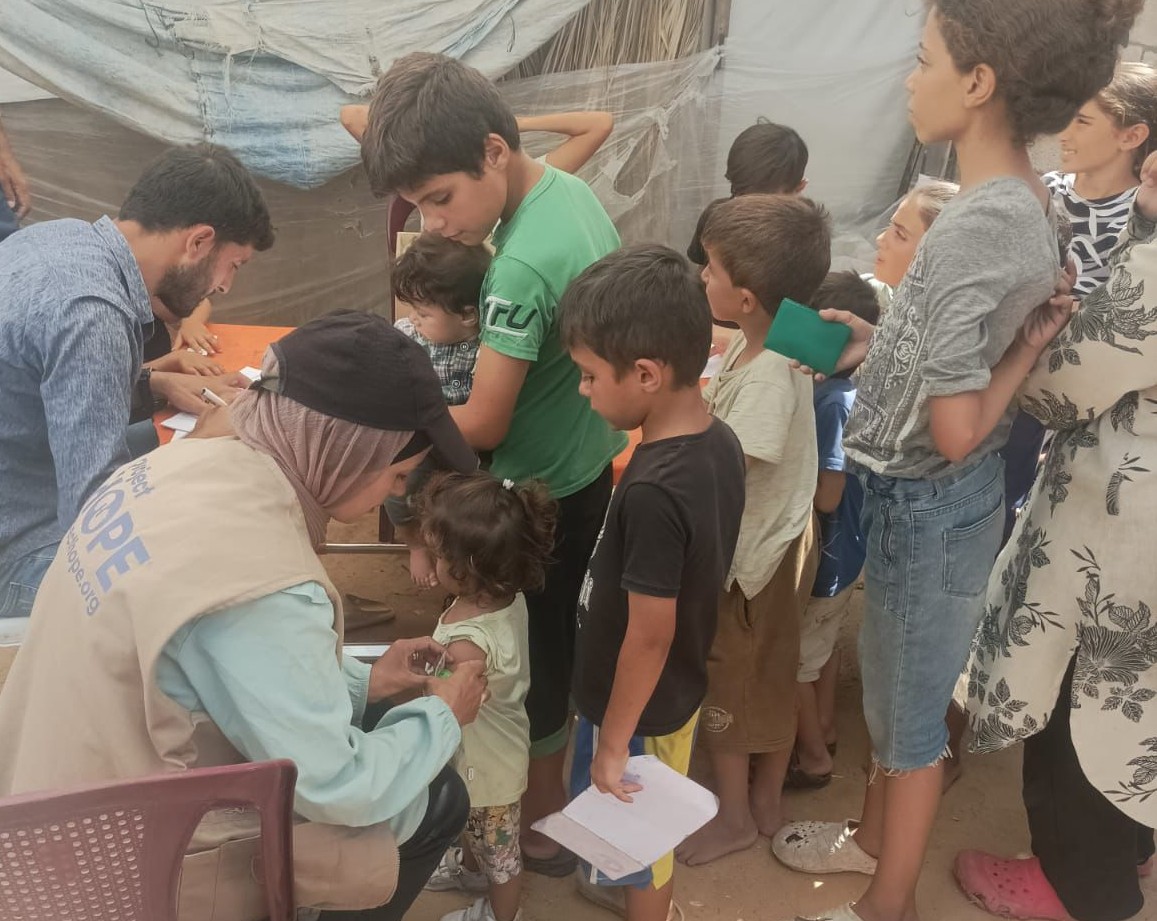
Project HOPE supports nutrition through its seven health clinics across Gaza, helping to reach tens of thousands of children with wasting (“acute”) malnutrition, which carries a high risk of death.   Gaza has been prone to increased prevalence of malnutrition over the last year or more as food imports and aid from outside, and movement/ distribution within Gaza have been blocked.  The highest prevalence of malnutrition has been measured in Gaza City.

Since the October 2025 ceasefire took effect, Gaza has experienced a partial recovery in market activity and food availability across Gaza, but supply shortages, cash-flow constraints, damaged infrastructure, and limited local production continue to hamper both supply and access. Food prices remain far above pre-conflict levels, with many basic commodities costing up to 200% more than before the fighting began. As a result, many households still struggle to afford a diverse diet, with consumption generally limited to staple cereals and pulses while meat, fresh produce, and other nutrient-rich foods remain largely out of reach.
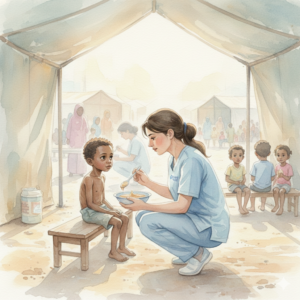
From July 2024 to November 2025, Project HOPE screened 158,884 people for malnutrition, particularly focusing on children under five years of age and pregnant or breastfeeding women.   They provide High Energy Biscuits (HEB), Ready-to-Use Therapeutic Food (RUTF), rapid rehydration, and case management for those suffering from malnutrition.  RUTF is a food optimized to save the lives of young children who are severely malnourished.  They also have provided Psychological First Aid to 18,000 people. and distributed over 2 million liters of potable water.

In Gaza, they operate health clinics in Khan Younis, Gaza City, and Deir al-Balah, providing an average of 1,170 medical consultations a day.  Because of their work in Gaza, World Hunger Education Service has granted them an award of $2,500 and recommendation to the public.
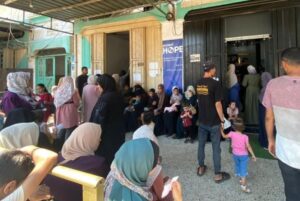
Supplies of RUTF are trucked via convoys into Gaza via roughly five border crossing points as palletized cargo.  Once inside Gaza, supplies are moved along major routes such as the Philadelphi Corridor and Al Rashid Rd to approximately 23 treatment sites.

Project HOPE is an international non-profit established in 1958.  Operating with public support for over 68 years, Project Hope strengthens health systems, combats infectious diseases and deploys emergency response and nutrition teams in crisis zones to provide humanitarian aid.  In severe crisis settings (e.g., conflict in Ethiopia, displacement in Gaza and Ukraine), Project HOPE’s emergency response includes clinical care and nutritional support for populations facing acute shortages.  They also work with communities and health workers about how to prevent waterborne illnesses like cholera and diarrheal disease.

For much of its history Project HOPE was known for its hospital ship which inspired people to choose careers in foreign aid.  Its flagship was originally the USS Consolation, which operated during the Korean war and then converted with 230 beds into a civilian aid ship.  Project Hope pioneered the concept of the first peacetime hospital ship operating the S.S. Hope for 14 years. For every American doctor or nurse on board, there was a local professional counterpart.   It traveled to many countries including Southeast Asia and South America.  Today they work in more than 25 countries across Africa, the Americas, Asia/Pacific, Europe, and the Middle East.

Similar to its work in Gaza, Project HOPE had been a lead US NGOs also responding Ukraine and Lebanon.  In Ukraine, the team operates mobile medical units, reconstructs health and social facilities, trains health workers, provides extensive mental health and psychosocial support, and more. In Lebanon, Project HOPE has been working around the clock to support urgent needs, including the distribution of water, sanitation, and hygiene (WASH) supplies and shelter items to displacement sites, as well as procuring essential medicines and medical supplies for hospitals and primary health centers.

See:  https://www.projecthope.org/

– WHES Board

Articles about Malnutrition Field Programs, “Field Exchange”, October 2025

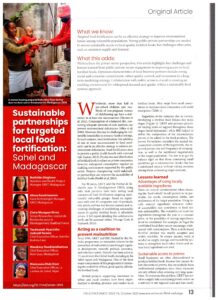
The Emergency Nutrition Exchange, based out of Dublin, Ireland, has published groundbreaking, field-level technical research about attacking malnutrition for the last few decades.  The latest edition, Issue 76 (October 2025) showcases community-led, data-informed, and systems-focused approaches to improving nutrition in fragile and resource-constrained settings, with a strong emphasis on adolescents, maternal nutrition, and service delivery quality.

The lead editorial underscores that practitioners are working in a period of acute crisis, including famine in Gaza, famine risk in Sudan, and constrained global humanitarian funding, yet highlights hopeful examples of innovation, local leadership, and adaptation.  Core cross-cutting messages are: community-owned initiatives matter, data and routine information systems can meaningfully guide programme improvements, and linking frontline programming to system-level frameworks and global guidance is crucial to sustain gains.  The issue repeatedly concludes that national regulation, better financing (including social protection), and stronger primary healthcare systems are needed to turn promising pilots into scaled, equitable nutrition responses.

Food assistance and local leadership in Sudan and the Sahel

The Sudan article concludes that different displacement contexts require tailored food assistance modalities: central kitchens are effective where households have lost cooking facilities, while food baskets better support dignity and agency in more stable settings.  A central finding is that local implementing partners are indispensable for access, contextualised design, and operational continuity, reinforcing calls to invest in local NGO capacity and leadership rather than relying solely on international actors.

Maternal nutrition in humanitarian settings

Analysis from Ethiopia, South Sudan, and Somalia finds that national guidelines and policy frameworks for maternal nutrition are largely in place and that pregnant and breastfeeding women are increasingly included in assessments and targeting. ] However, major gaps persist: maternal nutrition is routinely deprioritised relative to child wasting treatment, antenatal care coverage and quality are low, and key interventions such as multiple micronutrient supplements, balanced energy–protein products, and social protection for pregnant and breastfeeding women remain underfunded or small-scale.

IMAM coverage and use of routine data in Zimbabwe

Zimbabwe’s national IMAM coverage assessment, combining routine DHIS2 data, supply databases, and targeted SLEAC surveys, finds low coverage across all assessed districts, with high defaulter and non-recovery rates and recurrent RUTF stock-outs.  The analysis shows that routine data can reliably flag bottlenecks such as weak case-finding, poor growth monitoring, and commodity gaps, though data quality problems need continuous attention.

Using MUAC data to estimate wasting people in need in Afghanistan

A letter from Afghanistan describes an adjusted MUAC-based method to estimate wasting people in need when recent SMART survey data are unavailable, using correlations between MUAC and WHZ from historical surveys to correct for MUAC’s underestimation of total wasting.

Humanitarian nutrition must systematically include often-overlooked groups

Key articles stress gaps in maternal nutrition services in emergency settings and highlight the need to integrate infants under six months into SMART surveys through methodological adaptations. Research snapshots further underscore vulnerabilities among adolescents, pregnant women, and infants—groups whose needs frequently fall between existing program mandates. Expanded, life-course-oriented programming is essential to address these blind spots.

As always, the full edition can be downloaded free of charge at  https://www.ennonline.net/fex/en/76

Review by WHES Team

Gaza Humanitarian Food Aid – A Report by Senators Van Hollen & Merkley

A detailed report by U.S. Senators Chris Van Hollen (Maryland) and Jeff Merkley (Oregon) resulting from a fact-finding CODEL mission to Israel, Gaza’s border, the West Bank, Jordan, and Egypt is a review of their observations of destruction and forced displacement.  (Van Hollen, Merkley Report Following  2025 CODEL to Gaza Border, Israel, West Bank, Jordan, and Egypt, released Sept 11, 2025)

The two Senators begin their report observing that “In Israel, we met with families whose loved ones were taken hostage during Hamas’s heinous terrorist attack on Israel on October 7, 2023. We also returned to Kfar Aza, an Israeli kibbutz near the border with Gaza that we had previously visited in the summer of 2023. What we remembered as a vibrant community had become the site of one of the worst massacres on October 7th, with 80 people killed and 19 taken hostage.”

The Senators assert that U.S. complicity and international inaction have enabled a humanitarian crisis as a form of collective punishment against Palestinians. The Senators’ analysis is that collective punishment has replaced Israel’s initial military goal of defeating Hamas, extending suffering to the civilian population through the destruction of homes, hospitals, schools, and essential services: 92% of homes, 92% of schools, 94% of hospitals, and 86% of water/sanitation facilities have been destroyed or rendered unusable.

The report argues that Israel’s strategy combines the systematic devastation of Gaza’s civilian infrastructure—over 90% of homes, schools, hospitals, and water systems destroyed—with the weaponization of food and aid to render Gaza uninhabitable.

The authors observe that over 87% of Gaza’s territory is under military zones or evacuation orders, especially Gaza City where food access is minimal.

The Senators reference warnings of famine and that 132,000 children under five are at risk of food insecurity. NGOs reported instances of “starvation ketoacidosis”, an indication of weight loss.  As a result of patchy distribution of aid, northern Gaza appears to have more children who are malnourished than southern Gaza.

1.9 million people (90% of Gaza’s population) have been displaced, many multiple times.

Much of the Senators’ report is about the tight delivery of limited aid from outside Gaza.  Israel’s rejection of UNRWA’s role in aid delivery left 6,000 trucks of food and medicine warehoused and at risk of expiry.   They criticize Israel’s restrictions on entry points, permitting only Kerem Shalom and Zikim to operate irregularly, while Rafah remains closed.   The Jordan Corridor and Egypt aid crossing routes face high rejection rates (e.g., 68% for Egypt in August 2025), delaying non-food essentials like shelter and medicine, which disproportionately affect displaced families and the elderly ahead of winter.

Meanwhile, new customs and screening rules at Ashdod Port and along the Jordan Corridor drastically slowed aid shipments, reducing throughput to less than 10% of capacity.  Drawing on interviews with the World Food Programme (WFP):  “We were told by WFP officials that following the resumption of aid delivery to Gaza after the blockade was lifted, the Israeli government changed its screening practices and customs policies, resulting in the deliberate and unnecessary slowdown of the flow of food into Gaza.  WFP is only able to screen between 20 to 30 containers a day, whereas before these new requirements were put in place, they were able to screen over a hundred a day. The new screening procedures take about 3 to 5 hours per container, and they must physically check each pallet inside the container before the whole container is cleared.”

The authors expressed concern that new lead aid agency, the Gaza Humanitarian Foundation (GHF), operates only four distribution sites, primarily in southern Gaza Established on May 26, 2025, amid the blockade’s end, the GHF replaced the UN’s extensive network with just four sites (three in southern Gaza, none in the north), leading to deadly chaos. Over 1,300 Palestinians have reportedly been killed near these sites amid chaotic food distributions.  Doctors Without Borders (MSF) called this “orchestrated killing,” with 1,380 casualties (including 174 gunshot wounds to women and children) treated at nearby clinics over seven weeks.

Van Hollen and Merkley write that the current method of aid distribution has devolved into “the rule of the strongest,” where only the most physically able individuals can access assistance.

Israeli authorities have not protected humanitarian convoys from settler attacks, while bureaucratic barriers, including arbitrary “security concerns” and banned “dual-use” lists—further impede deliveries. Items such as water filters, tents, and even peanut butter have been prohibited. The report notes that there are “two sets of laws” for aid delivery at the Kerem Shalom crossing, with GHF trucks having access to a paved, orderly loading platform while UN trucks must use uneven dirt and gravel, making their cargo less secure.  Further, they report, “One of the major problems since the start of the war in Gaza has been that the Israeli government has never published, nor provided to humanitarian organizations, a definitive list of what items are permitted or prohibited. Humanitarian groups we met with on the ground stressed that this lack of transparency has created enormous uncertainty and delays.”

Report Recommendations

The Senators call for:

  •     An immediate ceasefire by both warring factions and hostage release by Hamas.
  •     Unrestricted humanitarian access, including increasing the crossings in Kerem Shalom, Zikim, Kissufim, Gate 96, Rafah. They recommend aid agencies flood Gaza with sufficient humanitarian assistance to restore orderly distributions and lower prices, urgently address shelter needs before winter, and focus on protecting vulnerable populations.
  •     Protection of aid workers and journalists, working inside Gaza. Allow international journalists unfettered access to Gaza to provide independent verification and reporting on conditions; at the same time, push back politically and diplomatically against attempts to dismantle, deregister, or muzzle humanitarian and human rights organizations working in Gaza.

For the full report, see:  www.vanhollen.senate.gov/imo/media/doc/van_hollen_merkley_report_following_2025_codel_to_gaza_border_israel_west_bank_jordan_and_egypt.pdf

Their press presentation can be seen at:  https://www.youtube.com/watch?v=qQBx9SDi2wU

by Steve Hansch, Hunter Notes, Editor, WHES  Board

Famine as Weapon of War — Lancet Commentary

The medical journal, the Lancet, on July 30 2025 ran an appeal against famine titled “The Famines in Gaza and Other Conflict Areas are a Moral Failure,” writing:  “Widespread starvation is deliberately used as a weapon of war, at a scale that we never thought possible….  Every child — every person — has the right to the nutrition they need to survive and thrive.”  This was by members of the “Standing Together for Nutrition Consortium”, or ST4N.

See:  https://www.standingtogetherfornutrition.org/

They continue:  “Wasted children are about 12 times more
likely to die before their fifth birthday than children
with a healthy weight.18 Those children who do survive
famine will bear the impacts for life…

“The science of malnutrition and the solutions are
known.  Treatment of severe acute malnutrition, access to nutritious foods, clean water, nutrient supplements, and medical care are not radical ideas—they are proven strategies that save lives and rebuild communities.”

The authors include staff at the Canadian Micronutrient Forum and include Saskia Osendarp, Lawrence Haddad, Robert Blackand others.

Hunger Hotspots Report, Summer 2025

Hotspots for elevated hunger and malnutrition during the summer of 2025 were highlighted for Sudan, Gaza, South Sudan, Haiti and Mali in the new report produced by the Food and Agricultural Organization of the UN, along with the World Food Program, with support from the European Union and the Global Network against Food Crises.  This is a semi-annual report published collaboratively by U.N. agencies.

See:  https://www.fightfoodcrises.net/sites/default/files/resource/file/HungerHotspots2025_CD5684EN.pdf

As reported on Reliefweb:  This report makes it veryclear: hunger today is not a distant threat – it is a daily emergency for millions,” FAO Director-General QU Dongyu said. “We must act now, and act together, to save lives and safeguard livelihoods.  Protecting people’s farms and animals to ensure they can keep producing food where they are, even in the toughest and harshest conditions … is essential.”

“This report is a red alert. We know where hunger is rising and we know who is at risk,” said Cindy McCain, World Food Programme Executive Director. “We have the tools and experience to respond, but without funding and access, we cannot save lives.”

In the Sudan, conditions are expected to persist due to the continuing conflict and ongoing displacement, particularly in the Greater Kordofan and Greater Darfur regions.  Displacement will further increase while humanitarian access remains restricted. The circumstances are driving the country toward the risk of economic collapse, with high inflation severely limiting food access. by the poor.  Around 24.6 million people were projected to face “Crisis” level food insecurity or worse.

In Haiti, record levels of gang violence and insecurity are displacing communities and crippling aid access.  in Mali, high grain prices and ongoing conflict are eroding the coping capacities of the most vulnerable households, particularly in conflict-affected areas.

In contrast to prior reports, however:   Ethiopia, Kenya, Lebanon, Lesotho, Malawi, Mozambique, Namibia, Niger, Zambia, and Zimbabwe have been removed from the Hunger Hotspots list.  In East and Southern Africa, as well as in Niger, better climatic conditions for harvests and fewer weather extremes have eased food security pressures. Lebanon has also been delisted following reduced intensity of military operations.

Vdieo of the report launch:  https://www.youtube.com/watch?v=K0_t_tCH-5s&t=11s

https://reliefweb.int/report/occupied-palestinian-territory/hunger-hotspots-fao-wfp-early-warnings-acute-food-insecurity-june-october-2025-outlook-enarit