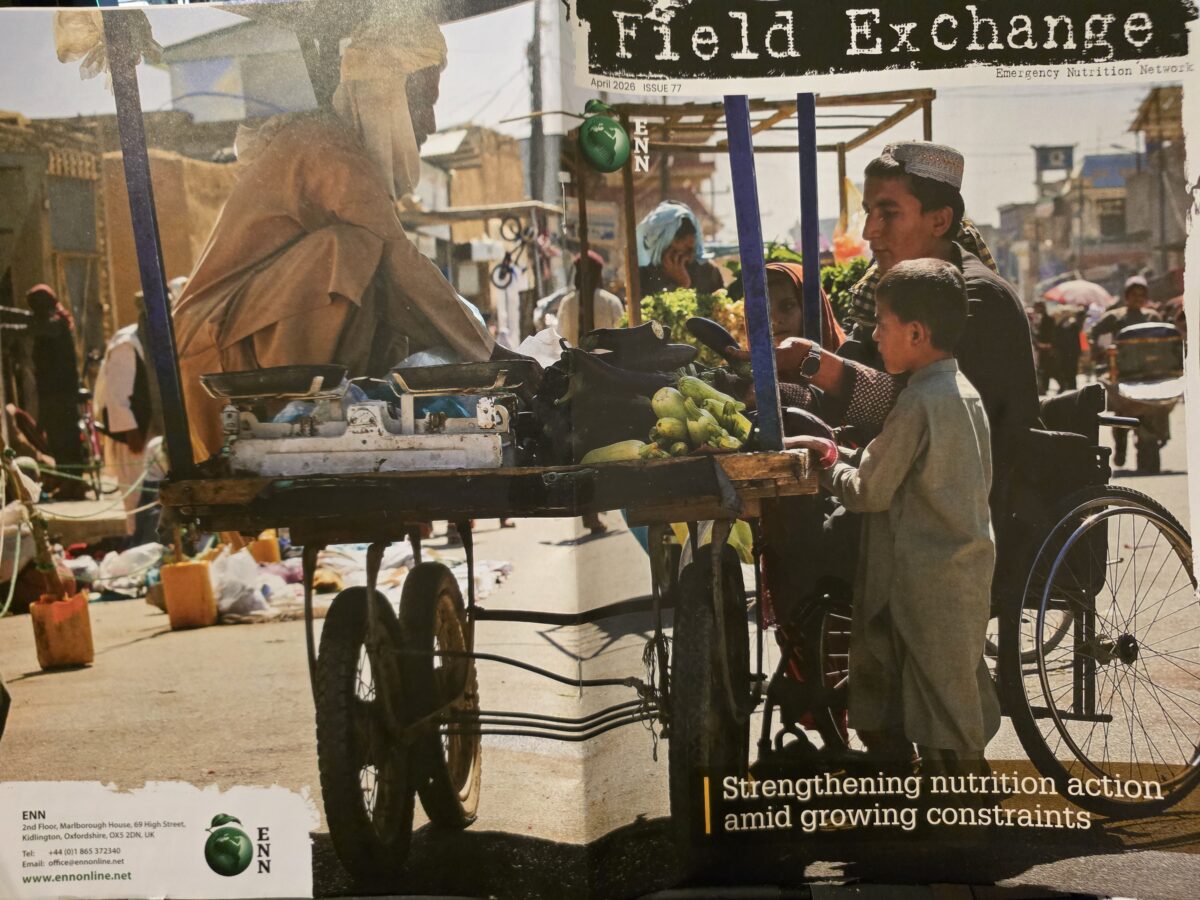
June 16, 2026 The latest (April 2026) edition of the “Field Exchange“ journal, by the Irish Emergency Nutrition Network, about combatting malnutrition in emergencies includes the following findings:
Relapse-inclusive costing of simplified CMAM protocols: Lessons from Mali (Original Article by Nina Firas et al.) This non-randomized study in Gao, Mali, conducted a provider-perspective costing analysis of standard versus simplified community management of acute malnutrition (CMAM) protocols for uncomplicated severe acute malnutrition (SAM) in children aged 6–59 months, explicitly including costs of post-discharge relapses over an eight-month follow-up. Findings showed similar or slightly higher per-episode treatment costs for the simplified protocol due to longer length of stay, but substantially lower average cost per child treated when relapses were included (USD 139 vs. USD 169 for standard), driven by much lower relapse rates in the simplified arm; comorbidities strongly predicted relapse. The authors conclude that relapse-inclusive economic evaluations provide a more accurate measure of program efficiency and sustainability, and that investing in stronger post-discharge follow-up and relapse prevention yields both clinical and financial gains, even in fragile, insecure settings where pragmatic costing remains feasible and valuable.
Keeping nutrition a priority in a constrained funding environment: A conversation with Lord Jonny Oates (Views) Lord Jonny Oates, Chief Executive of United Against Malnutrition & Hunger, reflects on his early experiences with famine in Ethiopia that shaped his lifelong commitment to nutrition as foundational to human development, societal stability, and global security. He discusses the alliance’s efforts to rebuild UK leadership in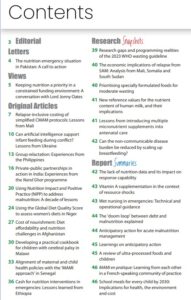 nutrition advocacy amid aid cuts, stressing the need to link nutrition to high-priority government agendas (climate, migration, security, economic growth) and to balance immediate humanitarian response with long-term investments in food systems, health services, and climate resilience. Oates emphasizes that cutting nutrition funding is a false economy, advocates for fairer debt restructuring and innovation/research support, and advises nutrition professionals to communicate clear returns on investment while persistently aligning messages with policymakers’ priorities without giving up.
Can artificial intelligence support infant feeding during conflict? Lessons from Ukraine (Original Article by Olena Rozhenko et al.) In response to disrupted in-person breastfeeding support and rising misinformation during the Ukraine conflict, FHI360 implemented the Harmony of Parenthood initiative across four oblasts, integrating a closed-domain, Telegram-based AI chatbot for evidence-based IYCF-E and psychosocial support with facility-based counselling by trained health workers and a structured mentorship program. The chatbot reached over 2,000 unique users with high engagement and satisfaction (93–99% found information useful and clear), while combined services increased exclusive breastfeeding rates from 60% to 69% among mothers receiving repeated support and improved counselling quality and consistency through mentorship and feedback loops. The experience demonstrates that responsibly governed AI tools (with human oversight, pre-approved content, and clear referral pathways) can responsibly extend reach and reinforce messaging in humanitarian settings without replacing skilled human support, offering practical lessons for ethical digital innovation, content governance, and integration into national systems.
Group relactation: Experiences from the Philippines (Original Article by Ines Avellana Fernandez et al.) Arugaan, a women-led organization with decades of emergency experience in the typhoon-prone Philippines, supports group re-lactation in mother-baby areas during crises by helping mixed- or formula-fed mothers restart breastfeeding through culturally adapted techniques including cross-feeding (wet nursing), drip-drop feeding, full-body lactation massage, and peer support groups. Success stems from deliberately building breastfeeding self-efficacy by addressing misconceptions, educating mothers on lactation physiology (prolactin for supply and oxytocin for let-down), creating safe empowering environments, and leveraging existing cultural practices while providing practical skills and peer modelling. The approach has enabled thousands of mothers to successfully relactate, underscoring that intentional investment in community-based, gender-responsive support can protect breastfeeding as a safe, sustainable, life-saving feeding option in emergencies where formula feeding carries high risks.
Private-public partnerships in action in India: Experiences from the Nand Ghar program (Original Article by Rohini Saran et al.) The Nand Ghar initiative is a large-scale public-private partnership between Vedanta (through its CSR) and Indian government bodies to upgrade over 12,000 Anganwadi centers into modern “smart” centers providing enhanced early childhood development, nutrition, health, and women’s empowerment services across 17 states. It addresses systemic gaps in infrastructure, frontline capacity, service quality, dietary diversity (via nutri-gardens), and monitoring through upgraded child-friendly facilities, targeted training, digital tools/AI dashboards, community mobilization, and time-bound operational support, with government retaining ownership and scaling responsibility. Key lessons include the importance of early co-design with government, working within existing systems for legitimacy and scalability, combining infrastructure upgrades with capacity building and accountability mechanisms, and ensuring private support leads to sustainable institutionalization and community ownership rather than parallel structures.
Using Nutrition Impact and Positive Practice (NIPP) to address malnutrition: A decade of lessons (Original Article by Ellise Brennan et al.) NIPP is a grassroots, gender-responsive, positive-deviance-based approach implemented by GOAL over more than a decade in six countries that uses 12-week participatory learning circles (separate for men and women) featuring practical cooking demonstrations, micro-gardening, hygiene infrastructure, and behavior-change sessions to address underlying causes of malnutrition in households with moderate wasting or at risk. Program data from Sudan, Niger, Malawi, and Zimbabwe showed high cure rates at graduation (73–96% for children with moderate wasting) and very low relapse rates (<2% at 2–12 month follow-ups), alongside sustained improvements in dietary diversity, feeding practices, hygiene behaviors, and household food security, with the approach proving more cost-effective and sustainable than input-heavy interventions because it builds community capacity and self-reliance. NIPP has been successfully institutionalized within national systems in several countries, demonstrating its potential to complement treatment programs by reducing relapse and supporting long-term nutrition recovery through community-driven, low-input behavior change.
The nutrition emergency situation in Pakistan: A call to action (Le tter by Dr Abdul Baseer Khan Achakzai) Dr. Abdul Baseer Khan Achakzai outlines Pakistan’s severe and worsening nutrition crisis, marked by high stunting (40%), wasting (18%), underweight (29%), and anemia rates among children under five, alongside a double burden of malnutrition and limited access to services, especially in rural areas. He attributes the crisis to structural factors including low health expenditure (<2% of GDP), climate shocks (floods, droughts, heatwaves), rapid population growth, weak governance, provincial disparities, and slow operationalization of the 2022 National Public Health Nutrition Strategy amid fiscal constraints and competing priorities. The letter calls for protected nutrition budget lines, integrated multi-sectoral responses, strengthened provincial capacity, accountability mechanisms, and sustained international support aligned with SDGs and the Global Action Plan on Child Wasting, positioning Pakistan as a case study of systemic vulnerability in a climate-stressed, resource-constrained setting.
A shorter article is about policy alignment analysis of the MAMI approach in Senegal (largely aligned with national strategies but with identified gaps in maternal mental health and support for vulnerable/disabled infants), Also included were Research Snapshots and Report Summaries cover topics such as relapse economics, WHO wasting guideline gaps, anticipatory action, and ultra-processed foods but are concise overviews rather than full articles.