
Hunger Crisis in Myanmar/Burma

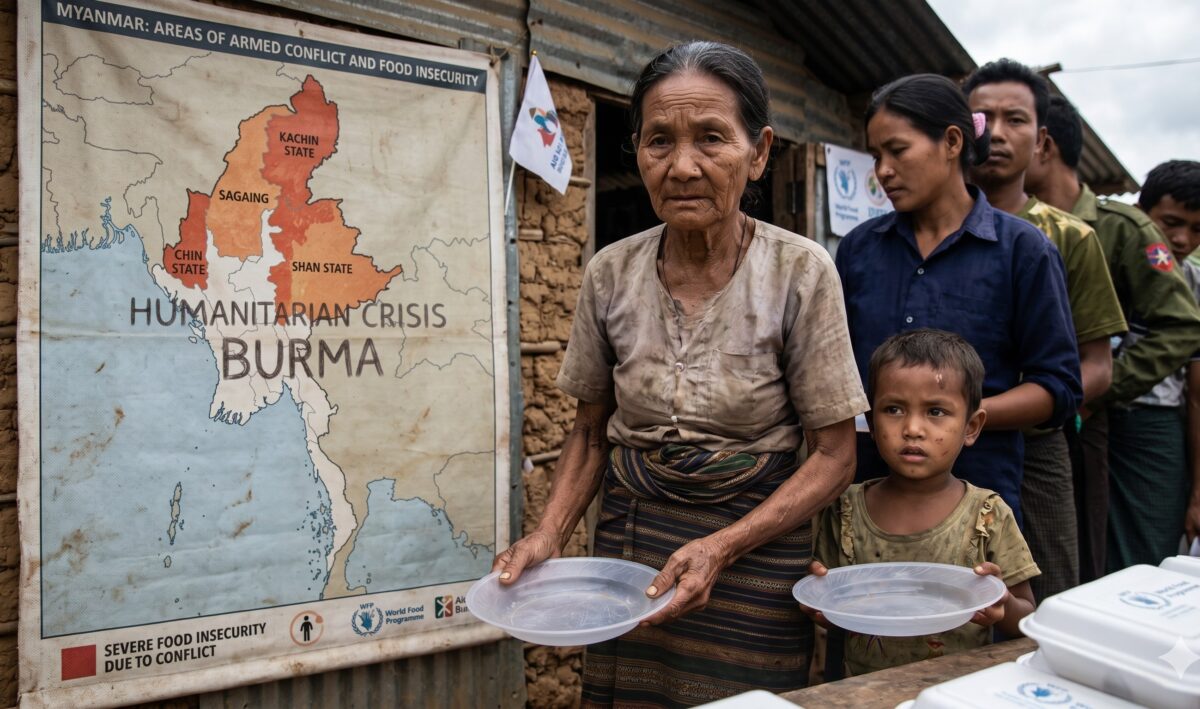
May 2, 2026      According to the latest Hunger Hotspots Report, 16.7 million people, or one in three citizens of Myanmar (also known as Burma), are acutely food insecure, a sharp increase from 13.3 million in 2024. Myanmar now ranks fifth globally for the highest number of people facing severe hunger.

More than 400,000 young children and mothers suffering from acute malnutrition are surviving on nutrient-deprived diets of plain rice or watery porridge. WFP’s country director has said the crisis is invisible to the world. WFP can target just 1.5 million of the 12.4 million people in need and requires $150 million to do even that. No recent national prevalence data exist on wasting, but subnational surveys (for example, one in Yangon and Ayeyarwady Regions in late 2023) found about 8 percent wasting, slightly higher than the prior national figure. Broader food security and nutrition monitoring, including Myanmar Household Welfare Survey rounds from 2021 to 2025, shows worsening dietary diversity, higher food insecurity affecting millions, and increased household hunger since 2021.

Related to malnutrition, Myanmar’s under-five mortality rate—39 deaths per 1,000 live births—is nearly three times higher than the East Asia and Pacific regional average of 14.4.

The roots of the current hunger crisis lie in the military takeover of the government in February 2021. Since the coup, intensifying conflict has led to an estimated 15.2 million people, nearly a third of Myanmar’s population, facing acute food insecurity in 2025. The junta has retaliated against resistance forces by blockading aid, restricting humanitarian access, limiting trade routes, and targeting humanitarian workers, further compounding the food crisis. Military attacks have destroyed agricultural equipment and contaminated farmland with landmines and unexploded ordnance, exacerbating challenges for local food production. The average price of a basic food basket has increased fourfold compared with prices before the military takeover.

The situation is particularly critical in Rakhine State, home to the Rohingya and other ethnic minorities. UNDP has reported that Rakhine State is on the brink of famine, with two million people at risk of starvation. The Myanmar military’s near-total blockade of humanitarian aid to Rakhine State since 2023 violates international humanitarian law and likely constitutes a war crime.

Many readers may remember the large 7.7-magnitude earthquake that struck central Myanmar on March 28, 2025, killing more than 3,700 people, destroying infrastructure, and reverberating through neighboring countries. A large share of aid donations was made in response to that quake.

International aid organizations working to address malnutrition in Myanmar include Action Against Hunger (ACF), Save the Children, Mercy Corps, Solidarités International, the International Rescue Committee (IRC), and Catholic Relief Services (CRS).

World Vision provides aid in 11 of the country’s 14 states and regions. ACF is currently implementing projects addressing malnutrition, mental health and care practices, food security and livelihoods, water, sanitation, and hygiene, nutrition security, and disaster risk reduction in Chin State, Kayah State, and Rakhine State. MSF has mobile teams in Naga and Sagaing, a remote, mountainous region in northern Myanmar where communities have limited access to basic healthcare. Despite restrictions on humanitarian access to conflict-affected areas, mobile teams based in Sittwe, in central Rakhine, offer primary healthcare and emergency referrals for patients from all communities.  The IRC works in Rakhine, Kachin, Kayin, and Shan States in close collaboration with the Ministry of Health.  Save the Children provides aid in Mandalay, Sagaing, Bago, Magway, Shan, and Naypyidaw. CRS’s current projects in Myanmar focus on agriculture and livelihoods and support for emergency response. CRS works with local Caritas partners to build capacity for community-led project design and implementation.  CRS Myanmar also supports partners in Kachin on community-led shelter efforts and provides technical assistance in community-led return and resettlement.

Community Partners International (CPI) provides community-based healthcare, particularly in conflict-affected border regions where government services are non-existent.  This includes “Backpack Medics,” who travel to remote villages to provide primary care, trauma surgery, and vaccinations. CPI also runs maternity waiting homes and trains community health workers to support safe births in conflict zones.

In Myanmar, the UN World Food Program (WFP) provides food rations to vulnerable populations, including internally displaced persons (IDPs), refugees, and people affected by natural disasters or conflict.  WFP also runs school feeding programs in areas with high food insecurity, providing nutritious meals to children in schools.

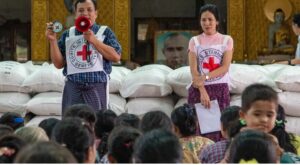
The International Committee of the Red Cross (ICRC) provides nutrition and health support for war victims in Myanmar.  In 2024 and 2025, the ICRC provided food rations, including rice, oil, and beans, to thousands of displaced families in areas such as northern Shan State, Mandalay, and Sagaing.

To the east of Myanmar, there are some two million refugees in Thailand.  The Border Consortium (formerly the Burma Border Consortium) of NGOs has operated in  nine refugee camps along the Thai–Myanmar border since the 1980s, providing foodIt remains the primary agency responsible for food assistance.  However, its operations have been severely reduced. By mid‑2025, TBC announced that food assistance for most households would be cut by 75% or eliminated entirely.

The Use of Food as a Weapon: Reflections Working with Khmer Refugees

Field Experience on the Thai–Cambodian Border, 1979

The year was 1979.  In October, I braved the streets of Bangkok, Thailand at five o’clock in the morning to get on a volunteer bus bound for the Thai–Cambodian border. Our destination was Sakeo, a newly established refugee camp sheltering 30,000 sick and dying Cambodian displaced people.

The camp sprawled across a large rice field.  Because it was the rainy season, there was thick mud everywhere and rows of blue tarpaulins stamped with UNHCR logos.  A so-called “hospital” occupied one corner of the encampment, made up of several large tents hastily erected by volunteer organizations.  There were few trained staff or expatriate presence.  The  stench of excrement, death, and human suffering overwhelmed me.

I was only 23 years old, utterly unprepared for what lay ahead. Yet every time I reached a breaking point, I found renewed motivation in the urgency and desperation of those I was trying to help.

In the beginning, I volunteered in the tuberculosis ward, which was just a large tent attached to the International Rescue Committee. I had the honor of being trained over a few days by the Medical Missionary Sisters, a group of nuns from the United States.

My training consisted of rudimentary nursing skills: giving injections, carrying water, applying medical bandages, and setting up IVs. For about a month, this became my daily work.

Early on, a UN reufgee camp coordinator suggested I return to Bangkok to sign up formally with the International Rescue Committee, an NGO.  I did so and was hired on the spot, returning quickly to the Sakheo camp.

Addressing Deficiency Diseases

At one point, someone learned that I had training in nutrition. They approached me because there was an apparent outbreak of a thiamine (vitamin B1) deficiency disease in the camp.  This was unsurprising: the population arriving from Khmer Rouge–controlled areas inside Cambodia had endured prolonged malnutrition and starvation under Pol Pot, and the food rations at Sakeo were grossly inadequate.

I examined the food being distributed and discovered it lacked sufficient protein and particularly B vitamins, causing deficiencies that were manifesting as disease.  I recommended adding mung beans to the rations. Once implemented, with such a simple intervention, we saw a rapid improvement in the health of many refugees, and several deficiency syndromes began to disappear.

Discovering Food Distribution Inequities

What this article  explores formed the basis of my later master’s thesis, “The Use of Food as a Weapon.”

Through my translator, I began receiving complaints from refugees across the camp that they were not receiving their proper food rations at the distribution points. To investigate, I brought scales, set up a table, and—together with translators—began weighing the food voluntarily as refugees exited the distribution site.

Each person was supposed to receive specific gram amounts of rice, meat, mung beans, and vegetables. But after a week or two, it became clear that there were major discrepancies: some people were receiving more than the allotted amount, and some much less.

Naively, as a 23-year-old, just fresh out of my university in the U.S., I set up public weighing stations and posted the expected ration amounts on a board, so people could check whether their distribution matched the standard.

Uncovering Coercion by the Khmer Rouge

I soon learned that my actions had unintentionally disrupted a covert power structure within the camp. The Khmer Rouge, still active among the refugees, were manipulating food distribution to coerce people to return to Cambodia and submit to Pol Pot’s authority. Those who complied received extra food; those who resisted received less or none.

Rumors of this circulated quickly. Not long after, I was summoned by the UN head of the camp to attend a meeting with the “refugee leadership”—in reality, Khmer Rouge operatives and former enforcers. The topic was this “major food distribution problem.”

As I walked to the meeting, my knees were shaking. I remember thinking, “Oh my God… what have I done?”

The Confrontation

As I walked into the tent, I saw a group of four or five men, the head of the UN office seated at the front, and a few others gathered around. I took a seat and immediately noticed the serious expression on the UN head’s face. It was clear that the situation was grave.

The Khmer Rouge representatives expressed their displeasure at the UN’s control over the food distribution points. They wanted to regain authority over the rationing system. Fortunately for me—and for the refugees—the head of the UNHCR office was exceptionally firm.  He declared that control over food distribution would not be relinquished, as the food was provided by UNHCR and must be distributed equitably.

During the meeting, they asked about what was my role. I sat there uncomfortably, only to hear the UNHCR leader announce that I was now “in charge” of food distribution.  Well, this was news to me, but apparently, my job had just changed.

Unexpected Negotiation

After the meeting, the Khmer Rouge representatives approached me. My heart sank andI thought, “This is it — I won’t survive this new role.”

But to my surprise, they asked for extra rice for weddings, explaining that many young people were marrying after years of prohibition under the Khmer Rouge. Relieved, I agreed to arrange extra rice allocations for wedding celebrations, which helped defuse tensions and built a tenuous rapport.

Scaling Up the System

The next phase was to expand the weighing stations across all food distribution points. We posted clear boards showing exact ration weights per person, enabling refugees to verify whether they were receiving their proper share.

A few months later, when the camp was preparing to move, the Khmer Rouge leadership could only coerce less than one-third of the population to return to the border. By shifting control to transparent, neutral distribution mechanisms, we had undermined their power and protected the majority of refugees who remained.

This simple innovation became a systematic new process adopted by the UN in the 16 refugee camps across Thailand in 1980.  We replicated the weighing stations and ration boards, giving people the right to know their entitlements and receive adequate food.  Then, I was hired by the UN, and we expanded this practice to refugee camps all over the world.  I had the honor of working with UNHCR for thirty years in numerous countries afterward, helping develop guidelines and manuals to institutionalize equitable food distribution systems globally.

Entitlement & Moral Responsibility

I share this story, learned nearly 50 years ago, because today we are again facing a dangerous trend of using food as a tool of coercion. In several contexts, food aid is being blocked or manipulated to control civilian populations, undermining the principles of human rights that humanitarian actors fought to establish decades ago.

The concept of entitlement is central to any aid program. Food and health care are not favors—they are human rights essential to survival. When entitlement is stripped away by those in power—whether through guns or the lingering trauma of past violence—a profound moral disequilibrium is created. Our failure to uphold these principles represents a corrosion of obvious ethical standards.

Over the years, the UN — especially the World Food Programme — developed extensive tools, kits, and guidelines to uphold these principles. Yet too often, these manuals gather dust on shelves while oversight and neutrality waver on the ground.

Ultimately, the neutrality of humanitarian agencies and their ability to ”hold power—not yield it to armed actors—“ remains the cornerstone of equitable food distribution. In recent years, we’ve witnessed how corrupted access to food can become when neutrality erodes.

We often say, “Let’s learn from our past mistakes.”   This story is a reminder that transparency, entitlement, and moral clarity in humanitarian aid are not abstract ideals—they are lifesaving practices.

  •      –  Angela Berry-Koch, Former UNHCR Senior Nutrition Adviser, currently faculty at Psychiatry Redefined and contributor to Hunger Notes, 12 Oct. 2025