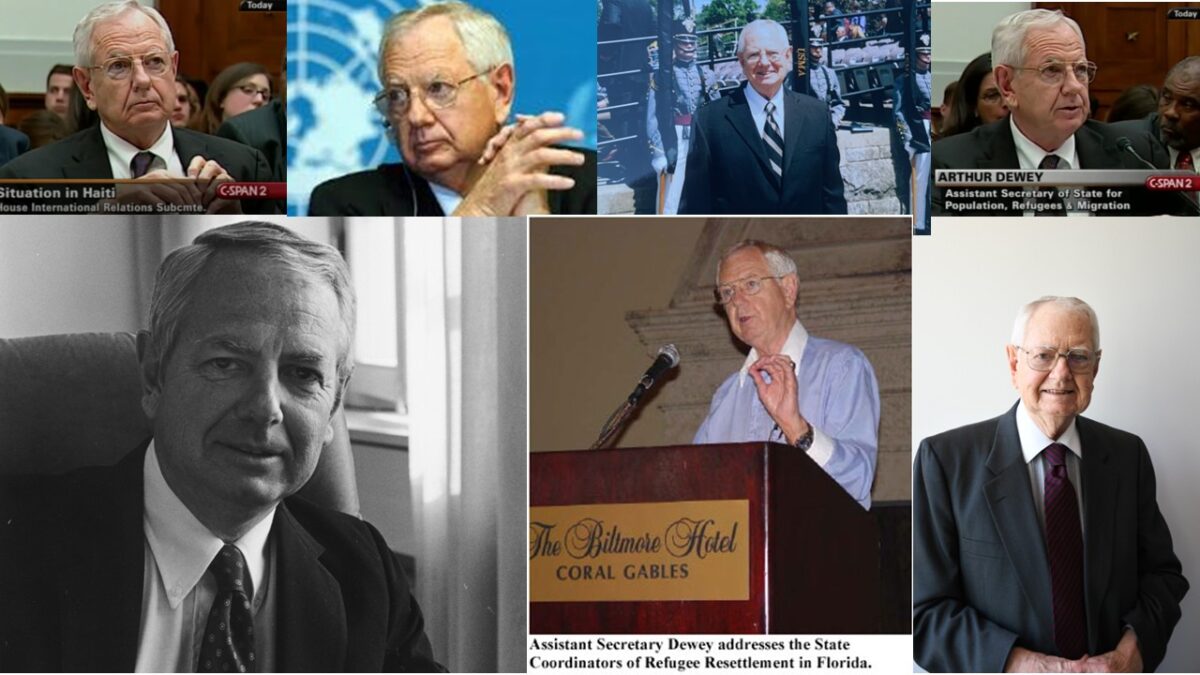
Gene Dewey, who passed away on February 22nd, was one of the great humanitarian leaders of his generation, inspiring many people and managing to move food and relief supplies to needed areas over the course of several decades. He was also an institution builder, seeing the need for new organizations to lead and to train leaders.
His career spanned many of the global emergencies of the last 40 years, from Biafra in the 1960s to Sudan in the 1980s, to Rwanda in the 1990s, to Afghanistan in the 2000s. While he attained senior levels in the UN and US Government, he never lost the common touch. He was affable and supportive of his colleagues and never stood on ceremony.
Throughout his distinguished career, Ambassador Dewey embodied an unwavering belief in the power of multilateral cooperation to address the world’s most pressing humanitarian crises. His conviction that international challenges required international solutions shaped his approach to diplomacy and refugee protection for more than four decades.
He is survived by his wife Priscilla, his daughter Elizabeth Parce Ainsworth, son in-law Anthony Ainsworth, and grand-daughter, Charlotte.
Arthur Eugene Dewey went by the name of “Gene.” Testimonials contributed from his friends and colleagues for this obituary appear in the following
I. Gene’s Life and Mission
Born on February 18, 1933, in Pennsylvania, Gene grew up in a ministerial family that taught him values of service and compassion, which would define his life’s work. Gene graduated from West Point Military Academy in 1956 and began a distinguished 25-year military career. After earning a Master of Science in Engineering from Princeton University in 1961, Gene deployed to Southeast Asia for two combat tours. For his leadership during a multinational prisoner rescue operation in Cambodia, he earned the Distinguished Flying Cross and six additional air medals.
Philip Sargisson (UNHCR): “Gene was a highly principled yet particularly warm human being. We worked together, traveled together and remained close friends.“
His advocacy for streamlined international aid structures and enhanced civil-military cooperation in humanitarian response reflected his belief that effective assistance required both strategic coordination and operational flexibility. His vision influenced how the aid agencies respond to displacement crises today.
Betsy Lippman (State Dept): “Gene Dewey was the ultimate humanitarian and a gentleman in the old style. One of a kind. He will be truly missed.”
II. Gene’s Leadership in Fighting Global Hunger
Gene fought malnutrition and hunger in numerous capacities, starting as a White House Fellow in 1968 when he was posted to USAID to coordinate civilian food aid for the Biafra famine (also known as the Nigerian Civil War), which was the first real-time, big night-time news crisis in Africa.
Susan Martin (Georgetown): “I met Gene in 1981 when he had retired from the military and began working on refugee issues in the State Department. He was largely responsible for shifting U.S. policy toward finding solutions for the famine in Ethiopia.”
Working at the U.S. Department of State Gene supported the response to the devastating Ethiopian famine of 1984-1985. He played a pivotal role in convincing the UN Secretary-General to establish the UN Organization for Emergency Operations in Africa that responded to the regional famines across the Horn of Africa including the Ethiopia famine.
Margaret McKelvey (State Dept): “I cannot count the number of times he [Gene] cited the UN Office of Emergency Operations in Africa work on famine across the continent in the mid 1980s as the UN’s finest hour.”
Angela Berry (UNHCR Nutritionist) met Gene in 1985: “At that time, I had met many dignitaries. I assumed my list would disappear into some distant bureaucracy. To my astonishment, within weeks everything I had requested began to arrive – tents, blankets, therapeutic food, emergency kits – pouring in with a speed and coordination I had never seen. I knew it was Gene. … Knowing Gene was there, steadfast in his dedication, unwavering in his humanity, was a deep comfort to me and to so many others. Over the decades we continued to exchange messages, sharing concerns about neglected crises and places in need of attention. He always seemed like someone who would be with us forever.”
In 1993, Gene set up and led the Congressional Hunger Center (CHC), which was authorized by Congress in the wake of the dissolution of the House Select Committee on Hunger. Working closely with Congressional representatives, Gene built up the CHC. Drawing on his experience with the White House Fellows program, Gene led the CHC to provide two-year fellowships to dozens of young leaders to train fight hunger, working with UN agencies and NGOs.
Margaret Zeigler (CHC): “He inspired a generation of young leaders who now work to make the world a better place – in the UN system, in the US government, private sector and in the humanitarian non-governmental organizations here and around the world. Gene always lifted up young leaders and especially believed in women, youth and those less advantaged. His favorite words were “we” and “us”.”
Ambassador and former Congressman, Tony Hall chaired the Committee on Hunger from Congress. He remembers: “Gene Dewey was one of the most decent and honorable man I’ve ever met. He was always caring and working to help people who were hurting.”
In 1989 Gene was tapped to lead USAID’s new, unprecedented aid to the former Soviet states when the Soviet Union unraveled and brand, new countries were in need. He pioneered new ways of providing aid to unconventional populations in Central Asia. His partner in this effort, Don Krumm, remembers: “He was a big-minded guy, energetic, and encouraging. He was always there with positive bravo. He liked audacity. Gene kept the supply lines going in. It was a chance, if we succeeded, to be on top of a transition to democracy.”
Margaret Zeigler explains “CHC still exists today, and is a private, bi-partisan center that keeps a focus in Congress on domestic and international hunger and humanitarian issues and galvanizes action. It is where our teams established the Bill Emerson Hunger Fellowships and the Mickey Leland International Hunger Fellowships, programs that raise up the next generation of leaders working to end hunger in the United States and around the world.”
III. Gene’s Leadership in Refugee Assistance and Protection
While outside of government, during the Rwandan Refugee Crisis in 1995, Gene Dewey arranged, developed a five-point plan shared with the National Security Council and the U.S. President that helped facilitate the deployment of military assets to provide water supply in Goma and the refugee camps around Goma.
Later, as Assistant Secretary of State for Population, Refugees, and Migration from 2002 to 2005, Dewey oversaw the return of over four million Afghan refugees following the fall of the Taliban. By mid-2002, approximately 1.6 million refugees had returned home, supported by U.S.-funded UNHCR programs providing transport, shelter, and reintegration assistance. Dewey championed an innovative Program Secretariat Structure in Afghanistan that paired UN agencies with Afghan government ministries, creating accountability mechanisms while building local capacity. He also initiated the Afghan Conservation Corps, modeled on the U.S. Civilian Conservation Corps, to employ returnees in environmental and infrastructure projects.
Susan Martin (Georgetown University): “My most vivid memories of Gene were working with him when he was Deputy UN High Commissioner for Refugees. UNHCR had been pressured by some of its member states to do a better job in protecting the rights of refugee women and children. Some of the UNHCR staff saw the problems faced by women and girls to be social issues, not human rights issues. When I talked with Gene about it, he immediately brought a group of staff members together and let them know that UNHCR had an obligation to protect all refugees and they should cooperate with the efforts underway to address the many problems facing women and children. I will always be thankful for Gene’s support.”
At the Department of State, Gene encouraged Don Krumm to pioneer early warning of refugee flows, such as in the Fergana Valley in Central Asia. Don (State) remembers: “Gene was always encouraging new thinking. He was one for pushing the envelope. He and I got along so well because I would recommend going to the site of the problem, and he trusted me to do that.”
Anne Richard (State}: “When he became head of the refugee bureau at the State Department, the humanitarian community expressed huge relief…. He made his mark early on when his issued a fact-based report that defended UNFPA’s role with regard to China’s coercive one child policy. … His leadership on refugee matters was respected throughout Washington, DC… While a friendly and avuncular figure, he never hesitated to critique humanitarian policies if he thought they were off-track.”
Gene negotiated the reopening of Vietnam’s Orderly Departure Program in 2004, allowing thousands of refugees to resettle safely. He also advocated for Bhutanese refugees in Nepal and North Korean refugees in China, pressing for their recognition and protection under international law.
Globally, he advocated for “un-warehousing refugees” i.e., out of long-term artificial camps so they could actively participate in finding their own solutions.
Kelly Clements {UNHCR): “He was known then as a man of conviction and determination to make the lives of others better with Africa a focus during his time at State Department and serving at UNHCR during the 1980’s pivotal adoption of the Comprehensive Plan of Action for Indochinese Refugees and the CIREFCA process which provided a humanitarian framework to implement Cartagena protection principles and solutions in Central America. “
United Nations’ Leadership
Gene’s commitment to multilateralism and “burden sharing” among donors found its fullest expression during his tenure as UN Deputy High Commissioner for Refugees from 1986 to 1990. Based in Geneva, he served as the second-ranking official at UNHCR during a pivotal period of global displacement. His leadership helped strengthen the agency’s capacity to respond to refugee crises worldwide, and he championed the integration of protection principles into all humanitarian operations.
In this role, Gene worked to enhance coordination among UN agencies, NGOs, and national governments, recognizing that effective humanitarian response required seamless collaboration across institutional boundaries. His efforts to promote burden-sharing among nations and to elevate refugee protection on the international agenda left a lasting imprint on the global refugee system.
Margaret McKelvey (PRM): “He was tenacious in his views and committed to multilateralism.”
Jan de Wilde (International Organization for Migration): “Gene was a rare combination of the good and the practical. Trust found an easy home in him. His Christian faith was a quiet but driving force in his charitable works, at least as far as I could tell.”
Former U.S. Secretary of State Condoleezza Rice reflected how Gene was devoted to a life of public service. She called out his “belief that the world’s most difficult challenges require multilateral cooperation. You represent the highest ideals of public service.”
Dr. Michel Gabaudan worked with Gene at UNHCR in Geneva. He remembers Gene as “always extremely courteous and looking at how to solve problems, Gene always saw the individuals, and their suffering, behind the policies, or institutional politics that guided them, carried out by our offices. And he always calmly analyzed the broader context in which we operated, which he understood with discerning subtlety. Some 20 years later, when we met regularly during my stints in DC, Gene remained the same concerned, amiable and well informed person we had always known. A true humanitarian gentleman.”
Strategic Partnerships with International Organizations
From long and hard experience, Gene learned that the U.S. Government’s humanitarian efforts were most effective when conducted in partnership with established international organizations. He cultivated long and deep operational relationships with UNHCR and the International Organization for Migration.
In January 2002, Gene was appointed Assistant Secretary of State for Population, Refugees, and Migration where he oversaw a humanitarian budget of over $700 million a year in refugee assistance that flowed through NGOs and international organizations.
Kelly Clements (UNHCR): “We worked most closely together when he was Assistant Secretary of State for the Bureau of Population, Refugees, and Migration from 2002 to 2005 and I was Deputy Director of Policy and Resource Planning. He argued forcefully for the U.S. to address significant humanitarian need from increased displacement in multiple parts of the world, including importantly in and around Afghanistan with senior department, White House, and Congressional leadership. I remember in particular his first budget defense in front of then Deputy Secretary Robert Zoellick – neither were shrinking violets and it made a lasting impression on me at a young age. He carried the day and our robust budget request proceeded to the White House.”
IV. Charitable Initiatives and Enduring Legacy
Gene co-founded the nonprofit, USA for UNHCR, establishing an enduring bridge between American compassion and global refugee protection. His role as Director Emeritus of USA for IOM further amplified his influence on international migration policy. In 2018, USA for UNHCR, established “the Gene Dewey Refugee Award” in his honor, recognizing individuals who demonstrate visionary leadership and extraordinary dedication to helping forcibly displaced people. The award’s criteria, courage, selflessness, sacrifice, and humility, mirror Gene’s values. Recipients include refugee-led organizations in Uganda to the Eleon Foundation providing therapy for Ukrainian refugee children in Poland.
Jeff Meer (US Association for UNHCR): “Gene was one of the first people I met who could move smoothly between public and private service. I learned so much in watching him do that.”
Kelly Clements (UNHCR) “While there are many Gene stories, the other piece of lasting advice I remember from our PRM days together is something often repeated now, with due credit to Gene.: ‘there are no lessons learned, only lessons identified.’ We can all take that to heart.”
Eric Schwartz (State) remembers Gene as: “a true humanitarian who was prepared to speak and lend his expertise without concern about which political party was in the White House. He will truly be missed. May his memory be a blessing.”
Encouragement of Others
Gene’s legacy lives on through the institutions he helped build and the countless lives transformed by his dedication. The award bearing his name continues to inspire new generations of humanitarian leaders, ensuring that his vision for a more compassionate world endures.
Betsy Lippman (State): “Gene showed me the ropes. How he used his discerning intelligence, diplomatic skills and knowledge were incredible to watch and learn from. His passion and caring for the forcibly displaced was so clear and his drive to change their lives for the better and help them find solutions was always at work.”
Margaret Zeigler (CHC) “First and foremost, in a town like Washington DC, where most people rarely share the limelight, Gene was radically different: he always created space for young people, like me, to get involved in everything he was working on”
Angela Berry (UNHCR) remembers Gene coming through with needed supplies when she reported her assessments. “He simply told me to stay the course. After a month, he called me back to Headquarters. He never drew me into the immense politics of that mission; he asked only that I remain true to the technical and humanitarian purpose of the work.”
John Buche (State): “At my 90th birthday party, after the string quartet had played “Happy Birthday”, I asked Gene to say a “few words”. Gene began with mentions of my college education, my army experience, my Foreign Service assignments, pointed out meeting me for the first time when I was in Zambia, continued with my assignments working together in PRM, and ended with recollections from our discussions at our luncheon get togethers in retirement. I felt so honored!”
Mukesh Kapilla (UK Government): “He was a good man and in my dealings with him I found him sincere, serious and sympathetic in co-operating constructively even as global and American politics swirled around us.”
Following the news of Gene’s passing, many offered testimonials, as Bill Hyde (IOM) notes: “Over the past days I’ve watched a cascade of emotion burst forth from decades of civil servants who were touched by Gene Dewey. Every person swiftly pulled up ‘a Gene moment’ – the time he listened when they needed it; the time he paused in his own busy life to guide them to do better; the time he reached out and amplified the effect of their efforts by easing a path. Many were surprised that a senior official like Gene even remembered them to offer help – but that’s exactly the kind of man he was. Gene didn’t need the praise, he simply wanted everyone to serve the best that they could. “
V. Recognition and Personal Life
Margaret McKelvey (State): “A committed Christian, he often cited the Biblical verse “the truth shall set you free” – not as a theological statement but as an admonition to always give a complete and truthful assessment of a humanitarian situation along with a detailed “get well” plan.“
During his final year, Gene was still at work writing and corresponding and trying to educate the U.S. government about how to save lives, as in this letter to the editor in the Washington Post (May 2, 2025), titled A Missing Sense of Duty, wherein he recalled the USG’s success in 1985 in stopping measles deaths during the Ethiopian famine through vaccinations, and questioning the recent changes in US policy, writing: “Where is that sense of duty for potential measles victims in America today? Health leaders who plant unscientific doubts about vaccine safety need to be held accountable.”
A few weeks before his passing, Gene met for lunch with Don Krumm: “he was looking incredibly spry. He talked about emergency operations in Africa was a high-water mark in Africa. We talked about old times. He said he was working on some draft recommendations. He was an exemplary person, driven to do good. “
Gene’s contributions earned distinguished recognition, including the Distinguished Graduate Award from West Point in 2006 and the John W. Gardner Legacy of Leadership Award in 2011.
Angela Berry (UNHCR): “Quiet. Kind. Sincere. Reflective. These are the qualities I will always associate with Gene Dewey. They are also the qualities that defined his extraordinary gift to the world and to all who had the privilege of knowing him.”
Bill Hyde (IOM): “I recall a dozen times over the years when I would receive an unexpected note from Gene. Each would convey his awareness, his appreciation, his offer in some way to contribute. And then he would slip away again, asking neither thanks or focus. Only better service. That’s the definition of a humanitarian.”
Throughout his peripatetic humanitarian life, his wife Priscilla provided unwavering support, for which he expressed profound gratitude.
March 8, 2026
Further informaon about Gene Dewey:
To see Ambassador Dewey’s testimony to Congress about Haiti, see the March 3, 2004 CSpan Haiti testimony where he speaks 46 minutes in: https://www.c-span.org/program/house-committee/political-crisis-in-haiti/197804
https://tile.loc.gov/storage-services/service/mss/mfdip/2004/2004buc02/2004buc02.pdf




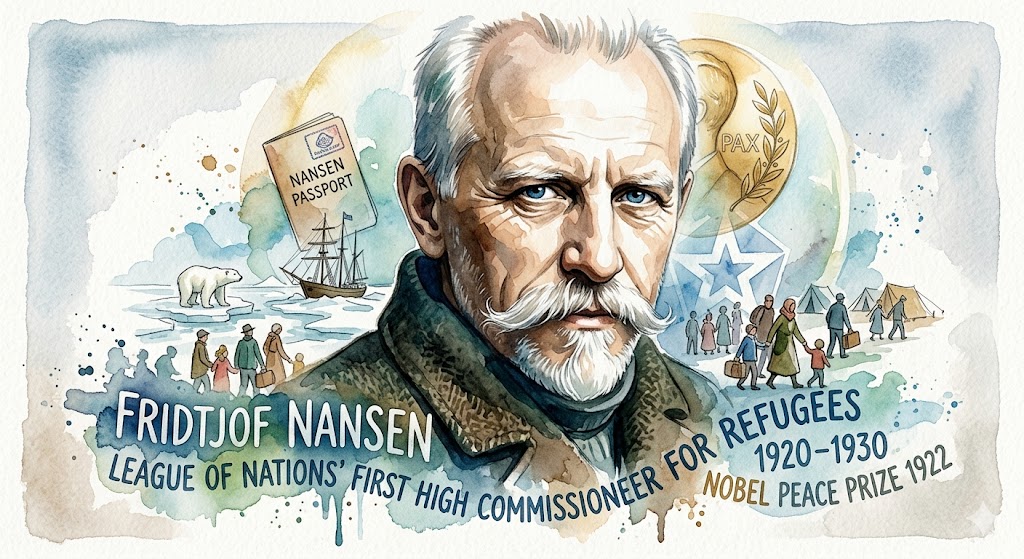
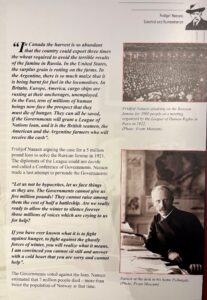
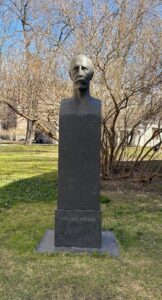 would later become UNHCR), where he continued to use his fame as a polar explorer and diplomat to call attention to the victims of famine and genocide in Russia, Ukraine, and Armenia. In 1922, Nansen received the Nobel Peace Prize for his tireless work for refugees in Europe after the war.
 courage and flexibility in his work. Always highly intelligent… loved field work. He always had a jovial spirit and a twinkle in his eye.”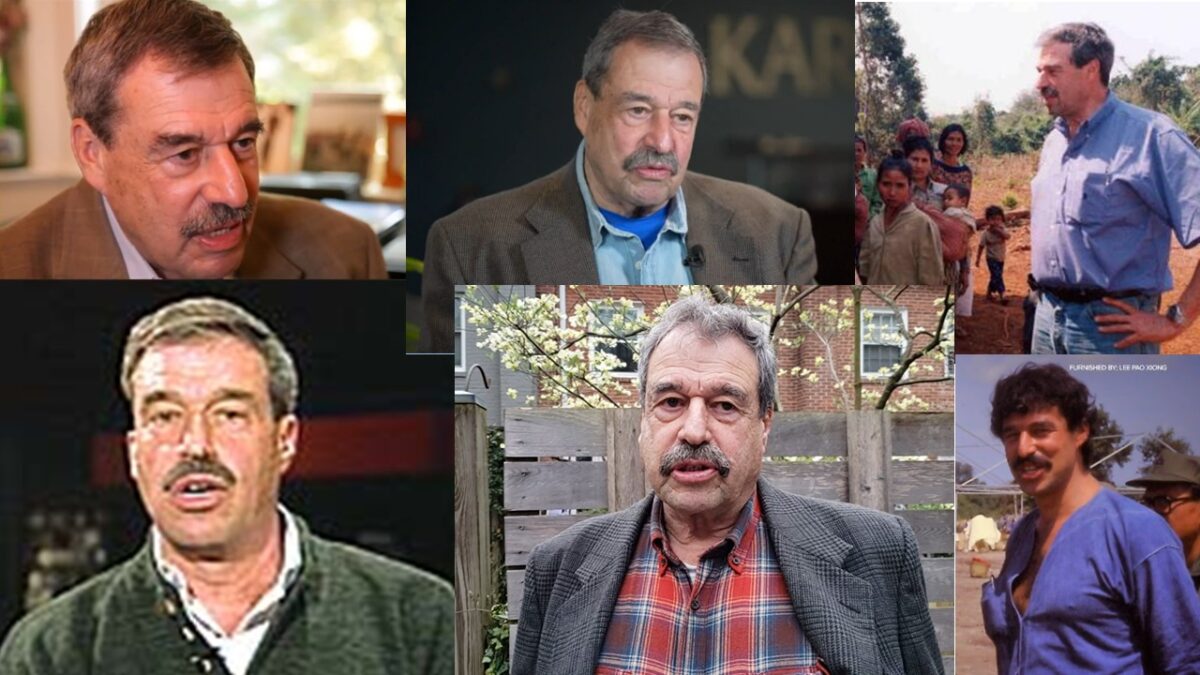
 courage.” Soon thereafter, Lionel was called before Secretary of State Henry Kissinger in Washington, DC to answer – he thought – for his clear violation of State Department instructions. He was instead complimented by Kissinger who praised him for doing exactly the right thing.
 influence U.S. engagement in Bosnia and the eventual Dayton Peace Accords – a powerful example of how principled action can reverberate at the highest levels of policy.” –
  his career postings and involvement in different crises.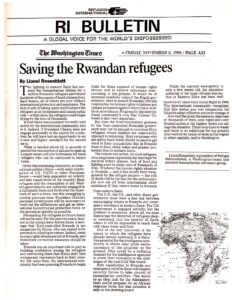

 U.S., I set up public weighing stations and posted the expected ration amounts on a board, so people could check whether their distribution matched the standard.
 cal standards.