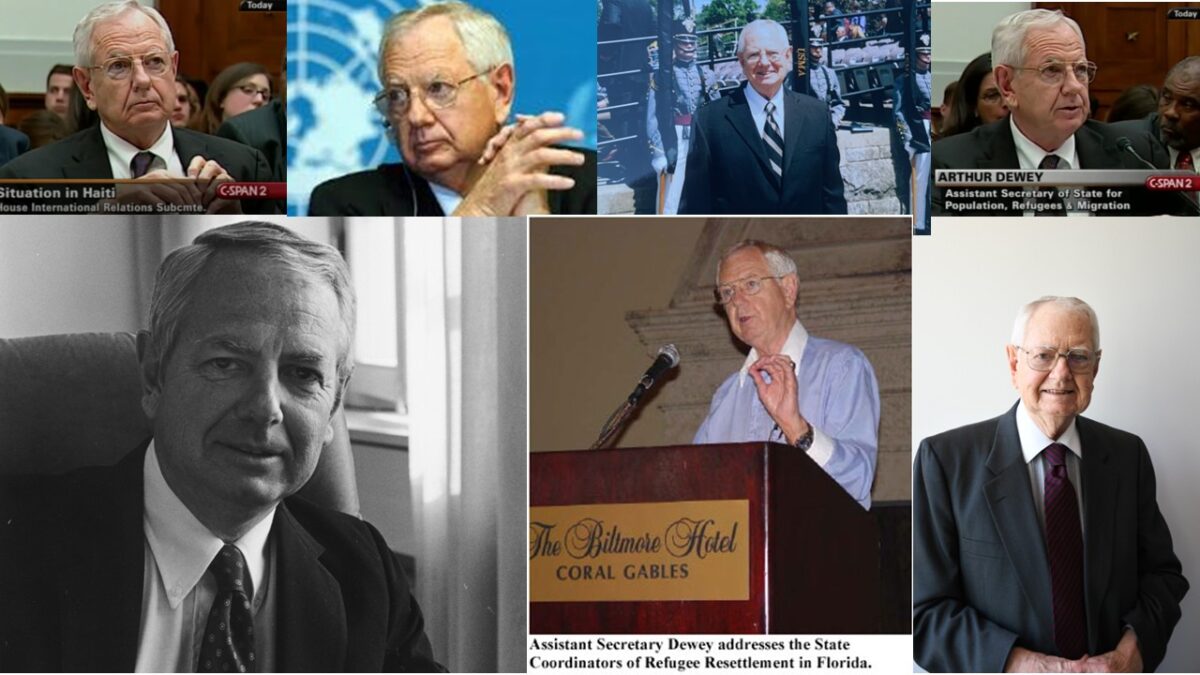
In Memoriam: Arthur Eugene ‘Gene’ Dewey, A Life of Service and Compassion

 Gene Dewey, who passed away on February 22nd, was one of the great humanitarian leaders of his generation, inspiring many people and managing to move food and relief supplies to needed areas over the course of several decades. He was also an institution builder, seeing the need for new organizations to lead and to train leaders.

His career spanned many of the global emergencies of the last 40 years, from Biafra in the 1960s to Sudan in the 1980s, to Rwanda in the 1990s, to Afghanistan in the 2000s.  While he attained senior levels in the UN and US Government, he never lost the common touch. He was affable and supportive of his colleagues and never stood on ceremony.

Throughout his distinguished career, Ambassador Dewey embodied an unwavering belief in the power of multilateral cooperation to address the world’s most pressing humanitarian crises. His conviction that international challenges required international solutions shaped his approach to diplomacy and refugee protection for more than four decades.

He is survived by his wife Priscilla, his daughter Elizabeth Parce Ainsworth, son in-law Anthony Ainsworth, and grand-daughter, Charlotte.

Arthur Eugene Dewey went by the name of “Gene.”  Testimonials contributed from his friends and colleagues for this obituary appear in the following.

  1. Gene’s Life and Mission

Born on February 18, 1933, in Pennsylvania, Gene grew up in a ministerial family that taught him values of service and compassion, which would define his life’s work.  Gene graduated from West Point Military Academy in 1956 and began a distinguished 25-year military career. After earning a Master of Science in Engineering from Princeton University in 1961, Gene deployed to Southeast Asia for two combat tours.  For his leadership during a multinational prisoner rescue operation in Cambodia, he earned the Distinguished Flying Cross and six additional air medals.

Philip Sargisson (UNHCR):  “Gene was a highly principled yet particularly warm human being. We worked together, traveled together and remained close friends.

His advocacy for streamlined international aid structures and enhanced civil-military cooperation in humanitarian response reflected his belief that effective assistance required both strategic coordination and operational flexibility.  His vision influenced how the aid agencies respond to displacement crises today.

Betsy Lippman (State Dept):  “Gene Dewey was the ultimate humanitarian and a gentleman in the old style.  One of a kind.  He will be truly missed.”

II. Gene’s Leadership in Fighting Global Hunger

Gene fought malnutrition and hunger in numerous capacities, starting as a White House Fellow in 1968 when he was posted to USAID to coordinate civilian food aid for the Biafra famine (also known as the Nigerian Civil War), which was the first real-time, big night-time news crisis in Africa.

Susan Martin (Georgetown):  “I met Gene in 1981 when he had retired from the military and began working on refugee issues in the State Department.  He was largely responsible for shifting U.S. policy toward finding solutions for the famine in Ethiopia.”

Working at the U.S. Department of State Gene supported the response to the devastating Ethiopian famine of 1984-1985.  He played a pivotal role in convincing the UN Secretary-General to establish the UN Organization for Emergency Operations in Africa that responded to the regional famines across the Horn of Africa including the Ethiopia famine.

Margaret McKelvey (State Dept):  “I cannot count the number of times he [Gene] cited the UN Office of Emergency Operations in Africa work on famine across the continent in the mid 1980s as the UN’s finest hour.”

Angela Berry (UNHCR Nutritionist) met Gene in 1985:  “At that time, I had met many dignitaries. I assumed my list would disappear into some distant bureaucracy. To my astonishment, within weeks everything I had requested began to arrive – tents, blankets, therapeutic food, emergency kits – pouring in with a speed and coordination I had never seen. I knew it was Gene. … Knowing Gene was there, steadfast in his dedication, unwavering in his humanity, was a deep comfort to me and to so many others. Over the decades we continued to exchange messages, sharing concerns about neglected crises and places in need of attention. He always seemed like someone who would be with us forever.”

In 1993, Gene set up and led the Congressional Hunger Center (CHC), which was authorized by Congress in the wake of the dissolution of the House Select Committee on Hunger.  Working closely with Congressional representatives, Gene built up the CHC.    Drawing on his experience with the White House Fellows program, Gene led the CHC to provide two-year fellowships to dozens of young leaders to train fight hunger, working with UN agencies and NGOs.

Margaret Zeigler (CHC):  “He inspired a generation of young leaders who now work to make the world a better place – in the UN system, in the US government, private sector and in the humanitarian non-governmental organizations here and around the world. Gene always lifted up young leaders and especially believed in women, youth and those less advantaged. His favorite words were “we” and “us”.”

Ambassador and former Congressman, Tony Hall chaired the Committee on Hunger from Congress.  He remembers:  “Gene Dewey was one of the most decent and honorable man I’ve ever met.  He was always caring and working to help people who were hurting.”

In 1989 Gene was tapped to lead USAID’s new, unprecedented aid to the former Soviet states when the Soviet Union unraveled and brand, new countries were in need.  He pioneered new ways of providing aid to unconventional populations in Central Asia.  His partner in this effort, Don Krumm, remembers:  “He was a big-minded guy, energetic, and encouraging.  He was always there with positive bravo.  He liked audacity.  Gene kept the supply lines going in.  It was a chance, if we succeeded, to be on top of a transition to democracy.”

Margaret Zeigler explains “CHC still exists today, and is a private, bi-partisan center that keeps a focus in Congress on domestic and international hunger and humanitarian issues and galvanizes action.  It is where our teams established the Bill Emerson Hunger Fellowships and the Mickey Leland International Hunger Fellowships, programs that raise up the next generation of leaders working to end hunger in the United States and around the world.”

 III.  Gene’s Leadership in Refugee Assistance and Protection

While outside of government, during the Rwandan Refugee Crisis in 1995, Gene Dewey arranged, developed a five-point plan shared with the National Security Council and the U.S. President that helped facilitate the deployment of military assets to provide water supply in Goma and the refugee camps around Goma.

Later, as Assistant Secretary of State for Population, Refugees, and Migration from 2002 to 2005, Dewey oversaw the return of over four million Afghan refugees following the fall of the Taliban.  By mid-2002, approximately 1.6 million refugees had returned home, supported by U.S.-funded UNHCR programs providing transport, shelter, and reintegration assistance.  Dewey championed an innovative Program Secretariat Structure in Afghanistan that paired UN agencies with Afghan government ministries, creating accountability mechanisms while building local capacity. He also initiated the Afghan Conservation Corps, modeled on the U.S. Civilian Conservation Corps, to employ returnees in environmental and infrastructure projects.

      Susan Martin (Georgetown University):   “My most vivid memories of Gene were working with him when he was Deputy UN High Commissioner for Refugees. UNHCR had been pressured by some of its member states to do a better job in protecting the rights of refugee women and children. Some of the UNHCR staff saw the problems faced by women and girls to be social issues, not human rights issues. When I talked with Gene about it, he immediately brought a group of staff members together and let them know that UNHCR had an obligation to protect all refugees and they should cooperate with the efforts underway to address the many problems facing women and children. I will always be thankful for Gene’s support.”

At the Department of State, Gene encouraged Don Krumm  to pioneer early warning of refugee flows, such as in the Fergana Valley in Central Asia.  Don  (State) remembers:  “Gene was always encouraging new thinking.  He was one for pushing the envelope.   He and I got along so well because I would recommend going to the site of the problem, and he trusted me to do that.”

 Anne Richard (State}:  “When he became head of the refugee bureau at the State Department, the humanitarian community expressed huge relief….  He made his mark early on when his issued a fact-based report that defended UNFPA’s role with regard to China’s coercive one child policy. …    His leadership on refugee matters was respected throughout Washington, DC… While a friendly and avuncular figure, he never hesitated to critique humanitarian policies if he thought they were off-track.”

Gene negotiated the reopening of Vietnam’s Orderly Departure Program in 2004, allowing thousands of refugees to resettle safely.  He also advocated for Bhutanese refugees in Nepal and North Korean refugees in China, pressing for their recognition and protection under international law.

Globally, he advocated for “un-warehousing refugees” i.e., out of long-term artificial camps so they could actively participate in finding their own solutions.

Kelly Clements {UNHCR):  “He was known then as a man of conviction and determination to make the lives of others better with Africa a focus during his time at State Department and serving at UNHCR during the 1980’s pivotal adoption of the Comprehensive Plan of Action for Indochinese Refugees and the CIREFCA process which provided a humanitarian framework to implement Cartagena protection principles and solutions in Central America. “

United Nations Leadership

Gene’s commitment to multilateralism and “burden sharing” among donors found its fullest expression during his tenure as UN Deputy High Commissioner for Refugees from 1986 to 1990. Based in Geneva, he served as the second-ranking official at UNHCR during a pivotal period of global displacement. His leadership helped strengthen the agency’s capacity to respond to refugee crises worldwide, and he championed the integration of protection principles into all humanitarian operations.

In this role, Gene worked to enhance coordination among UN agencies, NGOs, and national governments, recognizing that effective humanitarian response required seamless collaboration across institutional boundaries. His efforts to promote burden-sharing among nations and to elevate refugee protection on the international agenda left a lasting imprint on the global refugee system.

Margaret McKelvey (PRM):  “He was tenacious in his views and committed to multilateralism.”

Jan de Wilde (International Organization for Migration):  “Gene was a rare combination of the good and the practical.  Trust found an easy home in him.  His Christian faith was a quiet but driving force in his charitable works, at least as far as I could tell.”

Former U.S.  Secretary of State Condoleezza Rice reflected how Gene was devoted to a life of public service.  She called out his “belief that the world’s most difficult challenges require multilateral cooperation.  You represent the highest ideals of public service.”

Dr. Michel Gabaudan worked with Gene at UNHCR in Geneva.  He remembers Gene as “always extremely courteous and looking at how to solve problems, Gene always saw the individuals, and their suffering, behind the policies, or institutional politics that guided them, carried out by our offices. And he always calmly analyzed the broader context in which we operated, which he understood with discerning subtlety. Some 20 years later, when we met regularly during my stints in DC, Gene remained the same concerned, amiable and well informed person we had always known. A true humanitarian gentleman.”

Strategic Partnerships with International Organizations

From long and hard experience, Gene learned that the U.S. Government’s humanitarian efforts were most effective when conducted in partnership with established international organizations. He cultivated long and deep operational relationships with UNHCR and the International Organization for Migration.

In January 2002, Gene was appointed Assistant Secretary of State for Population, Refugees, and Migration where he oversaw a humanitarian budget of over $700 million a year in refugee assistance that flowed through NGOs and international organizations.

Kelly Clements (UNHCR):  “We worked most closely together when he was Assistant Secretary of State for the Bureau of Population, Refugees, and Migration from 2002 to 2005 and I was Deputy Director of Policy and Resource Planning.  He argued forcefully for the U.S. to address significant humanitarian need from increased displacement in multiple parts of the world, including importantly in and around Afghanistan with senior department, White House, and Congressional leadership.  I remember in particular his first budget defense in front of then Deputy Secretary Robert Zoellick – neither were shrinking violets and it made a lasting impression on me at a young age. He carried the day and our robust budget request proceeded to the White House.”

IV. Charitable Initiatives and Enduring Legacy

Gene co-founded the nonprofit, USA for UNHCR, establishing an enduring bridge between American compassion and global refugee protection. His role as Director Emeritus of USA for IOM further amplified his influence on international migration policy.  In 2018, USA for UNHCR, established “the Gene Dewey Refugee Award” in his honor, recognizing individuals who demonstrate visionary leadership and extraordinary dedication to helping forcibly displaced people.   The award’s criteria, courage, selflessness, sacrifice, and humility, mirror Gene’s values.   Recipients include refugee-led organizations in Uganda to the Eleon Foundation providing therapy for Ukrainian refugee children in Poland.

Kelly Clements (UNHCR)  “While there are many Gene stories, the other piece of lasting advice I remember from our PRM days together is something often repeated now, with due credit to Gene.:  ‘there are no lessons learned, only lessons identified.’  We can all take that to heart.”

Eric Schwartz (State) remembers Gene as:  “a true humanitarian who was prepared to speak and lend his expertise without concern about which political party was in the White House. He will truly be missed. May his memory be a blessing.”

Encouragement of Others

Gene’s legacy lives on through the institutions he helped build and the countless lives transformed by his dedication. The award bearing his name continues to inspire new generations of humanitarian leaders, ensuring that his vision for a more compassionate world endures.

Betsy Lippman (State):    “Gene showed me the ropes.  How he used his discerning intelligence, diplomatic skills and knowledge were incredible to watch and learn from.  His passion and caring for the forcibly displaced was so clear and his drive to change their lives for the better and help them find solutions was always at work.”

Margaret Zeigler (CHC)  “First and foremost, in a town like Washington DC, where most people rarely share the limelight, Gene was radically different: he always created space for young people, like me, to get involved in everything he was working on”

Angela Berry (UNHCR) remembers Gene coming through with needed supplies when she reported her assessments.  “He simply told me to stay the course. After a month, he called me back to Headquarters. He never drew me into the immense politics of that mission; he asked only that I remain true to the technical and humanitarian purpose of the work.” 

John Buche (State):  “At my 90th birthday party, after the string quartet had played “Happy Birthday”, I asked Gene to say a “few words”.  Gene began with mentions of my college education, my army experience, my Foreign Service assignments, pointed out meeting me for the first time when I was in Zambia, continued with my assignments working together in PRM, and ended with recollections from our discussions at our luncheon get togethers in retirement. I felt so honored!”

Mukesh Kapilla (UK Government):  “He was a good man and in my dealings with him I found him sincere, serious and sympathetic in co-operating constructively even as global and American politics swirled around us.

Following the news of Gene’s passing, many offered testimonials, as Bill Hyde (IOM) notes:  “Over the past days I’ve watched a cascade of emotion burst forth from decades of civil servants who were touched by Gene Dewey. Every person swiftly pulled up ‘a Gene moment’ – the time he listened when they needed it; the time he paused in his own busy life to guide them to do better; the time he reached out and amplified the effect of their efforts by easing a path. Many were surprised that a senior official like Gene even remembered them to offer help – but that’s exactly the kind of man he was. Gene didn’t need the praise, he simply wanted everyone to serve the best that they could. “

V. Recognition and Personal Life

Margaret McKelvey (State):  “A committed Christian, he often cited the Biblical verse “the truth shall set you free” – not as a theological statement but as an admonition to always give a complete and truthful assessment of a humanitarian situation along with a detailed “get well” plan.“

During his final year, Gene was still at work writing and corresponding and trying to educate the U.S. government about how to save lives, as in this letter to the editor in the Washington Post (May 2, 2025), titled A Missing Sense of Duty, wherein he recalled the USG’s success in 1985 in stopping measles deaths during the Ethiopian famine through vaccinations, and questioning the recent changes in US policy, writing:  “Where is that sense of duty for potential measles victims in America today?  Health leaders who plant unscientific doubts about vaccine safety need to be held accountable.”

A few weeks before his passing, Gene met for lunch with Don Krumm:  “he was looking incredibly spry.  He talked about emergency operations in Africa was a high-water mark in Africa.  We talked about old times.  He said he was working on some draft recommendations.  He was an exemplary person, driven to do good. “

Gene’s  contributions earned distinguished recognition, including the Distinguished Graduate Award from West Point in 2006 and the John W. Gardner Legacy of Leadership Award in 2011.

Angela Berry (UNHCR):  “Quiet. Kind. Sincere. Reflective. These are the qualities I will always associate with Gene Dewey. They are also the qualities that defined his extraordinary gift to the world and to all who had the privilege of knowing him.”

Bill Hyde (IOM):  “I recall a dozen times over the years when I would receive an unexpected note from Gene. Each would convey his awareness, his appreciation, his offer in some way to contribute. And then he would slip away again, asking neither thanks or focus. Only better service. That’s the definition of a humanitarian.”

Throughout his peripatetic humanitarian life, his wife Priscilla provided unwavering support, for which he expressed profound gratitude.

March 8, 2026

Further informaon about Gene Dewey:

To see Ambassador Dewey’s testimony to Congress about Haiti, see the March 3, 2004 CSpan Haiti testimony where he speaks 46 minutes in:  https://www.c-span.org/program/house-committee/political-crisis-in-haiti/197804

https://tile.loc.gov/storage-services/service/mss/mfdip/2004/2004buc02/2004buc02.pdf

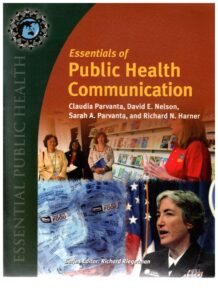
Essentials of Public Health Communication: A Valuable Book and Curricula

Around the world, a key shift during the past few decades in combatting malnutrition has been the adoption of social marketing, communications and “behavior change” to improve diets, caretaker behavior,  and recognition of failures in child growth.  The technical book, “Essentials of Public Health Communication” summarizes the state of the art in applying these tools in public health and nutrition.  Written by Claudia Fishman Parvanta, David Nelson, Sarah Parvanta, and Richard Warner.

Chapters walk the reader through implementation, with examples.  One example is the “Folic Acid First Campaign,” convincing women to take a multivitamin with folic acid (or a folic supplement) before they get pregnant.  Television, radio and print messaging should convey a sense of good health, warmth and energy to reduce the chances of birth defects in newborns.

Claudia Parvanta’s background in designing and evaluating health and nutrition social marketing programs in over 20 countries informs the text’s emphasis on using communication to influence dietary behaviors and address hunger-related issues.  The book references other nutrition-related initiatives, such as the Bangladesh Nutrition Education Project, to illustrate how strategic communication plans are developed and implemented in real-world settings.  It walks the reader through formative research methods, such as focus groups, to understand barriers to diet choices.

This 416-page text (published by Jones & Bartlett Learning) is divided into four major sections: Section One: Overview. Chapters 1, 2, and 3 provide an overview of public health communications, the planning, and informatics. Section Two: Informing and Educating People about Health Issues. Chapters 4 through 7 describe communication challenges and methods to provide information in a clear and unbiased manner.

The book analyzes how anti-vaccine content thrives online using emotive narratives and false expertise. It then contrasts this with proactive, empathetic communication strategies from health agencies, such as “pre-bunking” (inoculation theory) and engaging trusted community influencers (e.g., pediatricians, local mothers) as messengers.

The authors frame communication as a core public health function essential for prevention, behavior change, and policy advocacy.  Introduces behavioral and social science theories that guide message design (e.g., risk perception, social norms, diffusion of innovations).  The book includes discussion of media and channel selection and emphases  the 4 “P”s of Social Marketing, namely Product (the idea of being active), Price (reducing social/access barriers), Place (where tweens gather), Promotion (cool, aspirational ads).

Other case examples include the 2009 H1N1 Influenza Pandemic, the 2014 Ebola scare, and tobacco.  The “Truth” Campaign is described as an anti-tobacco campaign to illustrate audience segmentation and theory application. It didn’t target smokers with health warnings but segmented a new audience  i.e., teenagers, and used the Theory of Reasoned Action/Planned Behavior and empowerment models. The campaign framed tobacco use as a manipulation by big corporations, making rebellion synonymous with not smoking. This showcases moving from “knowledge-attitude-practice” to more sophisticated socio-ecological models.  A full chapter is dedicated to public health informatics which highlights how data systems, surveillance, and digital tools support communication planning and evaluation.

Apropos to its subject, the book reads easily for students and professionals and communicates its messages very well, using a mix of steps, examples, cautions and context.  The book has received very positive reviews, with a 4.5 out of 5-star rating on Amazon.  Reviewers praised it as an excellent resource for nutrition communications and for various types of public health communication work.  It remains the best learning resource in its category.  It is particularly required reading for anyone planning a public health campaign anywhere in the world.

World Hunger Day

May 28 is World Hunger Day, a global initiative to raise awareness about global hunger and inspire action to address food insecurity and malnutrition.  World Hunger Day has been celebrating sustainable solutions to hunger and poverty since 2011, and this year targets the importance of “sowing resilience.”  See:  https://www.worldhungerday.org/

Hunger kills more than AIDS, malaria, and tuberculosis combined, with 9 million deaths annually linked to malnutrition. Sub-Saharan Africa and South Asia are the hardest hit, with countries like Somalia, Ethiopia, Nigeria, South Sudan, and Yemen facing severe crises.

Initiated in 2011 by The Hunger Project, a nonprofit focused on ending hunger through community empowerment, World Hunger Day has grown into a global movement. In 2024, it reached an estimated 48 million people with its message.  The theme of “Sowing Resilience” for 2025 includes messaging about how every local food bank, community market, and volunteer effort is a sign of progress in a long and challenging journey.

In 2025, The Hunger Project hosted a dialogue featuring Rowlands Kaotcha (President and CEO of The Hunger Project) and Amath Pathe Sene (Managing Director Africa for The Africa Food Systems Forum) to discuss building resilience against hunger.

see:  https://www.awarenessdays.com/awareness-days-calendar/world-hunger-day-2025/?utm_source=chatgpt.com

Multiple international aid agencies are leveraging World Hunger Day to highlight the urgency of the global hunger crisis through coordinated awareness campaigns. Organizations are utilizing social media platforms, educational workshops, and community engagement activities to reach diverse audiences and promote understanding of hunger’s root causes.  Feed My Starving Children (FMSC) is commemorating World Hunger Day by highlighting their Project Based Food Assistance (PBFA) initiatives, which represent a comprehensive approach to addressing hunger through both immediate relief and long-term development. The organization’s work in Nakwanya, Uganda, illustrates how aid agencies are moving beyond simple food distribution to support community self-reliance through collaborative initiatives that include maintaining beehives and growing crops like maize and beans that thrive in local climates.

Save the Children is using World Hunger Day to highlight the critical situation facing children globally, emphasizing that 153 million children around the world are facing food insecurity.  The organization’s emphasis on the “triple threat of conflict, climate change and economic cost” reflects how aid agencies are framing hunger as a multifaceted crisis requiring comprehensive solutions.  Mary’s Meals is commemorating World Hunger Day by highlighting their school feeding programs that reach over 2.6 million children daily with food and access to education. The organization’s approach demonstrates how aid agencies are using the day to showcase innovative solutions that address multiple challenges simultaneously. Their model recognizes that hunger affects educational outcomes and that school feeding programs can serve as entry points for broader community development initiatives.

The use of hashtags like #WorldHungerDay, #EndHunger, #ZeroHunger, and #SowingResilience demonstrates how agencies are creating unified messaging that amplifies individual organizational efforts.

In Geneva the U.N. World Health Assembly’s of WHO approving two nutrition-related resolutions.  One expanded provisions of the International Code of Marketing of Breastmilk Substitutes, which counteracts dangerous messaging to new parents about breastmilk powder which increases infant deaths, undermining breast feeding.

The second was the WHO Extension of the Comprehensive Implementation Plan on Maternal, Infant, and Young Child Nutrition: This resolution extended the implementation plan to the year 2030, to address malnutrition in mothers and young children.  It encourages  momentum to address persistent malnutrition, such as the 149 million children under five who were stunted and 45 million who were wasted globally as of 2022, along with addressing disorders such as anemia, overweight, and obesity in women.

WHES Undertakes Research about Attacks Against Food & Nutrition in Humanitarian Aid

This month, toward the end of 2024, World Hunger Education Service  launched a broad  study about the patterns, trends and extent of violent attacks and threats against aid programs delivering food and nutrition solutions in famines, crises, war zones, and for displaced populations.  The results will be published here, in Hunger Notes.  This is an independent study that is at WHES’s initiative.

In recent years, there has been a growth in attention to and professional publications about attacks on health care in fragile states and conflicts, which include missiles, drones, shooting, targeted assassination, roadblocks, air strikes, mortar fire, kidnapping and siege.  All of these are prohibited by the Geneva Conventions.

There has been no corresponding attention to attacks on food assistance or nutrition programs, which this new study hopes to fill in.

WHES’s Lead Researcher, Eline de Looijier, is seeking inputs from a wide range of UN agencies, non-governmental organizations, donors, journalists,  researchers and observers who can help her document not only the extent of attacks on food/nutrition, but also how aid agencies adapt to threats and risks of attacks and seek to mitigate these risks.

WHES is an independent nonprofit and respects the confidentiality of people contributing to this study.  WHES thanks all those who are able to share their thoughts.  Please send inputs to Eline at:  Eline de Looijer <elinejdelooijer@gmail.com>

U.S White House Conference – $8 Billion toward a National Strategy for Hunger, Nutrition, and Health

On September 28, the White House held the U.S.’s second Conference on Hunger, Nutrition, and Health.  The main goal of this conference was “ending hunger, improving nutrition and physical activity, and reducing diet-related diseases and disparities” by 2030.

As a product of the conference, the White House released a National Strategy outlining federal policy initiatives to address these challenges: the Biden-Harris Administration National Strategy on Hunger, Nutrition, and Health is a comprehensive federal plan to end hunger in America by 2030.

This strategy articlates the priorities of the National Nutrition Policy – Healthy People 2020. It also reflects input from stakeholders across the country—including state, local and tribal governments; non-profit organizations; philanthropic foundations; private businesses; academia; nutrition professionals; consumers and advocates—who have been involved in hunger relief efforts.

Additionally, the White House released an associated fact sheet outlining the More Than $8 Billion in New Commitments as Part of Call to Action for White House Conference on Hunger, Nutrition, and Health

The Executive Summary on the National Strategy, published by the White House in tandem with the report, summarizes the five main pillars of the national strategy:

1. Improve Food Access and Affordability

End hunger by making it easier for everyone—including individuals in urban, suburban, rural, and Tribal communities, and territories—to access and afford food.

2. Integrate Nutrition and Health

Prioritize the role of nutrition and food security in overall health—including disease prevention and management—and ensure that our health care system addresses the nutrition needs of all people.

3. Empower All Consumers to Make and Have Access to Healthy Choices

Foster environments that enable all people to easily make informed, healthy choices, increase access to healthy food, encourage healthy workplace and school policies, and invest in public education campaigns that are culturally appropriate and resonate with specific communities.

4. Support Physical Activity for All

Make it easier for people to be more physically active—in part by ensuring that everyone has access to safe places to be active—increase awareness of the benefits of physical activity, and conduct research on and measure physical activity.

5. Enhance Nutrition and Food Security Research

Improve nutrition metrics, data collection, and research to inform nutrition and food security policy, particularly on issues of equity, access, and disparities.


State of Food Security and Nutrition in the World (SOFI) Report 2020

The State of Food Security and Nutrition in the World is an annual report prepared by FAO, IFAD, UNICEF, WFP and WHO to inform on progress towards ending hunger, achieving food security and improving nutrition and to provide in depth analysis on key challenges for achieving this goal in the context of the 2030 Agenda for Sustainable Development

An Interview with David Nabarro

Margie Ferris Morris and Peter Morris interviewed Dr. David Nabarro on a recent trip to Switzerland. David currently is the Founder and CEO of 4SD, a social enterprise based in Geneva. He has been a long-time advocate of nutrition and food security issues and was the recipient of the 2018 World Food Prize, along with Lawrence Haddad.


World Hunger Education Service (WHES): As the world is changing so fast, could you give us a short history of  your involvement with food security/hunger issues – and how you became involved and served as the UN point on Food Security and later was awarded the World Food Prize in 2018.  

David: My career began with public health, especially children’s health and why they were not doing well in early life. This included the child’s life in the home and their well-being. From that view, it was easy to get involved in agriculture and food security. Public health has remained my compass throughout my career.

In 2008, there was a food price crisis. At that time, the UN Secretary General was looking for someone who could coordinate the collective response.  He wanted someone familiar with public health. I had experience of coordinating between UN agencies and was made a deputy UN coordinator, and then coordinator, for food security. I helped the UN agencies to organize themselves on food and stayed in this role until 2014. I watched as the UN developed a much more integrated approach on food and food security – one which encouraged different groups to come together and work in synergy.

During my time as the food security coordinator for the UN, one of the areas on which I found myself focusing was nutrition. There were three quite distinct views on the best ways to enable people to be better nourished:

      1. Working from a focus on health and health care;
      2. Working from a focus on what people eat – diets and the foods on which they are based;
      3. Working from a focus on household well-being and resilience in the face of poverty – the economics of nutrition

Increasingly I have developed the view that nutrition belongs in every professional group.

I joined a group of nutrition leaders from communities, local authorities and national governments; from professional and civil society organizations, from across the UN system and the World Bank, and from bilateral donor agencies and philanthropic organizations. We worked together on the concept for a movement to Scale Up Nutrition (SUN) focusing within the first 1,000 days of a child’s life. We were informed by a special series of articles on nutrition produced by The Lancet, a medical journal. This encouraged convergence of thinking and alignment of action around nutrition and it inspired many to intensify efforts. The movement was not a program led by a UN agency (like WHO or FAO) or other international body. The movement was designed to be led from within countries by national nutrition platforms where multiple actors – from different sectors and different disciplines – would come together for women’s and children’s nutrition. One feature of these in-country efforts for nutrition is that the different actors from multiple sectors would share the same purpose, agree on priority outcomes and align their actions.

There were several features that seemed to be important for the success of in-country efforts. First – creating a “big tent” of nutrition actors who agreed on a series of principles and shared a common purpose: this reduced the potential for different entities to be concerned about who was inside the tent and who was on the outside. Second – ensuring that a diverse set of stakeholders participated in the national platform – not just from governments, but also from the private sector, civil society, and science.

When the SUN Movement was launched in New York at the end of September 2010, we thought that maybe 20 countries would get involved in the early stages. In practice, growth was rapid and strong with more than 60 countries joining, with three Indian States, many donor governments, and numerous businesses, civil society organizations and scientific institutions wanting to be involved.

I worked as SUN Movement Coordinator from 2010 through to 2014. I noticed that countries which engaged in this SUN Movement from the beginning are the countries where there have been significant improvements in nutritional status.

This association was noticed by members of the committee responsible for deciding who would receive the World Food Prize. They were impressed by ways in which the SUN movement widened public interest in ways to improve nutrition while keeping the focus on specific outcomes that really matter. They considered that the SUN Movement is a significant achievement.  I’ve done something that is useful, and so I was awarded the prize, together with Lawrence Haddad, whose science has been really special.

For many people this was exciting, for it is not often that the World Food Prize goes to people who have been involved in the kind of organizational work that created the conditions for the SUN movement. Normally the Prize goes to people who have made a scientific discovery in the lab or in the community.  Many of us rejoiced that an effort to encourage multi-disciplinary action for nutrition had found its way into the World Food Prize. It has been wonderful to be recognized in this way.

WHES: At some fundamental level, what has been the overall achievement of SUN? Not in terms of government programs or money spent, but actual progress that can be attributed to this movement?

David: From my perspective the main achievement of the movement has been that it encourages different actors within SUN countries to come together and work in synergy. As they do so, they increase the likelihood of levels of malnutrition will reduce more rapidly than would otherwise be the case.  In my view, people’s nutrition improves as a result of changes in the interactions between different systems within societies and in how they exert influences on people’s nutritional well-being. I have never held the view that reducing levels of malnutrition among women and children can be directly attributed to volumes of finance expended: system shifts can rarely be directly attributed to patterns of expenditure. It is hard to prove causality though there seems to be a strong association between progress with nutrition and diverse actors coming together around a shared narrative.

WHES: You’ve done so many different things in your career. Where have you done that you personally felt made the most difference?

David: The way of working that gives me greatest professional satisfaction and pleases me the most involves enabling all with an interest to engage and partner on an issue which concerns them all. I spend most of my time helping to create the conditions for this way of working together. I like to create conditions that enable all concerned to engage, work together and take decisions through together focusing on the issue and not worrying about professional, organizational or institutional identity. Indeed, for me this way of working involves leaving logos and egos outside the room.

I enjoyed being involved in the framing of several new partnerships:

  • Roll Back Malaria (RBM) – I was responsible for this effort in WHO over two years (1999 – 2001): it was wonderful to watch as different groups come together and prepared collective action on malaria, under the stewardship of Gro Harlem Brundtland, WHO Director General. It involved collective action by many different governments, community organizations, scientific institutions and professional groups. It has been an absolute joy to see levels of malaria mortality drop so profoundly, particularly among children in Africa.
  • UN System Influenza Coordination – I was involved in the effort by the UN to reduce the intensity and consequences of H5N1 (Avian Influenza) outbreaks between 2005 and 2010. My responsibility was to help groups of animal, human, and environmental health practitioners work effectively together. The concept of One Health Working evolved and became a meaningful identity for those who were working on the challenge of reducing the consequences of avian influenza.
  • UN system High Level Task Force on Food Security (2008 -14), Movement to Scale Up Nutrition (2010 – 14), Responses to the West African Ebola outbreak (2014 – 15); Advancing the UN’s work on the Sustainable Development Agenda and Climate Action (2016 – 17). I served as coordinator for these initiatives as Special Adviser to the Secretary-General of the UN.

On each assignment I found that extraordinary energy comes from connecting people so that they will work together rather than their being fragmented into different initiatives. These connections unleash valuable new energy through bringing multiple actors together and encouraging them to establish force fields rather than being tightly wired together. This is a way of working that tends to achieve results while making people feel good. That is one of the reasons why I have also had the good fortune to stay connected to many of the people that I have worked with in my earlier career – we enjoy this style of working and find it to be both constructive and effective. I keep asking myself: why isn’t this way of working the norm? Why is it so common that when groups tackle problems they focus more on what makes them different rather than on working together, aligning and synthesizing their efforts. I want to be sure that there is as much encouragement as possible for those who want to combine efforts for the common good: I just do not know why it isn’t the norm.

One of my priorities now is to take this approach to collective leadership and this way of working and make it into something that people can learn to do intentionally, rather than just stumbling upon it by accident. I am teaching collective leadership for systems change through our social enterprise 4SD.

WHES: With U.S. funding to the UN under increasing scrutiny and attack, what do you see as the unique and beneficial role multilateral actors play in ending hunger and good development?   

David: The term “multilateral” is used to describe the process of national governments working together on massive challenges which affect all our futures – like climate change, the future of food, access to drinking water and disease outbreaks. Typically, these challenges do not stay within national boundaries. They are bigger than any one government can tackle alone: they need the collective energy of leaders working together. It makes absolute sense that there are institutions designed to bring governments together so they can work on the challenges multilaterally.

Over the years the US has consistently supported multilateral efforts by bringing governments together with shared purpose. One example of this approach is the Global Health Security Agenda (GHSA) which was fostered by the United States and other governments some years ago to tackle infectious diseases crossing borders. GHSA is brilliant because it made it easy for like-minded governments to come together – however, it could be faulted, as it was only a selection of countries, so if there were other countries, which for whatever reason – political or other – could opt out so there was a limit to what that agenda could do.

So, what is the alternative? We could work through more formal structures. The formal structure we have is the United Nations system, which is based on one member, one vote. We have other formal structures that are there for specific purposes, e.g. the World Bank, which has a different governance. From my perspective, however, the United Nations offers the most legitimate institutional base for multilateral action.

Multilateral mechanisms of the UN are not always appreciated by every nation: the UN is sometimes portrayed as flawed and not fit for purpose. Some wealthier nations feel that others are ganging up on them (e.g. anxieties about the disparity of wealth between nations with wealthier countries being asked to redistribute their wealth among poorer ones). This has led to some of the rich countries perceiving that the multilateral mechanism through the United Nations is one that they feel very unsure about. There are some parts of the multilateral UN system that the rich countries are anxious about because they feel that they are systematically biased against the economic and political policies of the rich world.

What I would like to see is greater value given to universal multilateralism with more attention being paid to the misgivings of the wealthier nations, particularly given that through the budgeting system of the UN they are giving quite a large fraction of the budget. The United States generally pays 22 percent of the UN regular budget and has historically paid even more for peacekeeping. It’s no good just saying that the multilateral system – one country, one vote – means there will sometimes be criticism of U.S. policies on some issues that the U.S. and other rich nations must just put up with. We must recognize it is legitimate for those who pay significant sums of money to have their concerns heard, just as it is legitimate in a one country, one vote system for those who disagree with policies of some of the rich nations to express that disagreement. And, for me, finding ways to navigate those political anxieties is key to multilateral working. If we cannot navigate them, we will not achieve the full potential of our multilateral working, and if we can’t do that, then we can’t tackle the big issues of our time.

WHES: What do you see as the greatest threats in the near or long-term future for continued progress on hunger?

David: Over the last three years, we’ve seen rises in the estimated number of hungry people in the world. The pattern is clear; the numbers are coming up because of a combination of the effects of changing climate and violence that involves civilians. In parts of the world that are already fragile, such as the Sahel and several river delta areas, the impact of climate change leads to irregularity of rainfall and salination of productive land. These decrease productivity of land and increase poverty: they provoke fights over resources, and sometimes outright warfare, as we have seen in recent years in the western Sudan. There is a definite link between the risk of conflict and climate change. And obviously if there are not good mediation systems in local communities, then conflict can become violent, and this is particularly likely if governments are going to weigh in on one side or the other, so I do see these as very, very tightly interconnected.

The conflict over available resources is exacerbated by climate change and more likely to turn into violence because of the inability of governments to establish systems for the peaceful mediation of conflict.

I fear there is not really the level of global political intent to do everything possible to stop these conflicts. I think this lack of intent is the most disappointing part, because of the impact on hunger and child survival. To recap, the three major issues are:

      1. The problem of war,
      2. The problem of climate change, and
      3. The general inability of world leaders, through the instruments they have at their disposal – such as the UN security council – to work together on resolving conflict.

Often when member states act within the conflict – even joining the conflict – and that may well exacerbate things rather than improve them.

WHES: What specific program that you have seen has had a strong impact on hunger in a community? Would that be different than an approach that has made a difference at a county level?

David: In my experience hunger reduction at community level occurs most rapidly If you get different actors together to diagnose what is happening and work on the issues together. This way of working needs leadership and willpower. For example, in India, Maharashtra state has a Nutrition Mission. Some districts have fantastic results, other districts, less good results. As I understand it the good results are due to the capacity for local organizations to bring people together. At the central or country level, it is much harder to incentivize collective working and get leaders to consolidate around these ideas. However, there are several policy levers that can help.

I have found that a good collective buy-in is enabling girls to continue education later in life so they are able to have agency and to take steps in local communities. I am impressed by the power of productive social safety nets, such as in Ethiopia.  This has been strongly advanced by the Government and has proved to be super-helpful. When government leaders take a personal interest, then their agencies get involved.

WHES: What are some ways people reading this interview can start to have an impact on world hunger either in their own community or on a more global level?

David: It has to start with having that fire within you. It needs to come from your own inner anger and frustration. Here is my narrative. We produce a lot of food within our world. There IS enough FOOD to go around. Hunger is with us due to failure of political processes…political failure. Hunger is a moral blot on humanity. Hunger is an immediate challenge to society in that the hungry may only get one meal a day. This impacts their future development and handicaps them. We must deal with problem of hunger where it is…there are always underlying circumstances…just about any one of us, whatever our status, can contribute, making sure people get good food when they need it.

WHES: Do you see a future for local food fortification (to address vitamin mineral gaps) on a large population scale?

David: YES!! I would encourage effective local food fortification – it is important to properly manage it well at local level. It should not be used as an excuse to avoid the purchase and use of locally produced foods in creating healthy and nutritious diets.

WHES: Do you have any views about how we (e.g. everyone) can/should ever get to funding for the massive scaleup of Community Managed Acute Malnutrition (CMAM) approaches to address hidden hunger?

David: We have to make sure that this is inside the purview of good development initiatives. It is an immensely empowering for communities. Every child should have access to therapeutic nutrition if needed.

A Shadowy Industry Group Shapes Food Policy Around the World

When the Indian government bowed to powerful food companies last year and postponed its decision to put red warning labels on unhealthy packaged food, officials also sought to placate critics of the delay by creating an expert panel to review the proposed labeling system, which would have gone far beyond what other countries have done in the battle to combat soaring obesity rates.