


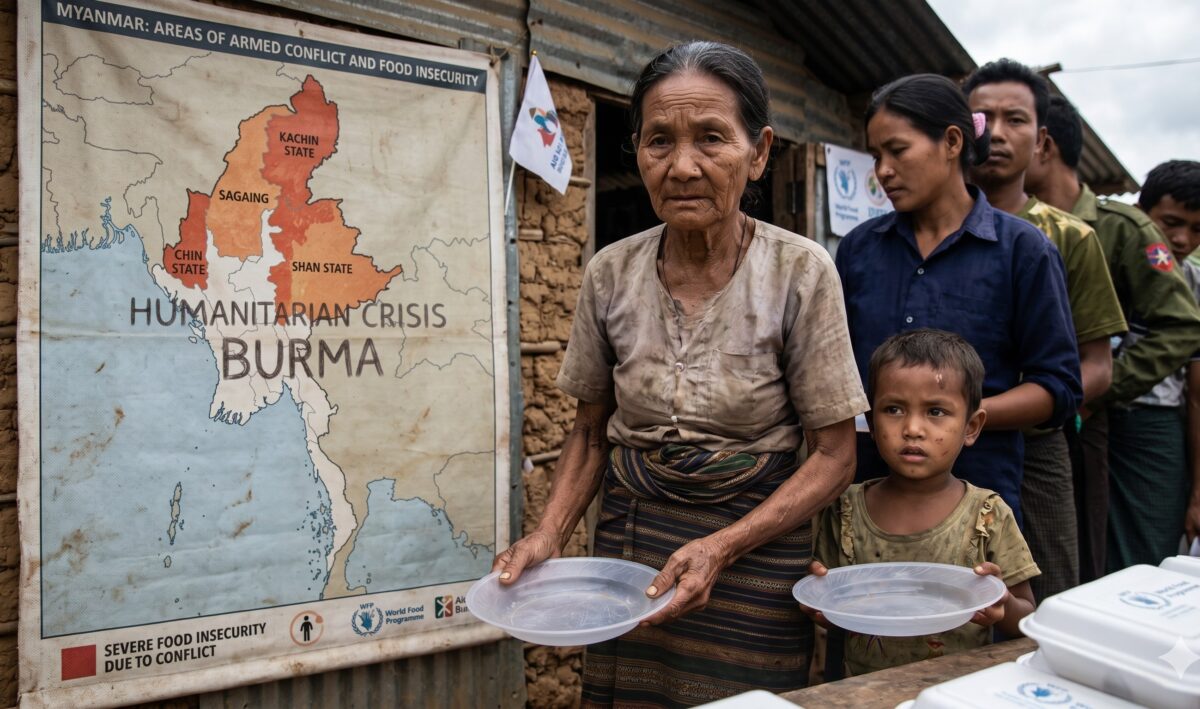
May 2, 2026 According to the latest Hunger Hotspots Report, 16.7 million people, or one in three citizens of Myanmar (also known as Burma), are acutely food insecure, a sharp increase from 13.3 million in 2024. Myanmar now ranks fifth globally for the highest number of people facing severe hunger.
More than 400,000 young children and mothers suffering from acute malnutrition are surviving on nutrient-deprived diets of plain rice or watery porridge. WFP’s country director has said the crisis is invisible to the world. WFP can target just 1.5 million of the 12.4 million people in need and requires $150 million to do even that. No recent national prevalence data exist on wasting, but subnational surveys (for example, one in Yangon and Ayeyarwady Regions in late 2023) found about 8 percent wasting, slightly higher than the prior national figure. Broader food security and nutrition monitoring, including Myanmar Household Welfare Survey rounds from 2021 to 2025, shows worsening dietary diversity, higher food insecurity affecting millions, and increased household hunger since 2021.
Related to malnutrition, Myanmar’s under-five mortality rate—39 deaths per 1,000 live births—is nearly three times higher than the East Asia and Pacific regional average of 14.4.
The roots of the current hunger crisis lie in the military takeover of the government in February 2021. Since the coup, intensifying conflict has led to an estimated 15.2 million people, nearly a third of Myanmar’s population, facing acute food insecurity in 2025. The junta has retaliated against resistance forces by blockading aid, restricting humanitarian access, limiting trade routes, and targeting humanitarian workers, further compounding the food crisis. Military attacks have destroyed agricultural equipment and contaminated farmland with landmines and unexploded ordnance, exacerbating challenges for local food production. The average price of a basic food basket has increased fourfold compared with prices before the military takeover.
The situation is particularly critical in Rakhine State, home to the Rohingya and other ethnic minorities. UNDP has reported that Rakhine State is on the brink of famine, with two million people at risk of starvation. The Myanmar military’s near-total blockade of humanitarian aid to Rakhine State since 2023 violates international humanitarian law and likely constitutes a war crime.
Many readers may remember the large 7.7-magnitude earthquake that struck central Myanmar on March 28, 2025, killing more than 3,700 people, destroying infrastructure, and reverberating through neighboring countries. A large share of aid donations was made in response to that quake.
International aid organizations working to address malnutrition in Myanmar include Action Against Hunger (ACF), Save the Children, Mercy Corps, Solidarités International, the International Rescue Committee (IRC), and Catholic Relief Services (CRS).
World Vision provides aid in 11 of the country’s 14 states and regions. ACF is currently implementing projects addressing malnutrition, mental health and care practices, food security and livelihoods, water, sanitation, and hygiene, nutrition security, and disaster risk reduction in Chin State, Kayah State, and Rakhine State. MSF has mobile teams in Naga and Sagaing, a remote, mountainous region in northern Myanmar where communities have limited access to basic healthcare. Despite restrictions on humanitarian access to conflict-affected areas, mobile teams based in Sittwe, in central Rakhine, offer primary healthcare and emergency referrals for patients from all communities. The IRC works in Rakhine, Kachin, Kayin, and Shan States in close collaboration with the Ministry of Health. Save the Children provides aid in Mandalay, Sagaing, Bago, Magway, Shan, and Naypyidaw. CRS’s current projects in Myanmar focus on agriculture and livelihoods and support for emergency response. CRS works with local Caritas partners to build capacity for community-led project design and implementation. CRS Myanmar also supports partners in Kachin on community-led shelter efforts and provides technical assistance in community-led return and resettlement.
Community Partners International (CPI) provides community-based healthcare, particularly in conflict-affected border regions where government services are non-existent. This includes “Backpack Medics,” who travel to remote villages to provide primary care, trauma surgery, and vaccinations. CPI also runs maternity waiting homes and trains community health workers to support safe births in conflict zones.
In Myanmar, the UN World Food Program (WFP) provides food rations to vulnerable populations, including internally displaced persons (IDPs), refugees, and people affected by natural disasters or conflict. 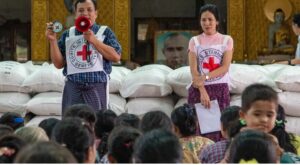 WFP also runs school feeding programs in areas with high food insecurity, providing nutritious meals to children in schools.
The International Committee of the Red Cross (ICRC) provides nutrition and health support for war victims in Myanmar. In 2024 and 2025, the ICRC provided food rations, including rice, oil, and beans, to thousands of displaced families in areas such as northern Shan State, Mandalay, and Sagaing.
To the east of Myanmar, there are some two million refugees in Thailand. The Border Consortium (formerly the Burma Border Consortium) of NGOs has operated in nine refugee camps along the Thai–Myanmar border since the 1980s, providing foodIt remains the primary agency responsible for food assistance. However, its operations have been severely reduced. By mid‑2025, TBC announced that food assistance for most households would be cut by 75% or eliminated entirely.
– Contributed by WHES board member, Steven Hansch

