

June 17, 2026 Yesterday, the UN was advised that the extent of food insecurity in Yemen had ratcheted up further: “The hunger crisis in Yemen is worsening sharply, with the share of people unable to meet basic food needs rising from about half to nearly 60 percent within a month,” UN Under-Secretary-General for Humanitarian Affairs and Emergency Relief Coordinator Tom Fletcher warned on Tuesday, calling for urgent funding to prevent further starvation. “The number of Yemenis facing the most severe levels of deprivation has increased from one in four to nearly one in three. More than 18 million people, …are now experiencing acute hunger, ” Fletcher told the UN Security Council during a June 16 briefing.
Over 2.2 million children under five are acutely malnourished, including more than half a million in the severe, life-threatening form. Nearly half of all children under five suffer chronic malnutrition (stunting), locking in lifelong disadvantages for a generation. In hard-hit areas, half of households with young children report at least one malnourished child, while one in four has a malnourished pregnant or lactating woman.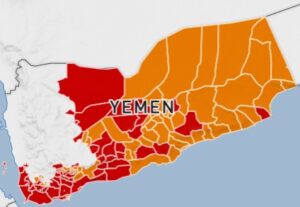
The Integrated Food Security Phase Classification System (IPC) of famine predicts and projects a growing number of regions moving into Phase 4 — Emergency, shown in red in the map at right — for the period September to December 2026. The Orange Zones are very food insecure and Red are emergency.
The 2026 Yemen Humanitarian Needs and Response Plan of the U.N. requested $2.16 billion for aid in order to reach 12 million of the 22.3 million people in need of assistance. Yet, donor fatigue and competing global crises threaten another shortfall. Recent floods have destroyed displacement camps and livelihoods, while economic pressures and regional shipping tensions continue to inflate food and fuel prices. In government-controlled areas alone, nearly half the population now are now suffering crisis-level acute food insecurity, with emergency levels expected to climb through the lean season.The country’s arid climate, limited arable land, and chronic water scarcity have always constrained domestic production. Yemen has long depended on imports for over 90 percent of its food, especially wheat, of which it imports around 96 percent, leaving it acutely vulnerable to global price spikes, shipping disruptions, currency collapse, and fuel shortages that drive up transport costs. War has only deepened this dependency.
The current civil war, fueled by Iranian support to Houthi rebels, has made humanitarian aid more difficult. NGOs that had been building long-term food resilience for years had to shift to more short-term life-saving aid. Damaged irrigation, lost livestock, displacement of farmers, and soaring input costs have left cereal production well below average. Even when commercial imports through Red Sea ports remain adequate in volume, economic collapse and rial devaluation put basic staples beyond reach for millions.
The chart at right comes from the CEOBS Report: Yemen’s agriculture in distress – ceobs.org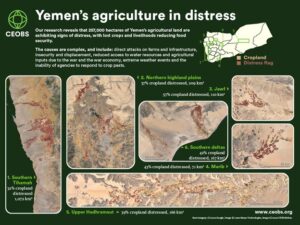
What is new and especially alarming in 2026 is the sharp contraction of the humanitarian response itself. In January, the World Food Programme announced it was terminating operations and contracts for its 365 staff in Houthi-controlled northern Yemen, home to roughly 70 percent of the country’s humanitarian needs—after repeated obstructions, arbitrary detentions of aid workers, and an increasingly impossible operating environment. This followed earlier suspensions and adds to chronic underfunding. The 2025 appeal was only 29 percent funded, forcing agencies to scale back nutrition, health, and food programs nationwide.
Yemen’s food insecurity has deep roots, but the convergence of aid cutbacks, operational halts in the areas of greatest need, economic freefall, and climate shocks risks erasing fragile gains in nutrition and pushing more families beyond their breaking point.
Aid agencies helping to address malnutrition in Yemen include: the International Committee of the Red Cross, Action Against Hunger, Save the Children, the International Rescue Committee, Médecins Sans Frontières, CARE, Norwegian Refugee Council, Danish Refugee Council, Oxfam, Islamic Relief, Medair and the Adventist Development and Relief Agency. Relief International is working with WFP in food aid in the south of Yemen. UNICEF coordinates much of the nutrition programming for children and mothers, and the U.N. Nutrition Cluster (led by UNICEF), which reports for 44 operational nutrition partners in Yemen.
Further information, see: https://www.nutritioncluster.net/country/yemen
and https://fscluster.org/yemen