


June 18, 2026 Food insecurity the Democratic Republic of Congo (DRC) has formed a vicious circle this year with the latest Ebola virus outbreak, now the 17th recorded and the largest to date in terms of people infected.
The Adventist Development and Relief Agency (ADRA) is an example of an NGO that has been providing large scale food assistance in eastern DRC and has addressed the current and past outbreaks of Ebola with community education, hygiene promotion, and water, sanitation, and hygiene.
UPDATE: nutrition specialists have now created a dedicated Ebola-nutrition response structure. Two new postings on September 4—an August Nutrition Cluster/UNICEF Ebola nutrition SitRep and a separate operational framework for the nutrition sub-pillar—show that nutritional management is being formally incorporated into the Ebola response rather than treated as an ancillary service.
Lessons from the earlier West African Ebola outbreak include the value of self-isolation (self quarantine of people who may have been exposed to Ebola) which was a critical measure to interrupt transmission, and, in turn, self-isolation depended on aid agencies providing ample food aid to compensate the family for lost income. Today, the World Food Programme is doing the same thing, providing food aid to contacts and patients in DRC.
The map below shows the current spread, in 2026 of the virus, and possible future routes of spread.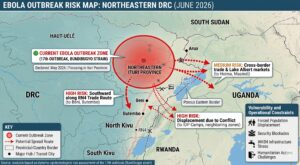
In the West Africa outbreak there were 11,323 recorded deaths but probably over 30,000 actual deaths, where the majority of Ebola cases were never reported. The United States Government alone spent some $2 billion on that earlier Ebola response. The United Kingdom spent £667 million (roughly $850 million–$1 billion at 2014–2016 exchange rates), and the World Health Organization spent some $500 million.
The USAID evaluation of that outbreak response was commissioned by Jeremy Konyndyk, then Director of the Office of U.S. Foreign Disaster Assistance. Writing in the New York Times on June 13, he warned that the current DRC outbreak could become the worst ever. He reports that the Centers for Disease Control and Prevention (CDC) projects that more than 20,000 cases may occur by late August. Konyndyk notes: “As bad as this situation is, we have a playbook for addressing such crises. But it requires a huge team effort.” He calls for specialized clinics, large‑scale contact tracing, safe burial management, and adequate personal protective equipment for health workers. However, he cautions that “security has deteriorated markedly as the government has lost control of large parts of the area.”
With clear relevance for the current global Ebola outbreak, a series of lesson‑learning roundtables were held in 2017 at George Washington University, Harvard University, and the Uniformed Services University of the Health Sciences. These discussions were part of a lessons‑learning evaluation requested by USAID and were intended to reflect on operational challenges during the West African Ebola crisis. Each roundtable included seasoned emergency practitioners who had overseen or implemented programs in Liberia, Sierra Leone, and Guinea during the lethal 2013–2016 outbreaks.
The Harvard Roundtable concluded that the greatest challenges in the Ebola response involved trust, including community skepticism and occasional violence. One participant warned that “we are setting ourselves up for the same problems all over again.” Families were initially reluctant to cooperate with referral systems in which infected relatives were taken away with little explanation. As one participant noted, once treatment centers were introduced and communities saw that Ebola was not always a death sentence, and that patients could both enter and leave safely, community transmission began to decline. Another participant observed that promising “Community Care Centers” were denied or delayed funding unless the NGO also staffed a larger hospital. Others emphasized that faith‑based organizations were often more effective at face‑to‑face engagement with communities.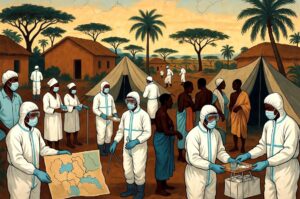
The 2016 lessons roundtable held with U.S. military representatives highlighted the indispensable role of the U.S. Navy’s Mobile Diagnostic Laboratories (MDLs) in West Africa. Operated by the Naval Medical Research Center (NMRC) in Guinea and Sierra Leone, these PCR‑based laboratories provided the only rapid diagnostic capacity early in the outbreak. The U.S. Air Force also played a critical role in airlifting doctors and epidemiologists across Liberia during the fall of 2014.
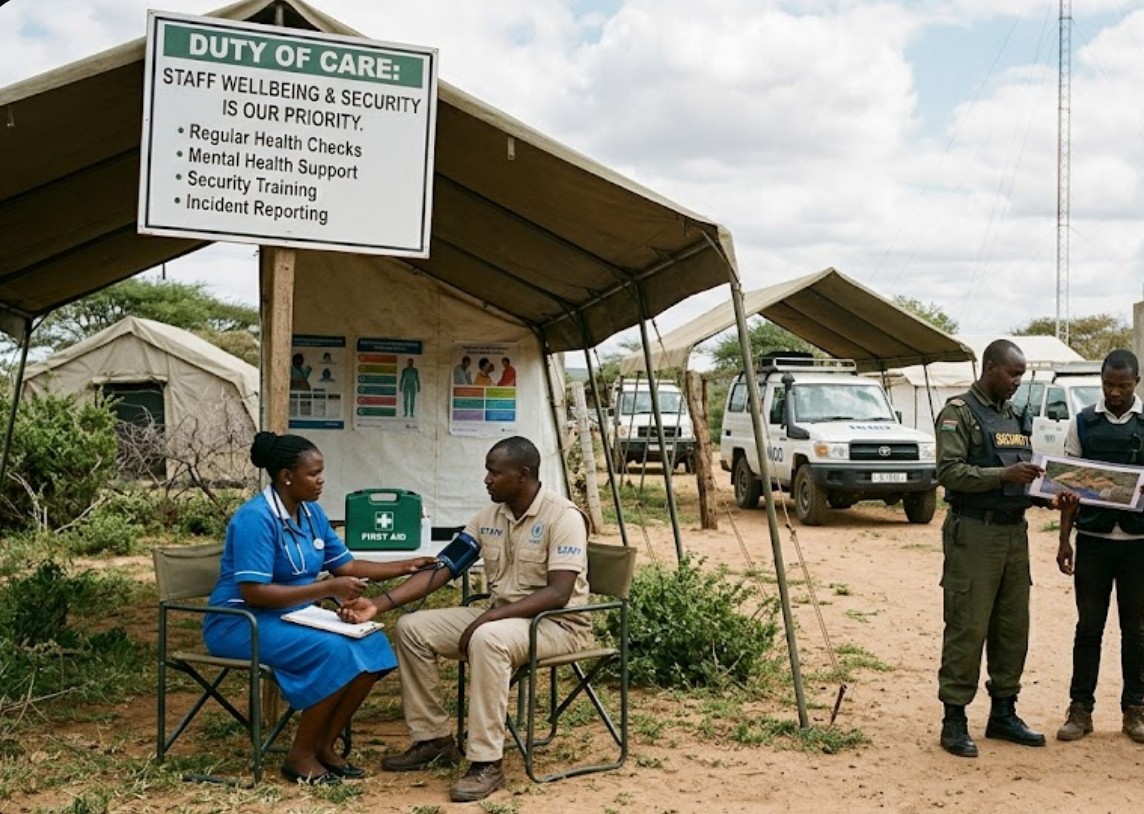
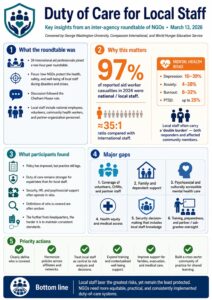
The roundtable at George Washington University’s Milken Institute School of Public Health, composed largely of NGO headquarters emergency coordinators—generated two major cautions about international response. First, although each NGO had developed new guidelines and standard operating procedures for Ebola‑type emergencies, there was no funding to package, archive, or preserve these materials for future use, and many were already being lost. There was no forward planning for how such lessons might be applied in future outbreaks, including today in the DRC. Second, although not on the agenda, participants volunteered that their organizations now have serious reservations about having responded at all, given the massive legal and duty‑of‑care liabilities they incurred. Donors urged NGOs to respond, but were unable to shield them from punitive audits afterward.
Key lessons about reducing transmission of Ebola in West Africa in 2014-2016 were published from a USG-commissioned evaluation which looked at all donors, UN agencies, NGOs, academia and other actors. The reports from that evaluation are linked below.
Four key lessons jump out from the research:
First, the aid response of separating family members with symptoms of Ebola had the unintended effect of discouraging honest reporting or referrals, such that the total official death count across West Africa was much lower than the true cause of death.
Second, what mattered the most in interrupting transmission was when local populations observed deaths of people they knew which led them to take seriously new changes in behavior (not touching the bodies of people wiht Ebola). This was the essential change that had to occur.
Third, much of the efforts overall by aid agencies had less of an effect in “bending the curve” of the epidemic than the simple communications by the families and communities affected.
Fourth, while many health professionals died early in the outbreak, attention to protecting them, including provision of protective gowns/gloves and equipment was necessary for further work to be achieved.
Food and Nutrition:
Food aid functioned less as a nutrition intervention and more as an enabler of disease control. Its main value was making isolation and quarantine viable. Qualitative data indicated that food distributions to isolation and treatment units, facilitated by Food for Peace (FFP), improved the effectiveness of isolation, quarantine, and response actions at community-based sites of transmission. FFP food distribution played a critical role in supporting isolation and restrictions on mobility, in response to warnings from implementing partners about food shortages among quarantined communities.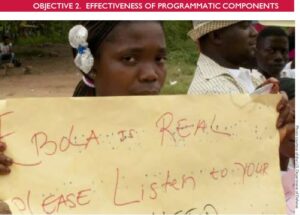
The scale was significant: through the end of 2014, USAID awarded nearly $35 million in food assistance to WFP through the Office of Food for Peace. Examples include WFP providing all patients discharged from the Guékédou treatment unit in Guinea with a 60-day food ration on leaving, and continuing general distributions of 45-day rations (rice, oil, pulses, salt) in affected communities.
The proportion of quarantined households that received food support was roughly similar across all three countries, between 60 and 70 percent. In Guinea, quarantined families with Ebola cases were more likely to have received food support in urban areas (89%) than in rural areas (53%), part of a broader urban bias the evaluation flagged in how supplies were targeted. Notably, the reports treat food almost entirely as rations/in-kind support for isolation; there is essentially no analysis of nutritional outcomes per se.
Behavior change
Behavior change was identified as one of the most decisive factors in bending the epidemic curve — arguably more than clinical capacity. The most effective USG-funded activities were nationally-led incident management and coordination, social mobilization, and safe human remains management; as OFDA scaled up community engagement — health education, household isolation, hygiene kits, community outreach, adapting safe burial practices, and involving local leadership — a downward trend in new cases is clearly seen in the data.
The substance of the behavior change effort was straightforward but hard to achieve: much of the social mobilization effort was oriented toward changing simple behaviors such as shaking hands, other physical contact, washing hands, and the handling of infected persons and dead bodies. The key lesson was sequencing — which donors under-prioritized at first. Whereas early priorities focused on facility-based responses, case isolation, treatment, and safe burial, donors and NGOs failed to prioritize social mobilization and community-level responses. Key lesson: social mobilization is the most relevant at the outset of the response. Aid agencies should hire and deploy anthropologists.
When trusted local actors led it, the payoff was fast: one Government of Guinea informant noted that within 1–2 months of accelerated social mobilization, the number of prefectures reporting social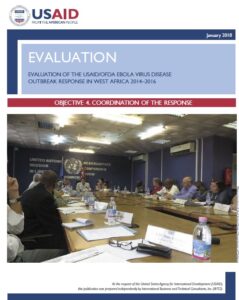 resistance dropped from 27 to 4.
A cross-cutting theme among evaluators were that while more than 90% of activity monitoring targets were reported as achieved, this reflected only activities and reveals little about actual change in bending the epidemic curve, a major limitation in analyzing the USG contribution.
These reports, led by the independent evaluation organization IBTCI were available on the USAID Development Experience Clearinghouse until a year ago when the Administration dissoved it. They are accessible via these links below:
Synopsis: https://www.worldhunger.org/wp-content/uploads/2026/06/Synopsis-of-Ebola-West-Africa-Evaluation.pdf
Coordination: https://www.worldhunger.org/wp-content/uploads/2026/06/Ebola-Response-Eval-4-Coordination.pdf
Effectiveness: https://www.worldhunger.org/wp-content/uploads/2026/06/ebola-ibtci-eval-effectivenes-1.pdf
Relevance: https://www.worldhunger.org/wp-content/uploads/2026/06/Ebola-evaluation-Relevance-of-response-3.pdf
A 2020 review of some selected lessons about the West Africa and DRC Ebola responses, largely non-medical, was commissioned by ALNAP here, focusing on community trust and messaging.
at the same time, ALNAP recommends these infection and control guidelines from WHO.
An earlier article about pandemics and hunger was published by Hunger Notes here. A Hunger Notes interview about Covid-19 and hunger also addresses these relationships.
See also the review about public health communication campaigns.
– Contributed by WHES trustee, Steven Hansch
 remain siloed within organizational systems and responsibilities, weakening crisis response.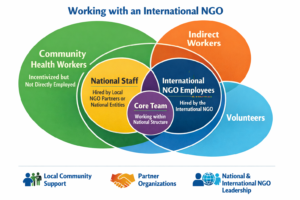
 The report also reports how: “disrupted services and disease outbreaks compounded by environmental change can threaten global health security, putting people at risk of health hazards both in countries where they occur and across borders.”