


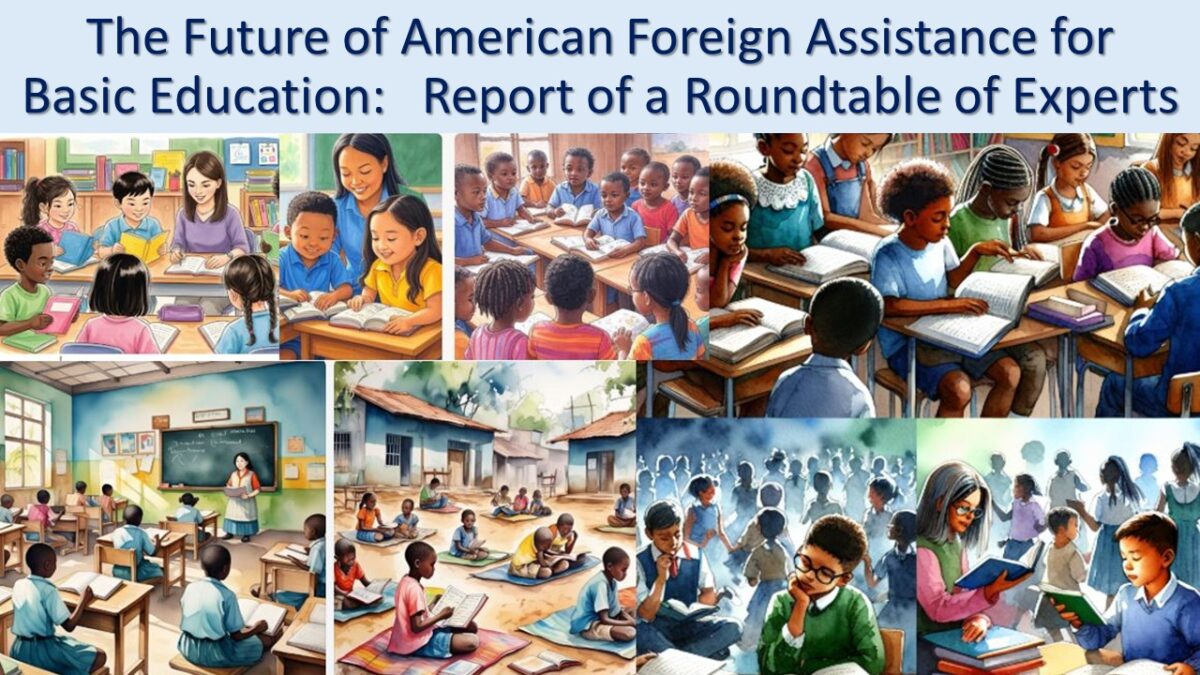
May 14, 2026 The Future of American Foreign Assistance for Basic Education was a roundtable held on June 12, 2025 among some forty-eight international education experts convened together over Zoom by the Global Coalition for Education-US, the Basic Education Coalition, the University of Massachusetts at Amherst, George Washington University, and the World Hunger Education Service (WHES) – the publisher of Hunger Notes.
It sought to chart a path forward for America’s assistance to child education in lower and middle income countries.
It was held in the context of a major disruption to America’s ongoing support to basic education around the world. The US had been the world’s largest bilateral donor for basic education, annually reaching over 34 million learners, training 2.9 million teachers, and distributing 174 million textbooks. Programs covered early grade reading, education in emergencies, disability inclusion, and teacher capacity building across more than 50 countries. The abrupt termination in early 2025 of 163 of 165 USAID education programs decimated implementing organizations, cost nearly 20,000 American jobs, and prompted parallel cuts by other donors including the UK.
US comparative advantages in supporting basic education: Participants identified early grade reading expertise, global field presence, strong higher education networks, convening power, catalytic leverage of donor funds, and leadership in evidence generation and Universal Design for Learning (UDL) as areas where the US stands apart.
Key recommendations for future aid looking ahead 5-10 years:
- Embed basic education within the restructured U.S. State Department programming for aid
- Shift further toward locally-led, government-owned programs rather than parallel systems
- Break down sectoral funding silos to enable whole-of-child approaches linking education, nutrition, and health
- Expand the timelines of individual programs to ten years to allow systemic change
- Invest in AI and technology while ensuring equity and accessibility
- Preserve and publicly catalog institutional knowledge at risk of being lost.
- Restore funding for education to FY2024 levels and comply with the Congressional READ Act
Participants agreed a follow-on roundtable should include voices from recipient-country governments and local organizations to complete the picture. In the meantime, the sponsors have been conducting additional research, field interviews with local educational organizations, and planning additional publications.
Download the summary report here.
UPDATE: From Aid On the Hill, July 28, 2026:
“Support for global basic education has long been bipartisan. Yet in 2025, the administration terminated 163 of 165 USAID-funded education programs, and its July 2025 rescission clawed back 100% of education funding appropriated that year. As of May 30, 2026, the U.S. government (USG) has only obligated $125.26 million of foreign assistance funding for education programs this fiscal year (FY.) $85 million has gone to Jordan and some funding has been disbursed among a variety of small Peace Corps projects, but most of the $691.5 million Congress appropriated for FY26 basic and secondary education seems to be unspent.
That’s a sharp contrast to FY24, when the USG obligated $1.48 billion for education overseas, $977 million of which was specifically dedicated to basic education. This is no small sum of money, but it is a relative bargain when you consider that the Fairfax County Public Schools approved a budget of $4.1 billion for FY 2027. For less than half of what it takes to educate the approximately 177,000 primary and secondary students enrolled in public schools in one Virginia suburb, USAID reached more than 36 million children and youth with foundational skills programs and formal and nonformal education programming in FY23, including more than 19.4 million young women and girls.
Education has long-term payouts. Each extra year spent learning foundational reading and math leads to an increase of 9 percent in lifetime earnings. Researchers estimate aid cuts could cost affected children $164 billion in future income. This is money that won’t circulate into local economies or buy U.S. goods. Increased schooling also correlates with lower rates of violence, including armed conflict. That’s especially urgent as an estimated 290 million students globally risk losing quality instruction due to donor pullbacks. During the pandemic, a single year of school closures cost students the equivalent of 1.1 years of learning—a preview of what funding gaps could mean, especially for students with disabilities, girls, and children in conflict zones. In December 2024, Congress voted to reauthorize the Reinforcing Education Accountability in Development (READ) Act with broad bipartisan support, including from then-Senator Marco Rubio (R-FL) alongside 80 other co-sponsors. Earlier this year, 110 members of the House of Representatives also signed a bipartisan letter in support of international basic education funding. The House’s FY27 bill still includes $691.5 million for basic education. Restoring U.S. funding to multilateral partnerships like the Global Partnership for Education and Education Cannot Wait, which serves children in conflict and disaster zones, would let the U.S. move money quickly to organizations with a track record of results—without foreclosing broader reform discussions. “
– The roundtable moderation, organizing and write-up by Steven Hansch of WHES


