
Summary of Aid Agency Roundtable Meeting about the Duty of Care of National Staff

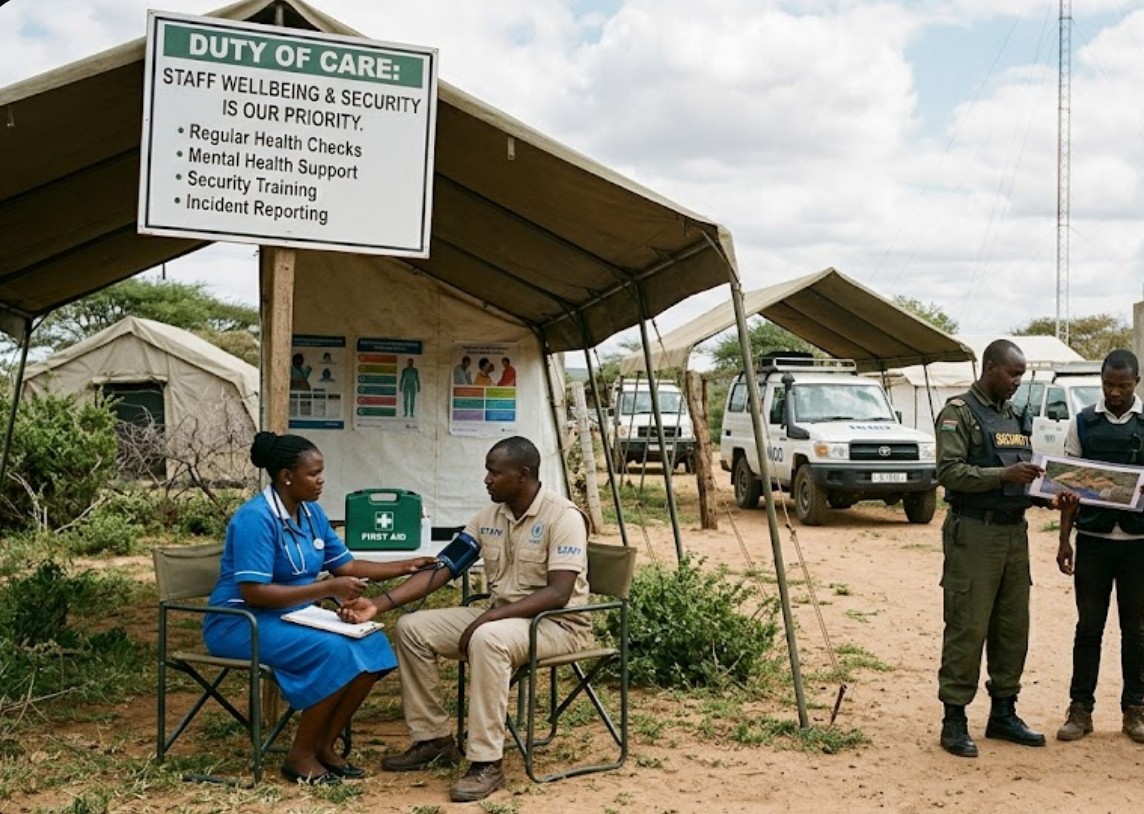
May 9, 2026       Increasingly aid agencies have argued for more decision- making, resources and active roles for “local”, or national, actors in aid programs, including food, nutrition and other development and humanitarian efforts.  At the same time, aid agencies have taken efforts to provide balanced “duty of care” (DoC) for local employees, partners, volunteers and their families during disasters.  But best practice standards remain unclear and there are many challenges, if not barriers, to achieving the goals of DoC across security, training, psychosocial care, rest and relaxation, legal support, relocation and other dimensions.

On March 13, World Hunger Education serivce (publisher of this online educational platform, “Hunger Notes”) partnered with Compassion International and George Washington University in hosting a roundtable of experts from two dozen aid agencies, for a two-hour open discussion to share lessons about DoC.

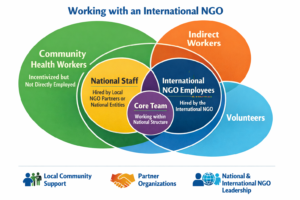
A central concern was the persistent gap between policy and practice. Local staff often work in dangerous environments, carry the “double burden” of being both responders and affected community members, and have limited access to evacuation, psychosocial support, family assistance, and equitable medical care. Participants also noted that security, HR, and wellness systems remain siloed within organizational systems and responsibilities, weakening crisis response.
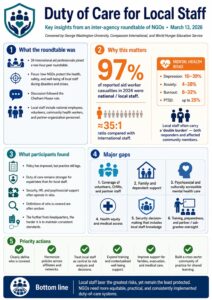
One participant said, “In disasters national staff deployed away from home are exposed to crisis contexts and deserve the same evacuation protections as international staff.”

The roundtable highlighted additional problems in federated NGO structures and sub-granting systems, where responsibility for partner staff is often unclear. Family support, remote work options during conflict, and coverage for indirect workers remain underdeveloped. At the same time, participants cited emerging improvements: more donor attention, growing mental health awareness, contextualized well-being frameworks, and some stronger onboarding and training models.

“Framing duty of care as mission-driven (not compliance- or HR-driven) is the key to getting executive support.”

Overall, the meeting concluded that NGOs need clearer definitions of who is covered, more equitable protections for local staff, harmonized policies, better training, and a stronger cross-sector community of practice

See this downloadable below: 

USAID Adds Value in Disaster Response, Says Former Hunger Notes Chair

Opinion piece from the former WHES Board Chair:   Most people do not realize what a huge mistake it would be to eliminate the United States Agency for International Development (USAID), as appears to be underway here in February 2025.  It would be like throwing the proverbial baby out with the bathwater.  I cannot imagine that either Elon Musk or President Trump are aware of full range of ramifications this elimination would have on the world.  If we as a nation eliminate USAID whole cloth, then all the disaster response and humanitarian efforts including the USAID Disaster Assistance (DART) teams would stop.  I know it has been said that the State Department will maintain emergency food and material aid.  In practical terms it is unclear how that can happen, when staff with institutional memory are gone, grant making ability is gone, and the  DART is gone.

I recently stepped down as Volunteer Board Chair from the World Hunger Education Service (WHES) Board.  WHES was started 50 years ago to inform the US Congress about international hunger issues and needs.  It widened its scope in the internet age beyond Congress to the public at large.

Prior to my role on the Board, I worked 23 years in USAID.  My USAID career was with the Office of U.S. Foreign Disaster Assistance (OFDA) within USAID. At OFDA, I initially served as a contingency planner and nutrition advisor then as a member of the Senior Management Team and Division Director for the Technical Assistance Division which included all the assistance sectors for disaster relief; Health, Pandemic response, Clean Water and Sanitation, Famine and Nutrition, Volcano and Earthquake risks, Floods and Storm risk, Pestilence, Shelter, Anti-trafficking in persons and Protection of Vulnerables.

Growth of Disasters

OFDA grew as post-cold war disasters and responses around the world became greater.  I was in Rwanda after the 1994 genocide, then DR Congo which had a internal war taking place as well as Sudan and Kosovo.  Historically, disaster assistance was modeled on refugee camps; including feeding, shelter, health care, and food distribution.  As internal wars increased, the global number of Internally Displaced Persons (IDPs) became greater than the number of refugees. As a result, humanitarian assistance became more dangerous and more complicated.  I was familiar with refugee assistance; before OFDA, I worked in Cambodian refugee camps on the Thai border; in Cambodia on health programs with World Vision, and the Red Cross and then in UN refugee camps in Congo during the Rwandan genocide.

Operational DART Teams

Until last week, USAID, through OFDA, funded many different non-governmental organizations (NGOs) like Catholic Relief Services, International Rescue Committee, and World Vision.  However, USAID, through OFDA, was also operational; it had the ability to send Disaster Assistance Response Teams (DART) to disasters.  The purpose of these teams was to report, to coordinate the US efforts and to fund humanitarian partners.  This was a much better model to keep an eye on the funds, literally in the field.

Another clear advantage was the DART also became a platform for coordination for the whole US Government.  As a DART team leader, I witnessed this on the DART during the Indian Ocean Tsunami in 2004; The US Navy, Marines, US Air Force reserve, Embassy Jakarta, and USAID all assisted there, in a coordinated effort.  The response dramatically changed Indonesian public opinion of the United States from negative to positive.

I also witnessed this on the 2014-15 DART when the DART platform was used to combat and eventually defeat the Ebola epidemic.  This involved US Centers for Disease Control and Prevention (CDC), USAID, Embassies in Liberia, Guinea and Sierra Leone and US Defense Department.

Ramifications

During this aid freeze, NGOs will go bankrupt.  The US Government was the largest single supporter of global disaster response and humanitarian efforts.  In my experience, it has always had bipartisan support, and goodwill from the House and the Senate. It would be a terrible mistake to continue down this destructive path.