
USAID Library of Project Reports and Evaluations Now Available from Third Parties

By: WHES Board (*Note this post was updated from its original Feb 18, 2025 version to add the two new pages with DEC resources.)


American Taxpayers often have questions about how funds for foreign aid work.  In early 2025 there has also been claims — and false information — by Congress and social media about an overall lack of transparency about this aid.

The primary or lead aid agency for the US Government is the United States Agency for International Development or USAID.  In tracking the tens of thousands of projects that have been funded, USAID has maintained a public, transparent, free, easy, searchable database, called the “Development Experience Clearinghouse”, or DEC.   Indeed, World Hunger Education Service has turned to the DEC many times in the last few decades to help provide educational content to the public.

The Development Experience Clearinghouse (DEC) is large database of several hundred thousand reports for sharing and accessing USAID-funded technical and program documentation, including reports, evaluations, studies, and other resources related to international development.   Most of the independent rigorous evaluations conducted of USAID activities can be freely download or read from this site.  In addition to serving as a historical record of USAID’s work, it also fosters knowledge sharing about American solutions to problems and technical advances between countries.  There is no comparably comprehensive, one-stop-shop source of information about development insights, for instance by the UN or in Europe or the UN.

Reports on the DEC are typically written by groups implementing programs overseas, including American nonprofits, universities, research groups and other independent specialists or front-line implementers summarizing their programs.

Ironically, during the January/February 2025 period of claims by some Congresspeople that USAID is not transparent, the new Administration shut down the DEC, so that it is no longer accessible for American citizens, including students or Congresspersons, to learn from.  No explanation was given about why the new Administration is blocking transparent access to details about USAID-funded programs.

However, two different independent groups have attempted to recreate the DEC (or at least portions of it) and make it available to the public for free again.

WHES Co-sponsors Roundtable About Aid Toolbox

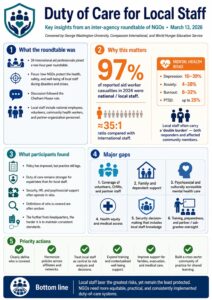
On June 19, 2025, a roundtable of two dozen experts about how international aid is designed and given will be held, co-organized by the World Hunger Education Service (WHES), the USAID Alumni Association, the Sanford School of Public Policy at Duke University, and George Washington University.

In order to advise and inform the future of U.S. foreign aid as well as for other international donors, the roundtable will compare the range of tools used to give aid, from grants and contracts to loans and investments, from incentives and prizes to insurance and direct technical assistance.   Also discussed will be the use of competition to make awards to NGOs or commercial organizations, the design of awards to achieve scale and sustainability, and the roles of evolving tools such as blended finance and payment-for-performance.

Participants will include former U.S. government experts plus aid managers from European governments, the World Bank, U.S. foundations and NGOs.

A summary of findings will be made public afterwards.

This is part of a series of roundtables that WHES has been involved in organizing this year, and educational seminars for senior US policy makers in the 1980s and 1990s.  Prior roundtables included expert discussions about food/nutrition, basic education, the role of faith-based organizations, health and what average Americans care about in aid.

Questions can be directed to:  WorldHungerEd@gmail.com

Prayer Vigil for Foreign Aid Unites Evangelicals for Aid

A prayer vigil for foreign aid was held March 11, among some 50 Christians, at the Capitol Hill Presbyterian Church, attended by Bread for the World, World Relief, Compassion International, Catholic Relief Services, the Adventist Development and Relief Agency, World Renew, Hope International, the Accord Network, and others.

Speakers called on Congress, the Administration and the American people to re-install aid programs serving the hungry around the world.

According to Ministry Watch:  Eugene Cho, president and CEO of  Bread for the World, denounced the “broad, un-targeted cuts” recently implemented at the U.S. Agency for International Development as an assault on vulnerable populations all over the globe.

The Impact of Unequal Wealth Distribution on Poverty Worldwide

September 29, 2019

While it is often said that more people were pulled out of poverty over the last century than in the whole history of mankind, there is still much work to do. Some numbers about Africa’s economy can seem encouraging at the surface level, but the harsh reality is that Africa still has some of the most unequal societies in the world. It is a continent still affected by political conflicts and corrupt governments. Let’s take a look at some of the effects of unequal wealth distribution worldwide, and what the prospects look like for the future.

Poverty in Africa is Decreasing, But Not Fast Enough

While some countries have had a renaissance, such as Rwanda or the Côte d’Ivoire, poverty on the continent remains very real, and out of the world’s poorest countries, 24 out of the 30 were located in sub-Saharan Africa.

One obstruction seems to be the huge gap between the immense wealth of a small group of persons and the rest of the population. Then there’s the specter of military conflict and rebel activity, often fueled by shadowy groups and old colonial powers.

Countries such as the Democratic Republic of Congo, where most of the world’s cobalt is produced, have been torn apart by conflict for decades. While the high demand for cobalt should have been a windfall for the impoverished country, a handful of warlords in highly disputed regions are the only ones benefiting from it, not to mention that political tensions are never good for foreign investment.

Africa is Not the Only Continent to Suffer from Poverty

South America, Central Asia, and various parts of Eastern Europe are also suffering from extreme poverty and inequality. As we can see on this map, the average income in countries like Afghanistan is below the $600 mark. This can be attributed to decades of conflict, the lack of infrastructure, and a lack of natural resources. The yearly income in Ukraine is also shockingly low at about $2,660, though the gap between the highest and lowest annual incomes is not as drastic there as it might be in other countries—a vestige of the old communist era.

What Are the Solutions?

The solution to the problem should eventually come from different parties. A long-term solution to poverty would be for foreign aid to focus on helping countries become more self-sufficient, through self-determination and development opportunities.

Infrastructure will also have to be improved, starting with roads and communications. Wireless has been a huge boon to Africa, and more people than ever have had the chance to get connected. This is in large part what has contributed to the sudden growth. Finally, leadership in these countries will have to be either pushed or forced to redistribute wealth and uphold the rule of law, either through sanctions or direct action. However, this approach could also lead to more inequality, as governments will often end up funding rebels who will then become the new financially elite, perpetuating the same cycle over and over again. One example would be Ortega in El Salvador.

The problem of poverty is a complex one. Aid efforts that give the impoverished increased access to education, financial mobility, more stable governance and better infrastructure should be given more attention. Much work still needs to be done, but there is still hope.


About the Author: William is a climate/weather enthusiast who takes a great interest in topics related to both climate change and weather. He graduated with a degree in chemistry from the University of Dallas. He is currently retired and lives with his family in Dallas, TX.

*This is an independent article and does not reflect the views of WHES.