
Ebola Control Lessons for DRC from Past Roundtables

June 18, 2026    The Democratic Republic of Congo (DRC) has long been a country of concern for conflict and hunger and remains a priority focus for U.S. and World Food Programme food assistance in 2026. Food insecurity in eastern DRC has been further aggravated by the latest Ebola outbreak, now the 17th recorded and the largest to date in terms of people infected.

The Adventist Development and Relief Agency (ADRA) is an example of an NGO that has been providing large scale food assistance in eastern DRC and has addressed the current and past outbreaks of Ebola with community education, hygiene promotion, and water, sanitation, and hygiene.

As described in the prior article of Hunger Notes, a lesson from the earlier West African Ebola outbreak was that self-isolation (self quarantine of people who may have been exposed to Ebola) was a critical measure to interrupt transmission, and, in turn, self-isolation depended on aid agencies providing ample food aid to compensate the family for lost income.   Today, the World Food Programme is doing the same thing, providing food aid to contacts and patients in DRC.

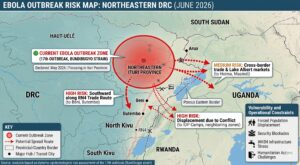
The map below shows the current spread, in 2026 of the virus, and possible future routes of spread.
In the West Africa outbreak there were 11,323 recorded deaths but probably over 30,000 actual deaths, where the majority of Ebola cases were never reported.  The United States Government alone spent some $2 billion on that earlier Ebola response.  The United Kingdom spent £667 million (roughly $850 million–$1 billion at 2014–2016 exchange rates), and the World Health Organization spent some $500 million.

The USAID evaluation of that outbreak response was commissioned by Jeremy Konyndyk, then Director of the Office of U.S. Foreign Disaster Assistance. Writing in the New York Times on June 13, he warned that the current DRC outbreak could become the worst ever.  He reports that the Centers for Disease Control and Prevention (CDC) projects that more than 20,000 cases may occur by late August. Konyndyk notes: “As bad as this situation is, we have a playbook for addressing such crises. But it requires a huge team effort.” He calls for specialized clinics, large‑scale contact tracing, safe burial management, and adequate personal protective equipment for health workers. However, he cautions that “security has deteriorated markedly as the government has lost control of large parts of the area.”

With clear relevance for the current global Ebola outbreak, a series of lesson‑learning roundtables were held in 2017 at George Washington University, Harvard University, and the Uniformed Services University of the Health Sciences. These discussions were part of a lessons‑learning evaluation requested by USAID and were intended to reflect on operational challenges during the West African Ebola crisis.  Each roundtable included seasoned emergency practitioners who had overseen or implemented programs in Liberia, Sierra Leone, and Guinea during the lethal 2013–2016 outbreaks.

The Harvard Roundtable concluded that the greatest challenges in the Ebola response involved trust, including community skepticism and occasional violence. One participant warned that “we are setting ourselves up for the same problems all over again.” Families were initially reluctant to cooperate with referral systems in which infected relatives were taken away with little explanation. As one participant noted, once treatment centers were introduced and communities saw that Ebola was not always a death sentence, and that patients could both enter and leave safely, community transmission began to decline. Another participant observed that promising “Community Care Centers” were denied or delayed funding unless the NGO also staffed a larger hospital. Others emphasized that faith‑based organizations were often more effective at face‑to‑face engagement with communities.
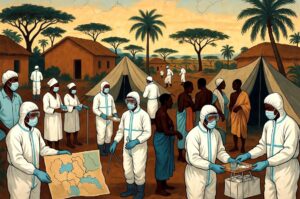
The 2016 lessons roundtable held with U.S. military representatives highlighted the indispensable role of the U.S. Navy’s Mobile Diagnostic Laboratories (MDLs) in West Africa. Operated by the Naval Medical Research Center (NMRC) in Guinea and Sierra Leone, these PCR‑based laboratories provided the only rapid diagnostic capacity early in the outbreak. The U.S. Air Force also played a critical role in airlifting doctors and epidemiologists across Liberia during the fall of 2014.

The roundtable at George Washington University’s Milken Institute School of Public Health, composed largely of NGO headquarters emergency coordinators—generated two major cautions about international response. First, although each NGO had developed new guidelines and standard operating procedures for Ebola‑type emergencies, there was no funding to package, archive, or preserve these materials for future use, and many were already being lost. There was no forward planning for how such lessons might be applied in future outbreaks, including today in the DRC.  Second, although not on the agenda, participants volunteered that their organizations now have serious reservations about having responded at all, given the massive legal and duty‑of‑care liabilities they incurred. Donors urged NGOs to respond, but were unable to shield them from punitive audits afterward.

See also:  https://www.worldhunger.org/ebola-lessons-from-2014-for-2026/

Ebola Lessons from 2014 for 2026

June 1, 2026     Germane to the current outbreak of Ebola Virus Disease in eastern DRC this month are lessons from the large humanitarian efforts to curtail transmission of Ebola in West Africa in 2014-2016.

The USG commissioned an evaluation of that response, which looked not only at USG response, but that of other donors, UN agencies, NGOs, academia and other actors.  The reports from that evaluation are linked below.

Four key lessons jump out from the research:

First, the aid response of separating family members with symptoms of Ebola had the unintended effect of discouraging honest reporting or referrals, such that the total official death count across West Africa was much lower than the true cause of death.

Second, what mattered the most in interrupting transmission was when local populations observed deaths of people they knew which led them to take seriously new changes in behavior (not touching the bodies of people wiht Ebola).  This was the essential change that had to occur.

Third, much of the efforts overall by aid agencies had less of an effect in “bending the curve” of the epidemic than the simple communications by the families and communities affected.

Fourth, while many health professionals died early in the outbreak, attention to protecting them, including provision of protective gowns/gloves and equipment was necessary for further work to be achieved.

Food and Nutrition:

Food aid functioned less as a nutrition intervention and more as an enabler of disease control.  Its main value was making isolation and quarantine viable. Qualitative data indicated that food distributions to isolation and treatment units, facilitated by Food for Peace (FFP), improved the effectiveness of isolation, quarantine, and  response actions at community-based sites of transmission. FFP food distribution played a critical role in supporting isolation and restrictions on mobility,  in response to warnings from implementing partners about food shortages among quarantined communities.
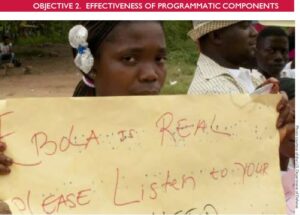
The scale was significant:  through the end of 2014, USAID awarded nearly $35 million in food assistance to WFP through the Office of Food for Peace.  Examples include WFP providing all patients discharged from the Guékédou treatment unit in Guinea with a 60-day food ration on leaving, and continuing general distributions of 45-day rations (rice, oil, pulses, salt) in affected communities.

 The proportion of quarantined households that received food support was roughly similar across all three countries, between 60 and 70 percent.  In Guinea, quarantined families with Ebola cases were more likely to have received food support in urban areas (89%) than in rural areas (53%),  part of a broader urban bias the evaluation flagged in how supplies were targeted. Notably, the reports treat food almost entirely as rations/in-kind support for isolation; there is essentially no analysis of nutritional outcomes per se.

Behavior change

Behavior change was identified as one of the most decisive factors in bending the epidemic curve — arguably more than clinical capacity. The most effective USG-funded activities were nationally-led incident management and coordination, social mobilization, and safe human remains management; as OFDA scaled up community engagement — health education, household isolation, hygiene kits, community outreach, adapting safe burial practices, and involving local leadership — a downward trend in new cases is clearly seen in the data.

The substance of the behavior change effort was straightforward but hard to achieve: much of the social mobilization effort was oriented toward changing simple behaviors such as shaking hands, other physical contact, washing hands, and the handling of infected persons and dead bodies. The key lesson was sequencing — which donors under-prioritized at first.  Whereas  early priorities focused on facility-based responses, case isolation, treatment, and safe burial, donors and NGOs failed to prioritize social mobilization and community-level responses.  Key lesson: social mobilization is the most relevant at the outset of the response.  Aid agencies should hire and deploy anthropologists.

When trusted local actors led it, the payoff was fast:  one Government of Guinea informant noted that within 1–2 months of accelerated social mobilization, the number of prefectures reporting social resistance dropped from 27 to 4.
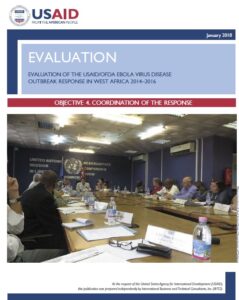
A cross-cutting theme among evaluators were that while more than 90% of activity monitoring targets were reported as achieved, this reflected only activities and reveals little about actual change in bending the epidemic curve,  a major limitation in analyzing the USG contribution.

These reports, led by the independent evaluation organization IBTCI were available on the USAID Development Experience Clearinghouse until a year ago when the Administration dissoved it.  They are accessible via these links below:

 Synopsis:     https://www.worldhunger.org/wp-content/uploads/2026/06/Synopsis-of-Ebola-West-Africa-Evaluation.pdf

        Coordination:  https://www.worldhunger.org/wp-content/uploads/2026/06/Ebola-Response-Eval-4-Coordination.pdf

        Effectiveness:  https://www.worldhunger.org/wp-content/uploads/2026/06/ebola-ibtci-eval-effectivenes-1.pdf

         Relevance:   https://www.worldhunger.org/wp-content/uploads/2026/06/Ebola-evaluation-Relevance-of-response-3.pdf

        Components:   https://www.worldhunger.org/wp-content/uploads/2026/06/Ebola-evaluation-vol.-2-effectiveness-of-components-2018.pdf

A 2020 review of some selected lessons about the West Africa and DRC Ebola responses, largely non-medical, was commissioned by ALNAP here, focusing on community trust and messaging.

at the same time, ALNAP recommends these infection and control guidelines from WHO.

Review of “Channeling Cassandra”

Dennis King’s new monograph, Channeling Cassandra, draws on his over 35 years of experience managing information about international humanitarian disasters, including his creation of ReliefWeb.com and overseeing USAID and US Department of State humanitarian information systems.

Published by the National Intelligence University, the monograph makes the important insight that while there have been endless gigabytes of humanitarian data and publications about information management, there has been relatively little on analysis, or interpreting data, particularly how evidence is used to make decisions.

This book refers to food aid as part of the response to crises of varying severity, and in response to food insecurity driven by climate change.

King asserts that “a keystone for improving humanitarian response is understanding complexity.”  He gives examples of how analysis of humanitarian needs and options require a multi-disciplinary lens.  He writes, “The problem is rarely a lack of information; it is the inability of decision-makers to process complexity and the tendency to prioritize political expediency over humanitarian early warning.”

“Humanitarian crises are non-linear systems where small changes in one variable (like a grain price or a local skirmish) can lead to catastrophic system-wide failures.”

King cautions against causation bias and linear-logic fallacies.  He distinguishes between descriptive analysis of humanitarian emergencies, explanatory analysis, evaluation, comparisons, predictive esimation and anticipatory analysis.

He encourages analysts to consider black swan events that are rare and unanticipated (such as pandemics), gray rhinos that are probable, yet neglected threats; “boiling frogs” that are slow-simmering crises that build in scale and harm; and “Dragon Kings” that are first-time events such as nuclear weapons, transational cyber-shutdown, sea level rise or a solar storm.

He views complexity as a growing problem in part because of accelerating climate change.  “Climate disasters are occuring in unexpected locations.  2023 alone saw tropical storm-induced flooding in Libya; wildfires in Hawaii, Canada and Greece, floods in Niger, drought in the horse latitudes of South America and heat waves in Europe.  Most unresolved armed conflicts have been ongoing for more than 10 years” and have displaced generations of refugees and internally displaced persons.

King utilizes several historical and contemporary disasters to illustrate the “Intelligence-Policy Gap.”

One section reviews applications of technology including information and communication (ICT), Geospatial analysis from remote sensing, and newer applications of artificial intelligence.

He recounts the 2004 Indian Ocean tsnumi, the 2010 Haiti Earthquake, and civil wars in South Sudan and Syria.

He examines how the Ebola outbreak in west Africa that became a priority in 2014 had siloed intelligence and interpretation (medical vs. security) that inhibited a more unified response.

King fears that “the humanitarian ecosystem has not adapted to these threats, challenges and actors…  this has led many to proclaim the international humanitarian system is both broke and broken.”

His recommendations are to adapt to complexity (monitor and adapt), facilitate decision-making, enhance alternative analyses and understand that technology can often introduce more noise than signal.

– Hunger Notes board member Steven Hansch

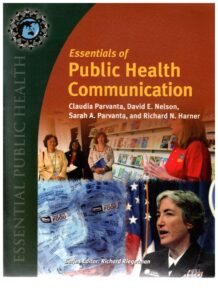
Essentials of Public Health Communication: A Valuable Book and Curricula

Around the world, a key shift during the past few decades in combatting malnutrition has been the adoption of social marketing, communications and “behavior change” to improve diets, caretaker behavior,  and recognition of failures in child growth.  The technical book, “Essentials of Public Health Communication” summarizes the state of the art in applying these tools in public health and nutrition.  Written by Claudia Fishman Parvanta, David Nelson, Sarah Parvanta, and Richard Warner.

Chapters walk the reader through implementation, with examples.  One example is the “Folic Acid First Campaign,” convincing women to take a multivitamin with folic acid (or a folic supplement) before they get pregnant.  Television, radio and print messaging should convey a sense of good health, warmth and energy to reduce the chances of birth defects in newborns.

Claudia Parvanta’s background in designing and evaluating health and nutrition social marketing programs in over 20 countries informs the text’s emphasis on using communication to influence dietary behaviors and address hunger-related issues.  The book references other nutrition-related initiatives, such as the Bangladesh Nutrition Education Project, to illustrate how strategic communication plans are developed and implemented in real-world settings.  It walks the reader through formative research methods, such as focus groups, to understand barriers to diet choices.

This 416-page text (published by Jones & Bartlett Learning) is divided into four major sections: Section One: Overview. Chapters 1, 2, and 3 provide an overview of public health communications, the planning, and informatics. Section Two: Informing and Educating People about Health Issues. Chapters 4 through 7 describe communication challenges and methods to provide information in a clear and unbiased manner.

The book analyzes how anti-vaccine content thrives online using emotive narratives and false expertise. It then contrasts this with proactive, empathetic communication strategies from health agencies, such as “pre-bunking” (inoculation theory) and engaging trusted community influencers (e.g., pediatricians, local mothers) as messengers.

The authors frame communication as a core public health function essential for prevention, behavior change, and policy advocacy.  Introduces behavioral and social science theories that guide message design (e.g., risk perception, social norms, diffusion of innovations).  The book includes discussion of media and channel selection and emphases  the 4 “P”s of Social Marketing, namely Product (the idea of being active), Price (reducing social/access barriers), Place (where tweens gather), Promotion (cool, aspirational ads).

Other case examples include the 2009 H1N1 Influenza Pandemic, the 2014 Ebola scare, and tobacco.  The “Truth” Campaign is described as an anti-tobacco campaign to illustrate audience segmentation and theory application. It didn’t target smokers with health warnings but segmented a new audience  i.e., teenagers, and used the Theory of Reasoned Action/Planned Behavior and empowerment models. The campaign framed tobacco use as a manipulation by big corporations, making rebellion synonymous with not smoking. This showcases moving from “knowledge-attitude-practice” to more sophisticated socio-ecological models.  A full chapter is dedicated to public health informatics which highlights how data systems, surveillance, and digital tools support communication planning and evaluation.

Apropos to its subject, the book reads easily for students and professionals and communicates its messages very well, using a mix of steps, examples, cautions and context.  The book has received very positive reviews, with a 4.5 out of 5-star rating on Amazon.  Reviewers praised it as an excellent resource for nutrition communications and for various types of public health communication work.  It remains the best learning resource in its category.  It is particularly required reading for anyone planning a public health campaign anywhere in the world.

David Nabarro, Nutrition Leader, Passed Away

Sir David Nabarro, a distinguished British physician, international civil‑servant, and global health visionary, passed away at his home on July 25, 2025, aged 75.  His legacy includes decades of transformational work in global nutrition, food security, public health and crisis response — marked by initiative, collaboration, and deep compassion.  

In 2010, Dr Nabarro was appointed the first Coordinator of the global Scaling Up Nutrition (SUN) Movement, uniting governments, civil society, donors, the UN, and the private sector in a shared mission to reduce undernutrition in the first 1,000 days of life.  As Coordinator of the SUN Movement, he worked closely with NGOs such as Action Against Hunger, Concern Worldwide, CARE, Helen Keller International, and others who were key partners in delivering community-level nutrition programs.  Nabarro said, in a Devex interview:  The creation of malnourished societies is an injustice, is itself an act of violence that is causing damage that is just going on for too long.”

Over his career, he led important U.N. aid responses such as for the 2004 Indian Ocean tsunami, avian influenza (2005–14), the Ebola outbreak in West Africa (2014–15), and the cholera epidemic in Haiti (2010).  As WHO Special Envoy for COVID‑19, from 2020 until his passing, he emphasized “precision public health” — promoting testing, isolation, and vaccine equity over blanket lockdowns.

  His international health colleague, Dr. Ron Waldman remembers:  “Nabarro has to be considered among the most important and most influential leaders of our time in global health.  It would be difficult to name all of his positions in a single sitting, but even though some of them were brief, he always had a major impact. He led WHO’s efforts on polio, malaria, Ebola, Covid, and disaster relief, among others.

“He was skilled diplomat, but never afraid to ruffle feathers when that would advance a righteous cause; he was a consummate technocrat, but always had innovative and creative ideas and was eager to put them on the table; he was a dreamer and a visionary, but also as much a goal-oriented, down-to-earth pragmatist as any leader could be.

“Dr. Nabarro’s leadership came from deep within, to be sure, but it was as much defined by the loyalty and devotion of his followers from all around the world and from every station, to whom he would never stop listening and from whom he would never stop learning.   He was a great man.”

 Nabarro championed collaboration across sectors, believing that “dialogue, collective and synergistic action” was essential for sustainable impact—an approach celebrated by the Micronutrient Forum, which lauded him as the “founding father of the Scaling Up Nutrition Movement.”   In 2018, Dr Nabarro received the World Food Prize as recognition of his outstanding leadership in maternal and child undernutrition.  In his acceptance speech, Nabarro explained “Nutrition is not just about food. It’s about changing societies, empowering communities, ensuring access to clean water, sanitation, and healthcare.”

     Peter Morris, the retired chair of World Hunger Education Service (publisher of Hunger Notes) recalls “David was a great soul. I remember the first time I met him he was already a legendary persona in the emergency and humanitarian world and very high-placed in the United Nations.  My first impression was how personable and genuinely interested he was in those he spoke to, and what they had to say. A most memorable time for me was when we were in Guinea at the same time during the 2014 Ebola Crisis.  I was the USAID Team Leader, and David was leading the UN actions.  We were on the same UN helicopter whose schedule had been late. “

      “We were up in the air when he was also scheduled to open a meeting via zoom in Europe.  The helicopter was a noisy Russian model yet instead of cancelling the opening, David via his mobile and earphones gave a speech from his webbed seating to a full meeting room without notes, concise, and clear, with great aplomb.  Meanwhile the rest of us were hanging on to the webbing in the helicopter, praying for a safe landing.”

Peter interviewed Dr. Nabarro for Hunger Notes for this article:  https://www.worldhunger.org/an-interview-with-david-nabarro/

The World Health Organization, where he was a senior leader for much of his career, described him as “a widely respected, impactful and loved champion of health, equity and disadvantaged people worldwide,” noting his kindness, mentorship, and readiness to support others in their careers.

Dr. Rick Brennan, who worked many years leading emergency responses at WHO remembers:  “David was one of the most visionary, practical, ethical, and compassionate people with whom I ever worked.  There are so many memories and examples of his extraordinary contributions to global health and humanitarian action.  In Darfur in 2004, we admired him for his determination to demonstrate to the world the scale, scope, and public health impact of the humanitarian crisis.  In Geneva in 2005, partners were amazed by his brilliant management of the first Global Health Cluster meeting – he was the chairman, main technical expert, and rapporteur, writing and projecting the discussions in real time. 

       “And I will always be grateful for his extraordinary support during the Ebola crisis – his encouragement of the WHO team during difficult times; his frequent and positive participation in our morning meetings in Geneva; and his humble, yet authoritative chairing of the Global Ebola Response Coalition.  I envied him for his strategic insights, technical smarts, political savvy, and ability to convey true compassion for the most vulnerable.  A unique man of great passion, and extraordinary personal and professional qualities.”

One of his most hands-on and influential contributions was the development of a simple, locally made height board—a tool used to assess stunting in young children, a key indicator of chronic malnutrition.  Early in his career, serving as the District Child Health Officer in Dhankuta District, Nepal, Dr. Nabarro recognized that many health workers lacked tools to measure child growth and malnutrition.  Deployed by Save the Children UK, Dr. Nabarro helped design and field-test a wooden height board that could be built locally, using simple materials and carpentry skills. The board included a sliding headpiece, a measuring scale, and was constructed to be durable, portable, and easy to use in rural health posts or during outreach clinics.

Dr Nabarro’s legacy is written not just in awards and positions, but in the millions of children saved through improved nutrition programs, the strengthened health systems through crisis response, and the global leaders he mentored.  

Other tributes: