
Review of “Channeling Cassandra”

Dennis King’s new monograph, Channeling Cassandra, draws on his over 35 years of experience managing information about international humanitarian disasters, including his creation of ReliefWeb.com and overseeing USAID and US Department of State humanitarian information systems.

Published by the National Intelligence University, the monograph makes the important insight that while there have been endless gigabytes of humanitarian data and publications about information management, there has been relatively little on analysis, or interpreting data, particularly how evidence is used to make decisions.

This book refers to food aid as part of the response to crises of varying severity, and in response to food insecurity driven by climate change.

King asserts that “a keystone for improving humanitarian response is understanding complexity.”  He gives examples of how analysis of humanitarian needs and options require a multi-disciplinary lens.  He writes, “The problem is rarely a lack of information; it is the inability of decision-makers to process complexity and the tendency to prioritize political expediency over humanitarian early warning.”

“Humanitarian crises are non-linear systems where small changes in one variable (like a grain price or a local skirmish) can lead to catastrophic system-wide failures.”

King cautions against causation bias and linear-logic fallacies.  He distinguishes between descriptive analysis of humanitarian emergencies, explanatory analysis, evaluation, comparisons, predictive esimation and anticipatory analysis.

He encourages analysts to consider black swan events that are rare and unanticipated (such as pandemics), gray rhinos that are probable, yet neglected threats; “boiling frogs” that are slow-simmering crises that build in scale and harm; and “Dragon Kings” that are first-time events such as nuclear weapons, transational cyber-shutdown, sea level rise or a solar storm.

He views complexity as a growing problem in part because of accelerating climate change.  “Climate disasters are occuring in unexpected locations.  2023 alone saw tropical storm-induced flooding in Libya; wildfires in Hawaii, Canada and Greece, floods in Niger, drought in the horse latitudes of South America and heat waves in Europe.  Most unresolved armed conflicts have been ongoing for more than 10 years” and have displaced generations of refugees and internally displaced persons.

King utilizes several historical and contemporary disasters to illustrate the “Intelligence-Policy Gap.”

One section reviews applications of technology including information and communication (ICT), Geospatial analysis from remote sensing, and newer applications of artificial intelligence.

He recounts the 2004 Indian Ocean tsnumi, the 2010 Haiti Earthquake, and civil wars in South Sudan and Syria.

He examines how the Ebola outbreak in west Africa that became a priority in 2014 had siloed intelligence and interpretation (medical vs. security) that inhibited a more unified response.

King fears that “the humanitarian ecosystem has not adapted to these threats, challenges and actors…  this has led many to proclaim the international humanitarian system is both broke and broken.”

His recommendations are to adapt to complexity (monitor and adapt), facilitate decision-making, enhance alternative analyses and understand that technology can often introduce more noise than signal.

– Hunger Notes board member Steven Hansch
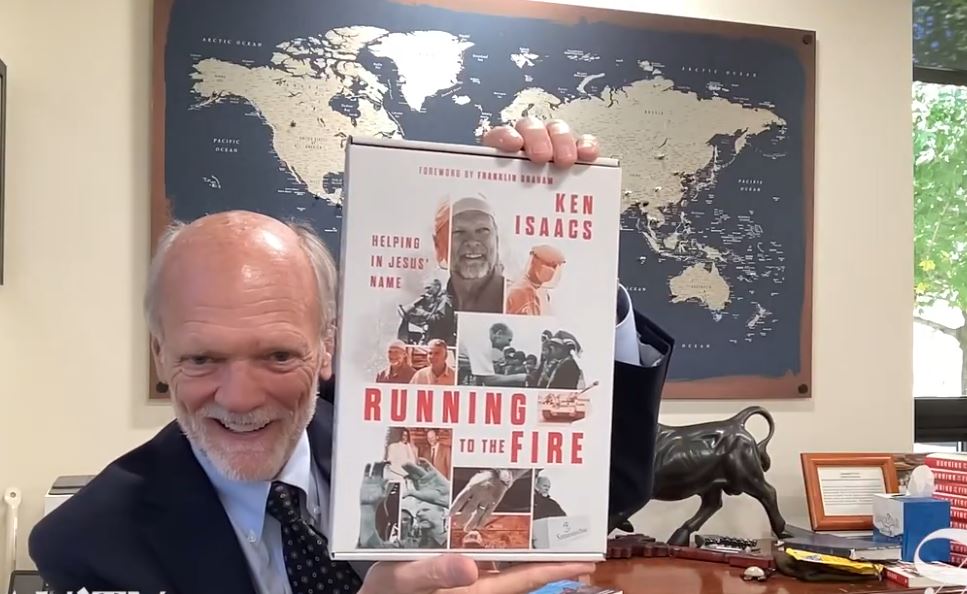
A Crucible of Courage: A Review of Ken Isaacs’ “Running to the Fire”

Ken Isaacs spent more than three decades with Samaritan’s Purse, rising to executive vice-president and helping turn Franklin Graham’s organization into one of the largest Christian relief agencies on earth. In Running to the Fire he recounts that journey through a series of crisply told, boots-on-the-ground stories: drilling wells in Marxist Ethiopia, delivering child “Christmas” care boxes in besieged Sarajevo, providing food aid and building 15,000 transitional shelters after Haiti’s 2010 earthquake, and negotiating with warlords across Sudan and Congo.

Isaacs is candid about the practical lessons learned the hard way: be radically transparent with any armed group, never promise what you can’t deliver, and—if you’re around people with guns—make friends fast.

Isaacs’ journey as a humanitarian worker is marked by a profound sense of purpose and an unwavering dedication to helping others.  The book is a testament to the power of faith in guiding one’s path and the impact that a single individual can have on the lives of countless others. Throughout the book he acknowledges the key roles of his colleagues and his wife and his faith citing inspirational biblical passages in each chapter.

Isaacs begins his story talking about inspiration from Gideon, the Apostle Paul, David, and others from the Bible who were men who thought in terms of what they could do, not what they couldn’t do. He credits his tendency toward having a nomadic lifestyle to his childhood going to different schools in different cities. Isaacs made his first trip to Africa to Togo in March 1985 as a volunteer drilling water wells. He was asked to take a job drilling wells in Ethiopia following the 1985 famine.

The book conveys the unpredictable, helter skelter bouncing around between countries and continents that marks the life of disaster relief workers.  Isaacs began working regularly for Samaritan’s Purse in 1988. In 1988 he hit the ground running on a new well drilling project owned by the Ethiopian Kale Haywat Church. Founded in 1927, the church is now its own denomination of 10 million members with headquarters in Addis Ababa. The immediate dilemma was working within the church’s structure to establish the program while having to liaison with the communist government that was oppressive to Christians.  “Quite the challenge” he describes.

He tells about the origins and population displacements during the Bosnia War of the 1990s.   He praises his colleague there, Dr. Mike Van Royen, who went on to set up the humanitarian program at Harvard.  Isaacs recalls the origins of the U.S.-based Operation Christmas Child Project, a successful program in Bosnia which Samaritan’s Purse later took over globally.

Following a letter from a missionary in 1997 to Franklin Graham, Samaritan’s Purse began organizing relief flights and supplies into South Sudan.  Sudan and South Sudan became one of the largest areas of aid for Samaritan’s Purse over many years.

Isaacs writes with a reporter’s eye for detail and a missionary’s heart for people. His prose is straightforward yet vivid, often weaving biblical reflection into practical accounts of logistics and survival.

While working in Afghanistan he learned about listening to local actors:  “I learned two principles from working in the region of the world. First, you always want to be transparent and let them know exactly who you are. Just be yourself and be the same to everyone. Second, if you’re around people with guns, it’s a good idea to try to make them your friends.  Do not be contentious. Which is why I had no hesitation to sit cross-legged on the floor to eat with the Mujahideen.”

In 2004, Isaacs moved to Washington, taking on the job overseeing the large Office of U.S. Foreign Disaster Assistance at USAID. He reflects, “I soon learned that Washington, D.C., is complicated, diluted, and highly inefficient. While I understood politics and complex power struggles, I wasn’t prepared for the politicization of humanitarian response.” After that assignment, he returned to Samaritan’s Purse as the overall Vice President for Programs and Government Relations.

Flying to Haiti after its 2010 earthquake, he recounts how quickly he was able to organize partnerships, rental of a camp for surgical care for earthquake victims after the 2010 earthquake. “One thing I learned later,” he says, “was that the sand most often used in Haitian concrete has a very high level of salt, which causes corrosion on the rebar inside the concrete, creating structural weakness. The obstacle wasn’t constructing shelters, but as our surveys had revealed, finding available land. We would request residency for 36 months. The next step was to set up a system of prefabrication utilizing a U.S. supply chain of pressure treated dimension lumber, specifically 2x4s.”  For reconstruction, Samaritan’s Purse devised a simple basic house plan of 12 feet by 12 feet. “The roofs would be 9 feet high at the front and sloped to 8 feet in the back for drainage. I am very pleased to tell you that 15,030 houses were constructed and set up.”
While Isaacs provides vivid descriptions of fieldwork, the memoir tends to gloss over failures and tensions within crisis response, limiting the reader’s exposure to the full complexity of humanitarian aid.  Yet it is a valuable primary-source record of what large-scale Christian relief looked like on the ground from the late 1980s through the 2010s, written by someone who was actually in the room (or the refugee camp, or the crashed helicopter) when decisions were made. Readers curious about the mechanics of emergency response—how you charter planes into active war zones, why Haitian concrete fails, or how a shoebox campaign scaled to 200 million children—will find plenty of nuts-and-bolts detail.  The book does not describe other aid agencies or provide systematic analysis of how aid could be improved, though he has recently been an advisor about humanitarian aid to the U.S. Department of State.

“Running the Fire” is not just a personal memoir; it is also a call to action. Isaacs’ experiences serve as a powerful reminder of the urgent need for humanitarian aid and the critical role that organizations like Samaritan’s Purse play in addressing global crises. The book encourages readers to reflect on their own responsibilities and the ways in which they can contribute to making a difference in the world.   In the end Isaacs wants the book to do two things: honor the national staff and local churches who do the real work, and prod comfortable Western Christians to “run to the fire” themselves.

– S Hansch, Hunger Notes Contributor / WHES Board Member

In South Sudan, mothers are so hungry many can no longer breast-feed

Weeks after the outbreak of deadly fighting in South Sudan, aid groups say their movement is being restricted by continued violence and government checkpoints, harming their ability to get food and medicine to severely malnourished children.  “We already have an extremely serious food-insecurity crisis,” said U.N. Emergency Relief Coordinator Stephen O’Brien in an interview. “And there are many circumstances where, appallingly, this only gets worse.”…O’Brien said that during a trip to South Sudan this week, he met with mothers unable to breast-feed their babies because they themselves were not getting enough food.