


This article explains how the long-term climate-related effects of cutting USAID are real in terms of actual dollar costs to countries, as well as other impacts, such as increased irregular migration, climate risks, endangered supply chains, humanitarian spending, and more.
Author: WHES Team
Scoop: State Department ends support for some food security programs

“The decision halts funding for initiatives that build resilience in chronically food-insecure regions — known as resilience food security activities or nonemergency food aid — which are designed to reduce chronic hunger and prevent future emergencies.”
Lesson Plans on Hunger and Food Insecurity

Lesson Plans on Hunger and Food Insecurity
As part of its mission to educate about hunger, WHES has put together an index of publicly available lesson plans on hunger and food insecurity. Whether you are a school teacher, a homeschooling parent, a daycare worker, a parent or guardian, or another type of educator, we hope you will find these resources inspirational in guiding the next generation. High schoolers or undergraduate students seeking to make class presentations may also find some of these resources useful.
Please do not hesitate to reach out to us at info@worldhunger.org if there are other resources you would like us to update this post with!
- The Hunger Gap. This is part of a larger lesson series by Johns Hopkins University. Students will consider how to define and measure hunger and food insecurity, examine community food availability maps, and explore interventions designed to improve food security. Level: High school or undergrad.
- Hunger and Food Insecurity: This lesson, also from Johns Hopkins University, is 90 minutes and covers the definition of food insecurity as well, but focuses more deeply on U.S. food insecurity, its history, and U.S. federal programs related to food insecurity. Level: High school or undergrad.
- Lesson Plan: Food Insecurity. This lesson from the Pulitzer Center focuses on global food insecurity, its definition, and its connection to journalism. While some of the stats are dated, much of the information is still relevant. Level: High School.
- Food Lesson: Food Insecurity. This civics lesson from Creative Commons is just over an hour and appropriate for middle schoolers. Like The Hunger Gap, it also talks about food insecurity, food deserts, and existing solutions but with more depth. Level: 6th, 7th, 8th grades.
- Hunger and Malnutrition: In this hour-long lesson from National Agriculture in the Classroom, students learn about healthy eating, diets around the world, and the scope of the problems of hunger and malnutrition using resources from the World Food Programme. Level: 6th, 7th, 8th grades.
- Global Food Insecurity: This lesson, also from National Agriculture in the Classroom, is two hours and explores the causes of hunger in the U.S. and globally. Level: High School.
- Debate Plate: Introduction to Food Systems and Choices and Cost and Access Debate Plate: Chili and Cornbread: These are two from a series by Edible Schoolyard. In the first, students read and discuss an article about a food cooperative in California as a case study. Students then analyze and discuss the intersections of health, environment, labor, economic inequality, and food access. In the second, students explore food access and the right to food. Level: 6th, 7th, 8th grades.
*Additional resource: While not a lesson plan or specific to food insecurity or hunger, the United States Department of Agriculture has teaching resources on nutrition for all ages on its Nutrition and Food Safety Education page, as well as links to external lesson plans. Younger children may enjoy learning about the food groups on MyPlate, which replaced the classic Food Pyramid of the past. Level: varies.
Food Assistance Outlook Brief
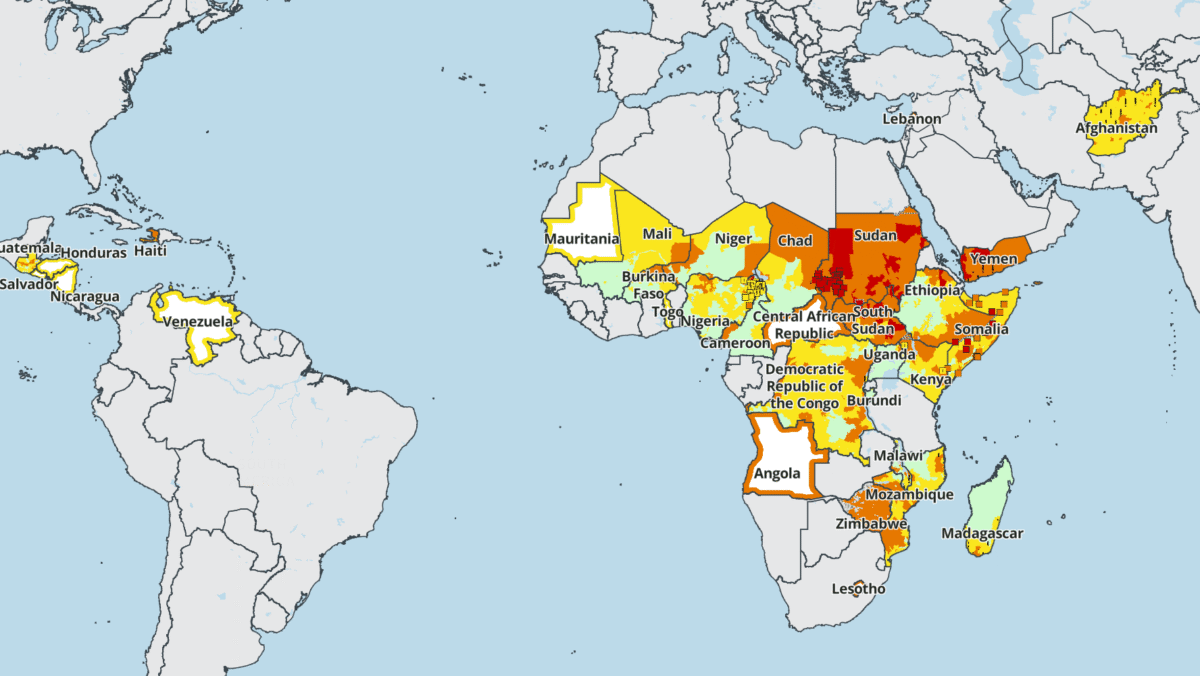
FEWS NET released their Food Assistance Outlook Brief for October 2025. The monthly outlook briefs provide country-by-country information on hunger hot spots as well as and global trends. This brief focused on Guatemala and Mozambique. You can also watch the recorded video of the free public briefing of the data from when it was released.
Past FEWS Briefings can be reached online https://fews.net/events/faob-registration
In Case You Missed It: “Without investment in innovation, volatility will send farmers like me backward”
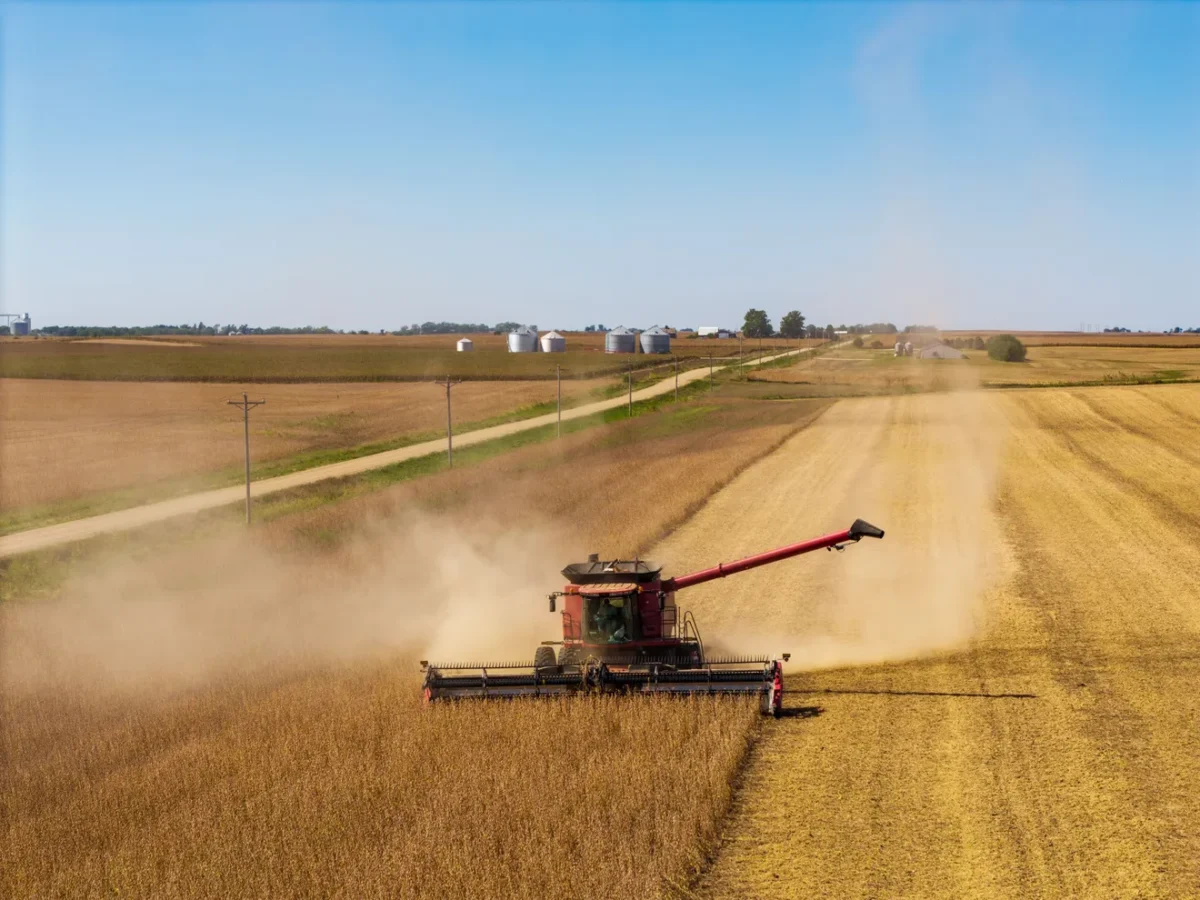
In an opinion editorial for the Des Moines Register second-year corn and soybean farmer Sarah Tweeten explores the pressures US farmers currently face including price drops, cost increases for equipment and inputs like fertilizer, trade uncertainty, debt, and the shutdown.
She notes, “it has been a roller coaster year for agriculture, and this volatility makes it difficult to plan for the future. The situation is especially challenging for young farmers like me, who are just starting out, since many of us have less access to capital, higher borrowing costs, and lower levels of land ownership than more established producers, which would help us ride out any impending storms.”
She points to some interesting opportunities to increase efficiency such as new technologies like drought-tolerant seeds, field-mapping, and even satellites. She explains how research and development in agricultural innovation benefits the US economy to the tune of a $20 return for every $1 in public funding. However, she also flags that “public investments in agricultural R&D have been shrinking for years, and this decline has been exacerbated by recent cuts to international research programs that have direct benefits for U.S. farmers. For example, numerous innovation labs based at land-grant universities across the country, formerly funded by the U.S. Agency for International Development (USAID) Feed the Future Initiative, have had to close their doors. While there has been some discussion about reopening them, their future remains uncertain. These labs had been conducting research on a wide range of issues to benefit both U.S. farmers and those abroad, on everything from improved varieties of soybeans and wheat, to livestock health, to solutions against crop pests and diseases.”
Read the full opinion editorial here to learn more.
Image: David Weaver harvests soybeans from a field near Rippey, Sept. 25, 2025. Zach Boyden-Holmes/The Register
-WHES
A Perspective from Cameroon: Hunger, Poverty, and Terrorism in the North
May 30, 2018
Hunger and poverty are similar concepts which have often been used interchangeably. Hunger is a state of disability or weakness caused by lack of food or the desire to eat. Poverty is the state of being poor. Hunger is one of the consequences of poverty. These are some of the greatest concerns known to common man today as almost 815 million people in the world are considered hungry or cannot boast of a proper meal a day.
Among this category, are some of the inhabitants of northern Cameroon, one of the poorest regions of the country and affected by droughts caused by the extension of the Sahara Desert. As a result, these people experience not only food insecurity but also water shortages. The continuous scarcity of basic human needs and the harsh climatic conditions in this region make these people vulnerable to disease, exploitation and terrorism.
In Cameroon, the main terrorist group is Boko Haram, which has found a haven in the northern regions of the country since 2012. Boko Haram has established several camps in northern Cameroon and also gathered many supporters and fighters, amongst whom are women and children. So many questions have been raised by citizens of Cameroon as to why young men, women and even children become recruited by such a dangerous terrorist organization. The most common answer received is that it is an Islamic organization and most of the inhabitants of northern Cameroon are Muslims, but the reality is much more complex. After some research, it was discovered that other factors push the inhabitants of this area to join this terrorist group.
Poverty, hunger and lack of basic human needs are the greatest factors pushing the inhabitants of northern Cameroon to join this group. First and foremost, this is one of the poorest regions in the country. Here, the inhabitants suffer food insecurity, harsh climatic conditions (a very harsh sun and high temperatures), desertification, water shortages, poor health facilities, unemployment, and high illiteracy rates. Most of the inhabitants feel inferior and marginalized as they expect more from the government which is never realized. On the other hand, poverty and hunger has been used by the Boko Haram terrorist group to recruit more people. Their recruitments are seen by the poor and jobless youths as employment opportunities. Most are recruited to serve as soldiers, cooks, porters and spies. This is accompanied by a good salary which is used to provide food and support families. Food is also used to attract hungry children who are used as suicide bombers.
Mercy Corps, in their article entitled “Inequality and Grievances Central to Boko Haram’s Recruitment of Youth,” investigated motives of youth joining Boko Haram. Their findings revealed that, some youths are lured with loans, financial support and promises of business loans in exchange for their membership.
Another dimension worth examining is that Boko Haram has also contributed to an increase in poverty and misery in northern Cameroon. As a result of their activities, many people have lost their lives especially men and young boys who are breadwinners in their families, leaving behind widows and children who are currently living in abject poverty and misery. Homes and property have been destroyed, livestock and crops have been lost, and many people have been internally displaced. It has also contributed to the collapse of businesses as some of their members are involved in looting. All these activities leave people in hunger, poverty and misery.
In sum, hunger and poverty are very important concepts that need urgent measures as it has severe consequences on peace, security and development. If everyone has enough to eat and is free from the state of being in need, the world will be more peaceful and secured as there will be no struggles or rivalry over scarce resources for survival. Poverty and hunger are sources of major conflicts that plaguing most developing countries today as it leaves most people angry and dissatisfied. It is often said that, “a hungry man is an angry man.” States are hereby called upon to devise more strategies to alleviate poverty and more measures to ensure the enjoyment of the right to food and freedom from want as a way of preventing conflicts in the world.
References
Mercy Corps, “Inequality and Grievances Central to Boko Haram’s Recruitment of Youths,” 2016, available at http://www.mercycorps.org. Accessed on the 25 of May 2017, 7pm.
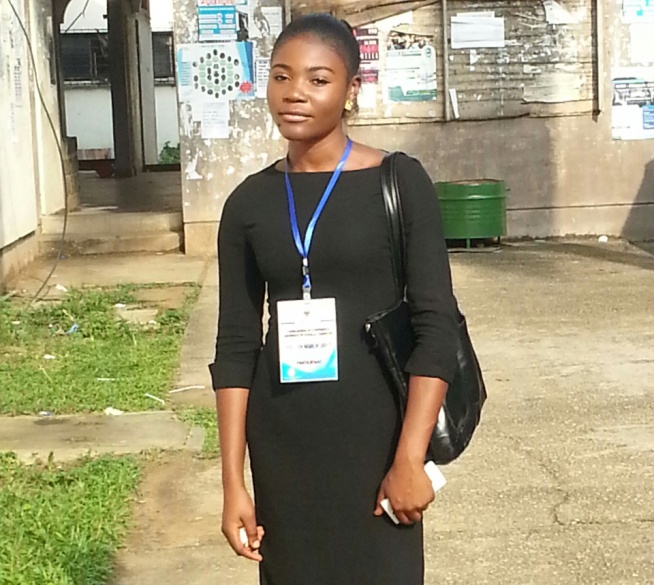
Author Biography: Nkwain Adeline Yafi is a Cameroonian writer. She holds a Double Bachelor’s Degree in Women and Gender studies and law and is currently in her final year as a Masters student in Peace, Conflict and Security at University of Buea in Cameroon. Poverty alleviation has always been her passion as it is one of the biggest concerns in the world today. She has particular interest in studying vulnerable groups, like women, children, the elderly, prisoners, people with disabilities and minority groups, who are the most affected by poverty and hunger. Adeline has served in several organizations like Women in Action against Gender Based Violence, The Social Centre (Ministry of Social Affairs, Cameroon) and Human is Right.
*This is an independent opinion editorial and does not necessarily reflect the views of WHES.
With bees on the brink, World Bee Day seeks to raise awareness

Organizations across the globe on Sunday marked the first-ever World Bee Day launched by the UN to raise awareness about the fate of pollinators.
Over the past decade, bees and other pollinators have witnessed a steady decline, with experts blaming several factors, including insecticides, climate change and disease.
Save the bees! Lawmakers join the battle to save pollinators

A pair of Michigan lawmakers introduced bills last week that aim to protect bees and other pollinators that are crucial to Michigan’s agriculture industry. (May 20 is #WorldBeeDay.)
This App Delivers Leftover Food To The Hungry, Instead Of To The Trash

Goodr has created an ap that has diverted nearly a million pounds of food in Atlanta from landfills–and into kitchens. Goodr is a food-waste management company that redirects surplus food from businesses to nonprofits that can share it with those who are food insecure.
Hunger: The brutal reality
Useful op ed for young people trying to understand what global hunger is and why it exists.
