
United States Cancels Household Food Security Report

In the United States, domestic hunger has been surveyed annually by the United States Department of Agriculture, or USDA, since 1995.  For 30 years, the USDA’s Economic Research Service has measured the level of food insecurity among U.S. households.

On September 20, 2025, the USDA announced that they are cancelling the Household Food Security Reports, meaning the 2024 report will be the last under the current format.  In its announcement, the U.S. administration stated they were cancelling the survey because “These redundant, costly, politicized, and extraneous studies do nothing more than fear monger”.   Additionally, the announcement indicated that “trends in the prevalence of food insecurity have remained virtually unchanged…between 2019 – 2023”

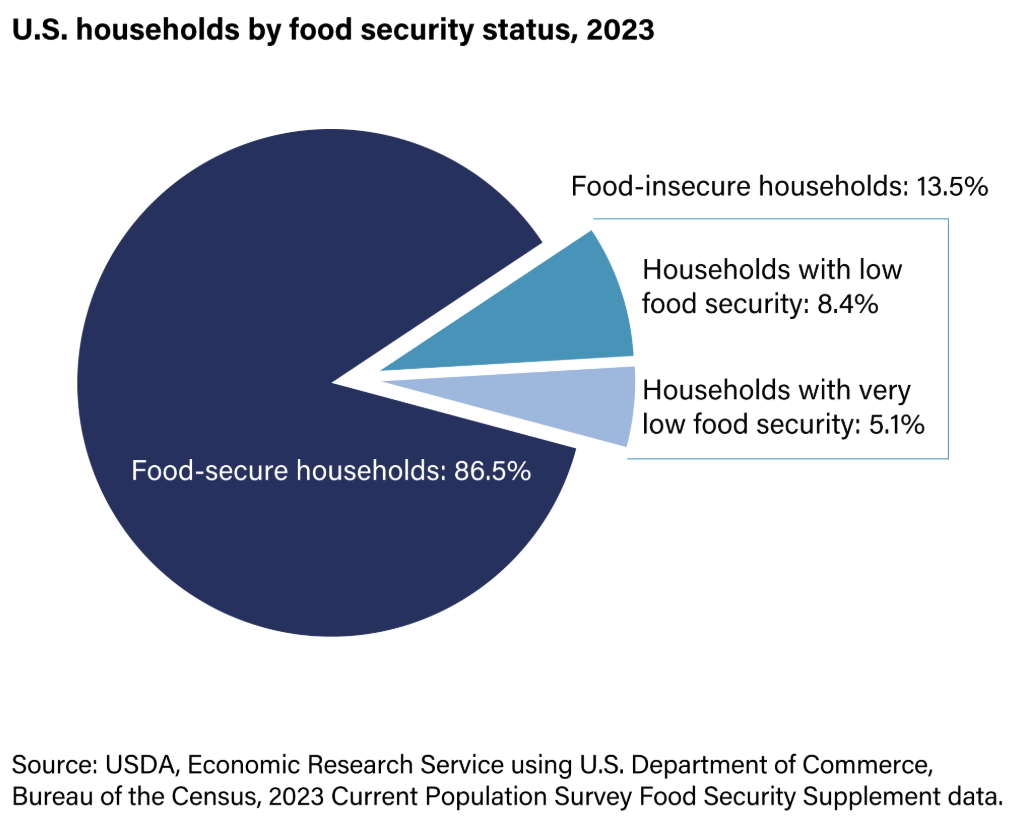
However, according to the USDA Household Food Security Report of 2023, food insecurity has been on the rise since 2020.  Across the 4-year period, the prevalence of food insecurity (those with low and very low food insecurity) among US households rose from 10.5% in 2020 to 13.5% in 2023, an increase of just less than 5 million households – representing 47.5 million Americans.  The same trend is seen with the prevalence of households with very low food security rising from 3.9% in 2020 to 5.1% in 2023, representing 1.7 million households.  According to the USDA, the definition of a food insecure household is one which had difficulty at some time during the year providing enough food for all their members because of a lack of resources.  A household with very low food security was one in which the food intake of some members of the household was reduced, and normal eating patterns were disrupted at times during the year because of limited resources.

The cessation of this report occurs at a time when the USG’s 2026 federal budget expands the work requirements for those receiving Supplemental Nutrition Assistance Program (SNAP) benefits.  According to the U.S. Congressional Budget Office, approximately 6% of beneficiaries, or 2.4 million Americans could lose benefits because of these changes to the law.  The loss of this key data source will likely make it more difficult to understand the scale of food insecurity in the U.S.

Various food security policy, advocacy and research experts are arguing that the cancellation of this annual survey will result in the loss of a significant data source that is used to inform policy on how to combat food insecurity in the U.S..  For example, Bread for the World issued a press release urging USDA to reverse the decision.  They argued that the survey/report has been foundational for understanding how families experience food insecurity, especially children, and for making evidence-based policy decisions.  The Food Research and Action Center criticized USDA’s decision as “shortsighted” and warned that eliminating the report hides the struggles of millions of families. They emphasized the importance of data in assessing policy impacts (e.g. SNAP cuts).
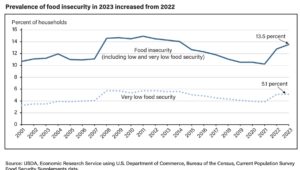
Ending the USDA Household Security Report eliminates one of the few consistent measures of household hunger at a time when food insecurity data is more important than ever. As Megan Lott, a food policy researcher, notes, “the report is an irreplaceable tool for assessing how policy decisions shape families’ lives.”   Protecting robust food insecurity data is not just a technical question, it is a matter of public accountability and an investment in evidence-based policymaking that prioritizes the well-being of households nationwide.

Update: Independent news sources indicated that the final set of data for 2024 would be released in part or whole on October 22, 2025, which has not yet happened.  The U.S. government was shut down from Oct 1-Nov 12.  Watch this space for additional updates.

References:

1. USDA Press release, “USDA Terminates Redundant Food Insecurity Survey September 20, 2025” https://www.usda.gov/about-usda/news/press-releases/2025/09/20/usda-terminates-redundant-food-insecurity-survey

2. USDA Economic Research Service, “Household Food Security in the United States in 2023”
https://ers.usda.gov/sites/default/files/_laserfiche/publications/109896/ERR-337.pdf?v=33413

3. Congressional Budget Office Congressional Budget Office, “Estimated Effects of Public Law 119-21 on Participation and Benefits” August 11, 2025 https://www.cbo.gov/system/files/2025-08/61367-SNAP.pdf

4. Bread for the World Press Release “Bread Urges the USDA to Retain the Annual Food Security Survey and Report” September 23, 2025. https://www.bread.org/article/bread-urges-the-usda-to-retain-the-annual-food-security-survey-and-report/

5. Food Research and Action Center Press Release “USDA’s Decision to End 30-Year Food Security Report Will Hide the Struggle of Millions of Families to Put Food on the Table” September 23, 2025
https://frac.org/news/foodsecuritysurveyterminationsept25

6. Douglas, L. (2025, September 22). Impact of Trump cuts will be harder to track without USDA hunger survey, advocates say. Reuters. https://www.reuters.com/business/healthcare-pharmaceuticals/impact-trump-cuts-will-be-harder-track-without-usda-hunger-survey-advocates-say-2025-09-22/

7. Datz, Todd. “Cancellation of food insecurity survey a blow to understanding hunger in U.S.” Harvard Crimson. October 16, 2025. https://hsph.harvard.edu/news/cancellation-of-food-insecurity-survey-a-blow-to-understanding-hunger-in-u-s/
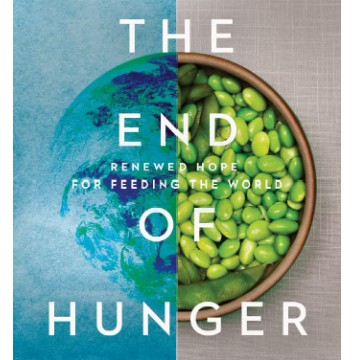

The End of Hunger — Essays by Leaders

The Anthology, The End of Hunger:  Renewed Hope for Feeding the World  (2019, Illinois:  InterVarsity Press), includes 29 short, readable chapters about the problem of hunger, early childhood nutrition needs, and recommendations for the future, with vignettes included of Nepal, Uganda, Malawi  and Mexico.  Many of the chapters draw on Biblical references, reflective of the faith based backgrounds of many the book’s authors.  The book also includes a helpful glossary of terms  and links to the websites of relevant non-profits.

Among the several dozen authors, former Congressman Tony Hall recalls visiting famine camps in Ethiopia in 1984, which changed his life, career and goals.  He recounts his 21 day fast in the early 1990s when the Congressional Select Committee on Hunger was de-funded.  He was surprised at all the people influenced by his fast, which also led to the creation of the Congressional Hunger Center, the nonprofit which operates today.

Former Direct of of the World Food Programme, David Beasely, writes how hunger in the world is closely associated with conflict:  “Conflict drives ten out of the thirteen largest hunger crises in the world.  Sixty percent of the world’s hungry live in conflict zones.”

Roger Thurow writes how “the effects of malnutrition and stunting steamroll through the generations in an accumulation of historical insults:  stunted girls grow up to be stunted women, who give birth to underweight babies who themselves are stunted.  And the vicious cycle grinds on.  The ripples from stunting then engulf the community at large.”

Kimberly Flowers of CSIS notes that “Life-saving humanitarian efforts are often the first step in responding to fragile countries that don’t have the kind of stability needed for investments in long-term agricultural growth.”

Countering the gloom, Will Moore of the Eleanor Crook Foundation writes of the incredible progress achieved in reducing the numbers of annual child deaths between 1960 and today.  “Thanks to improvements in housing, sanitation and water quality, the advent of scientific medicine, the development of low-cost vaccines, and huge leaps in agricultural productivity and nutrition, the survival of your child today is no longer a coin flip…. Unfortunately, our media is infatuated with reporting only the many events where things go wrong and does not shed light on the broader, steady upward trend in global development, human health and living conditions.” 

Kimberly Williams-Paisley writes about providing food and dignity and remembers how she “loved Meals on Wheels because it was a great way to get to know the people I was serving.”

Former CARE CEO Helene Gayle writes about partnerships and gives examples about agricultural improvements.  She cites “programs such as the Alliance for a Green Revolution in Africa… which is funded through a partnership between the Rockefeller Foundation and the Gates Foundation.”

Pastor David Beckmann writes that “the binding constraint on progresss against hunger is the lack of sufficient political will.”  He explains how the nonprofit Bread for the World mobilizes 2.5 million volunteers and five thousand churches who have helped sensitize Congress to supporting nutrition programs.  Diane Black talks about the Evangelical Lutheran Church in America’s approach to conferring skills to people to feed themselves.

Former U.S. Senate Majority Leader William Frist recounts how “our remarkable scientists got to work and developed powerful life-saving anti-retroviral drugs.  In Africa, infected teachers and workers regained their health to build stronger and more secure communities.  In Botswana, for instance, life expectancy jumped from thirty-nine years to sixty-seven.”

Editor of this volume, Jenny Eaton Dyer, summarizes that “we are halfway to defeating extreme povery and disease worldwide.”  She explains the recent emphasis on addressing nutrition during any child’s first 1,000 days of life.  She concludes that “we need to reconsider nutrition, its importance in the Sustainable Development Goals, its critical role in addressing global health and development and the amount of funding we as a nation are willing to spend to end hunger and malnutriton worldwide.”

The Regenerative Agriculture Solution – a Review

October 1, 2025    By Jim Phillips     The Regenerative Agriculture Solution by Ronnie Cummins and Andre Leu makes a compelling case for regenerative agriculture as a pathway to improving food production, sequestering carbon, and restoring soil health. The book focuses heavily on the Agave model used in Mexico and other arid regions.  Written in 2024, it opens with the story of how this approach began in Mexico, narrated by Ronnie Cummins, who also contributes the closing section. The remainder, authored by Andre Leu, broadens the scope by presenting examples beyond the Agave system and analyzing how different regenerative models enhance carbon sequestration, soil vitality, and agricultural productivity.  The Vía Orgánica Agroecology Center in the drylands of Mexico includes olive trees, pomegranates, mulberry trees, and other cover crops that thrive via precise cistern-fed drip irrigation.

Historically, livestock have been scarce in this region due to the difficulty of maintaining feed supplies in such dry conditions.  This changed when Dr. Juan Frías of the agroecology center began experimenting with agave as livestock feed.  Traditionally, agave leaves have been inputs to alcoholic beverages. In the regenerative system, however, the leaves (pencas) are chopped using a tractor’s power takeoff and fermented anaerobically in sealed containers to produce silage.  This provides a sustainable feed source in arid regions where forage is scarce.

One case study highlighted is Hacienda Zamarripa Ranch, a sheep and goat operation where agave is interplanted with nitrogen-fixing acacia trees. These trees are planted along contour lines to prevent erosion, stimulate pasture growth, and capture rainwater in the soil. Their deep roots also make them naturally drought resistant, creating a complete regenerative system.

The book places these practices in the wider context of climate change, arguing that many conventional adaptation strategies are inadequate. It defines regenerative agriculture, provides historical context, and outlines its diverse applications. While the Agave model is discussed in depth, the book also touches on a broader set of regenerative strategies, including long rotations, cover crops, green manures, legumes, composting, and organic fertilizers. Though covered more briefly, these approaches share a common philosophy: replacing monocultures with diverse, perennial plant-and-animal systems that restore soils and build resilient agroecosystems.

Among the agroforestry and land management practices described are:

  •     Adaptive Multi-Paddock (AMP) grazing – rotating livestock to prevent overgrazing.
  •     Pasture cropping – planting crops directly into perennial pasture rather than bare soil.
  •     Holistic planned grazing – managing livestock movement to regenerate biodiversity.
  •     Alley cropping – growing crops between rows of leguminous trees.
  •     No-kill/no-till systems – using mulch and, compost, with crop rotations to build soil health and break pest cycles without tillage or chemical inputs.

The authors highlight successful examples from around the world where regenerative approaches have boosted biodiversity and improved livelihoods. Still, as with many books on regenerative agriculture, this one would be strengthened by more direct comparisons—both ecological and economic—between regenerative systems and conventional industrial monocultures. For instance, side-by-side data on soil organic matter or profitability would help readers better grasp the tangible advantages of regenerative farming.

for further reading about regenerative agriculture see an earlier Hunger Notes article, https://www.worldhunger.org/regenerative-agriculture-to-mitigate-hunger-thurows-latest-book  

Regenerative Agriculture to Mitigate Hunger: Thurow’s Latest Book

Jim Phillips is a member of the board of World Hunger Education Service

The Passing of William Garvelink, Food and Disaster Leader

September 10, 2025      William Garvelink, from Falls Church, Virginia, who led how US aid could go to persons displaced within their country’s borders, passed away this August 23 unexpectedly.  Known to all as Bill, he studied Latin American history and dreamt of being a university professor before getting work at the Department of State in emergency response.  As colleague Dr. Joe Barbera (Professor of George Washington) reflects, “He ended up creating history, not just teaching it.  He pushed the bounds of humanitarian assistance in ways that were critically important.”

Historically, United States (US) aid to refugees who have crossed borders was managed by the U.S. Department of State where Garvelink worked before moving to USAID, where he pioneered new approaches to assistance to internally-displaced populations.

Garvelink often told the story of how, in 1988, the US Government was failing to assist NGOs working in the Sudan.  Eventually, USAID’s Office of US Foreign Disaster Assistance (OFDA) received the go-ahead to bypass diplomatic concerns from Deputy Secretary of State Lawrence Eagleburger who said “Don’t ask permission, just tell (Sudanese President) Bashir and the SPLM that you’re going to provide humanitarian assistance.”  Garvelink recalled “We broke through war lines because people were starving. That was the only calculation that mattered.  That changed everything,” recalled Garvelink. “That’s how humanitarian assistance has been provided ever since.”

In 2010, Garvelink became the first head of USAID’s $3.5 billion/year “Feed the Future” initiative, a new USAID flagship global food security and agriculture program.  He brought to this job a background of leading U.S. disaster assistance teams in countries fighting food crises, Somalia, Rwanda, and beyond, as well as helping launch Operation Lifeline Sudan, a groundbreaking effort to deliver food across conflict lines.  He said “Food security is not charity. It is the foundation of stability, dignity, and peace”.

Disaster field expert, Kate Farnsworth recalls: “Bill was a creative humanitarian and a supportive supervisor. He always saw possibilities for a principled humanitarian response, even in the midst of complex scenarios as in Sudan, Somalia, and Rwanda.  While he was an expert in working the bureaucratic system in Washington and on the Hill, those of us in the field saw how he enjoyed being on the ground and we knew that when Bill arrived on the scene there would be a breakthrough in whatever challenge we were facing.  With his tireless, engaging conversational, down-to-earth style, he endeared himself to donor colleagues, UN, NGOs, and ICRC workers, local communities, governments and “non-state” actors and in short order would develop a plan of action that everyone could buy in to. Even after he left fulltime work, we stayed in touch and I enjoyed reconnecting with him to review old experiences and discuss current humanitarian issues. His passing is the end of an era.”

Disaster shelter expert Chuck Setchell recalls: “Bill was my first supervisor when I began working at the OFDA in 1998.  Behind his genteel demeanor was a sharp, probing mind, a sharp wit, and an intense desire to provide quality, effective assistance to the affected populations we were hoping to support.  Bill asked a lot of questions, was open to new ideas, and took me to task a few times, but he never once failed to support my recommendations.  He set the bar of leadership very high, and pushed me to be a better humanitarian, for which I’m eternally thankful.”

He led USG Disaster Assistance Response Teams (DARTs) in critical and often dangerous environments, providing life-saving assistance to communities devastated by conflict and natural calamities.  In recognition of his extensive experience and leadership, Garvelink was appointed as the U.S. Ambassador to the Democratic Republic of the Congo from 2007 to 2010.

“I remember when I first joined OFDA in 1996, Bill, then OFDA Deputy Director, was encouraging and affirming, telling me that it was better to make a decision, even if wrong, then to not act,” recalls Emeritus World Hunger Education Service Chairperson, Peter Morris, adding, “He also told me not to be awed by position and rank in government, that in our work field experience was as important.”

Over his career, Garvelink received multiple USAID and State Department commendations, including a Presidential Meritorious Service Award. But those who worked alongside him often cited his field instincts and personal courage. Whether in Mogadishu, Kigali, or Kinshasa, he pressed the U.S. government to act decisively and compassionately, and he mentored a generation of younger humanitarian professionals who today carry forward his legacy.

Dina Esposito, who followed him as the head of USAID’s food security bureau credits Garvelink with her early formative experience, “and informed all that I did after.”  In her view, “He helped set the rules of engagement for U.S. intervention in the post–Cold War era, from Kuwait to Somalia to Bosnia and beyond. With deep faith in humanity and unmatched skill in policymaking, strategy, and operations, he was a compelling voice for action. He drew together the brightest minds of his era and helped unlock U.S. leadership as a force for good, saving millions of lives in war torn countries and inspiring those of us privileged to work with him.”

A USAID colleague, Carol Peasely recalls “Bill was a delight to work with. I would call ‘Bill the Quiet and Effective American.’  He quietly led; was always a gentleman who listened to others; and was a great team player.  That was not always easy to do within USAID where turf battles too often arose. Yet, Bill always had the uncanny ability to bring people together to solve problems and get the job done.  His quiet and calm leadership and collegiality was a model to others and saved countless lives around the world.”

Patricia McIlreavy recalls an engagement with Garvelink: “He had a way of supporting people with both wisdom and humor. In early 1996, I was being interviewed by an NGO VP in Kigali for the Sudan country director role.  Bill, who was visiting in-country on a DART rotation, strolled right up to our table, asked if we were done, and told the visiting VP he hoped she wouldn’t promote me because he wanted to bring me back to OFDA. With a grin, he added that I’d refused him up to that point, since I was holding out for the chance at this role.  It was classic Bill: simultaneously strategic, protective and quietly encouraging. That moment, like so many others, showed how deeply he invested in people, not just programs.”

Peter Morris adds, “Bill was always open to new ideas to improve emergency response and was interested in creative thinking to do our work better.  He had worked with Fred Cuny, Kate Farnsworth, Bob Gersony and Tim Knight in what I would call the ‘heady days’ of Humanitarian Assistance.  Bill had a great memory and could tell great stories that were always personable.  I will really miss him.”

After retirement, Garvelink became an advisor to the International Medical Corps, served on Boards, and became a regular lecturer in university courses, fulfilling his original dream.  Dr. Barbera adds: “His post-retirement efforts in advising and mentoring young professionals interested in humanitarian careers has been inspirational.  Bill Garvelink’s quiet humanitarian commitments changed the world. He will be deeply missed professionally and personally.”

Testimonies from his memorial service in October 2025 can be watched at:  https://www.youtube.com/watch?v=QowC1jHl8Zo

A 400-page oral history of his career is currently being edited by the Association for Diplomatic Studies and Training.  More about his life can be found at:  https://en.wikipedia.org/wiki/William_J._Garvelink , and https://usaidalumni.org/wp-content/uploads/2025/08/William-John-Garvelink.pdf

– Contributed by Steven Hansch, WHES board member

Hunger Increases Even Further in The Sudan

August 28, 2025:  Aid agencies estimate that malnutrition in Sudan increases in scale, depth and scope.  Much of the reporting comes from the far western region of Darfur, where, between January and May 2025, North Darfur saw a 46% increase in children admitted for SAM treatment at health centers compared to the same period in 2024 — with over 40,000 children treated in just that region.

As a result of 2 1/2 years of civil war, over 14 million Sudanese have been displaced by violence, both internally and across borders.  In the largest camp for displaced persons, Zamzam in North Darfur,  Médecins Sans Frontières (MSF) reported devastating malnutrition rates — as high as 29–30% acute malnutrition, and high mortality (e.g., one child dying every two hours.  Similarly,  Save the Children reported a nearly fourfold increase in severe acute malnutrition cases seen in one South Kordofan clinic from June 2023 to June 2024, with 1,457 children admitted in June 2024 alone.

Though access by international organizations to children in this large, rural country is limited, UNICEF estimates that some 3.2 million children under 5 may have  acute malnutrition in 2025, including about 770,000 experiencing Severe Acute Malnutrition, meaning they are extremely wasted.

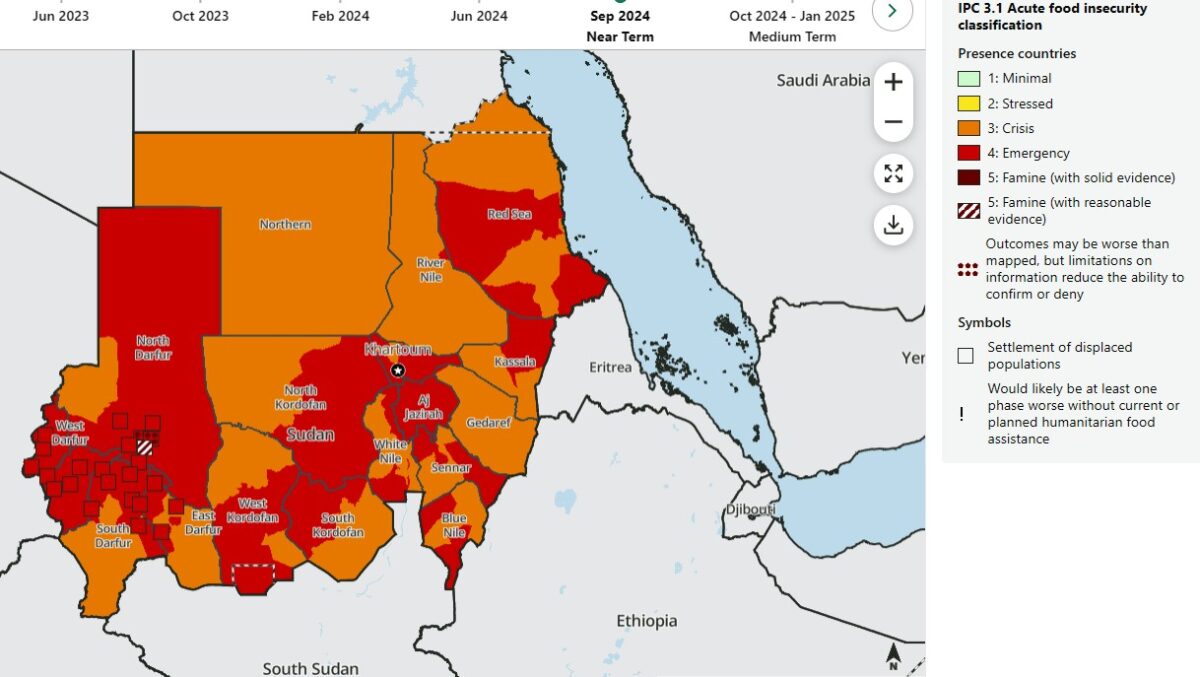
The U.N.’s advisory body about famine, the Integrated Food Security Phase Classification (IPC) reported 25.6 million people in the Sudan are food insecure, and of those, 8.5 million are in Emergency (Famine degree Phase 4) and another 755,000 are in Catastrophe/Famine (Famine degree Phase 5).

Humanitarian access is greatly constrained, with persistent fighting preventing deliveries of food or supplies into many areas, notably in Darfur, Khartoum, and regions with large numbers of internally displaced person.

Concern Worldwide is supporting 81 health facilities across Sudan, particularly in West and Central Darfur, treating children under five for acute malnutrition, with a focus on delivering ready-to-use therapeutic food (RUTF).  Despite the destruction of Sudan’s only RUTF factory in 2023, Concern has secured and delivered 10 metric tons of RUTF to vulnerable communities. In 2024, they reached nearly 484,000 people with lifesaving health and nutrition support.


Universal School Meal State Policies’ Effects on Food Security

The U.S. School Breakfast Program and National School Lunch Program are the largest child nutrition programs in America, providing nutritious meals to some 30 million children.1  The 2010 Healthy Hunger-Free Kids Act helped improve the nutritional quality of school breakfast and lunch meals, and research indicates these meals have higher nutritional quality than a school-aged child’s overall diet.2  But stigma exists around free or reduced-price meals and strict income guidelines that exclude families just above cut-off points, both deter participation and prevent many food-insecure households from participating.

However, during the COVID-19 pandemic, the US government provided free meal waivers for all K-12 students, waiving the income eligibility requirements. These waivers expired in 2022, prompting several states to adopt their own “School Meals for All” (SMFA) policies to maintain universal access to free school meals. In June 2025, the results of a study by Dania Orta-Aleman, PhD, Marlene Schwartz, PhD, et al., “Statewide Universal School Meal Policies and Food Insecurity in Households with Children”, examining these state programs was published in American Journal of Preventative Medicine. Specifically, the study focused on whether households in states with the SMFA policies experienced lower levels of food insecurity compared to those in states without such policies.

Method

In 2022-2023, the researchers surveyed more than 3,300 caregivers of public or charter school K-12 students in eight states.  Four of the states (California, Maine, Massachusetts, and Vermont) adopted SMFA, and the other four states did not (Arizona, Texas, Illinois, and New Hampshire), which served as a comparison group.  The team measured the level of household food insecurity using USDA’s Food Security Survey Module. Additional care was taken to control for confounders associated with food insecurity and isolate the effect of the SMFA through restricting survey participation to those not eligible for free and reduced-price meals prior to 2020.

Key Findings

  • Households residing in SMFA states reported lower rates of food insecurity, particularly among families eligible for free and reduced-price meals, but also among households just above the income eligibility cutoff.
  • While this study did not try to understand the mechanisms of this effect, other research on SMFA programs found them to be simpler to administer and effective at reducing the stigma of free and reduced-price meal programs, which ultimately results in greater student participation.  For example, in traditional income cut-off programs, many eligible students miss out—34% of full-price payers and 28% of reduced-price payers are eligible for free or reduced-price meals but are not certified due to reporting or administrative errors.3

Policy Implications

  • Expanding SMFA to the federal level could:
    • Increase participation by reducing stigma.
    • Simplify administration.
    • Ensure eligible children are not excluded due to paperwork errors.
    • Provide modest household savings that can be used for other needs, further stabilizing food access.
  • Such policies may also improve educational outcomes by reducing hunger-related barriers to learning.

Conclusions

  • SMFA policies were linked to lower household food insecurity among families with school-aged children, especially for families near or just above the free and reduced-price meal eligibility thresholds.
  • The study supports permanent expansion of SMFA as a strategy to reduce child hunger, improve health, and enhance educational outcomes.

Read the full article here: https://www.ajpmonline.org/article/S0749-3797(25)00433-7/fulltext

Additional links for further study:

Link to USDA Food and Nutrition Service overview: https://www.fns.usda.gov/nslp

USDA Healthy, Hunger-Free Kids Act of 2010:  https://www.fns.usda.gov/cn/healthy-hunger-free-kids-act

COVID-19 Waivers:  USDA page on waivers: https://www.fns.usda.gov/cn/covid-19-child-nutrition-response-waivers

State Policies:  a state policy summary from Food Research & Action Center (FRAC): https://frac.org/universal-school-meals

Educational Outcomes:  links between nutrition and learning, e.g., CDC: https://www.cdc.gov/healthyschools/npao/impact.htm

Notes:

1 Statewide Universal School Meal Policies and Food Insecurity in Households with Children Orta-Aleman, Dania et al. American Journal of Preventive Medicine, Volume 0, Issue 0, 107942

2 Au LE, Gurzo K, Gosliner W, Webb KL, Crawford PB, Ritchie LD. Eating School Meals Daily Is Associated with Healthier Dietary Intakes: The Healthy Communities Study. J Acad Nutr Diet. 2018;118(8):1474-1481.e1. https://doi.org/10.1016/J.JAND.2018.01.010

3Milfort R, Taylor J, May L, Collins M. Third Access, Participation, Eligibility, And Certification Study (APEC-III), SY 2017-18. U.S. Department of Agriculture; 2021. Accessed August 12, 2024. https://www.fns.usda.gov/sites/default/files/resource-files/APECIII-Vol1.pdf

Promoting Diagonal Approach for Nutrition

In a new paper by the Center for Global Development (Asti Shafira, Javier Guzman and JM Keller), the problem of siloeing of international support for basic nutrition is critiqued, with recommendations to integrate nutrition in universal health coverage.

The authors argue that nutrition is underprioritized at present, siloed and funded too often by vertical (stand alone) interventions that run parallel to other health care.  They write that this “makes it harder for governments to coordinate, plan or sustainabily finance nutrition services.”  Meanwhile, horizontal health programs make it harder to track and know about the impact on nutrition.

The author’s recommended solution is for diagonal approaches that embed nutrition interventions within health system strenghening but with measurable results referencing success in diagonal approaches with HIV.  They cite performance based budgeting as a successful approach seen in Indonesia to combat stunting.

Figure 1 from the paper shows, shown here at left, is of funding for nutrition (from the OECD) over the last four years by each of a number of key donor groups.

The full PDF paper can be sourced at:  “Diagonal” Approach to Integrating Nutrition into Health Systems: Opportunities, Challenges, and the Way Forward

or its summary at at Scaling Up Interventions

American Tariffs Hurt Poorest Nations

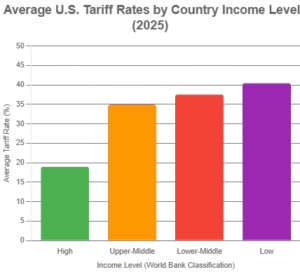
Recent tariffs imposed by the U.S. President in 2025 have been much in the news.  What has been less reported is how tarrifs more severely affect the poorest nations, with some countries facing tariffs 40% or higher.  These high tariffs will cripple some poorer nations’ export industries and lead to significant economic and human harm.  New American tariffs on poorer nations are 2 – 5 times higher than those placed on wealthier countries, potentially reversing decades of poverty reduction through trade.

Countries such as Vietnam, Bangladesh, South Africa, and Iraq now confront tariffs of 20% or more.  Poorer nations such as Laos are subjected to tariffs as high as 40%.  Burma which is recovering from a devastating earthquake, was hit with a 45% duty.  These countries have economies that are heavily reliant on a few key export sectors, such as textiles, garments, or agricultural products. A high tariff on these goods can have a devastating effect on their entire economy, leading to job losses and a decline in national income.

U.S. tariff rates now on Cambodia are 49%, on Angola 32%, on Mozambique 47%, on Syria 41%, on India 50%.   The tariff on Bosnia is 30% and Moldova 25%.  This represents a regressive policy shift that will un-develop countries, worsten debt crises and lead to higher unemployment.

The U.S. President has demanded in recent months that trading partners invest in the U.S., but few developing countries have anything near the finance to match the hundreds of billions of dollars that Japan, South Korea and the EU have pledged to sink into the American economy.

Wealthier nations generally have more diversified economies and greater resources to negotiate with the U.S. or to find new markets for their goods. In some cases, they have been able to reach agreements that result in lower tariff rates than initially threatened.  As seen in the chart at right, U.S. tariffs are lower for wealthier countries and higher for lower-income populations.

UNCTAD estimates that developing countries could see export losses of up to 15-20% to the U.S., worsening poverty and growth prospects. Wealthier nations, with diversified economies and stronger bargaining power, have secured exemptions or lower rates through “mini-deals,” mitigating impacts. For instance, the EU’s rate is 15% for most goods, reflecting pre-existing low mutual tariffs (around 1.4% average before 2025).

By: WHES Board

Famine as Weapon of War — Lancet Commentary

The medical journal, the Lancet, on July 30 2025 ran an appeal against famine titled “The Famines in Gaza and Other Conflict Areas are a Moral Failure,” writing:  “Widespread starvation is deliberately used as a weapon of war, at a scale that we never thought possible….  Every child — every person — has the right to the nutrition they need to survive and thrive.”  This was by members of the “Standing Together for Nutrition Consortium”, or ST4N.

See:  https://www.standingtogetherfornutrition.org/

They continue:  “Wasted children are about 12 times more
likely to die before their fifth birthday than children
with a healthy weight.18 Those children who do survive
famine will bear the impacts for life…

“The science of malnutrition and the solutions are
known.  Treatment of severe acute malnutrition, access to nutritious foods, clean water, nutrient supplements, and medical care are not radical ideas—they are proven strategies that save lives and rebuild communities.”

The authors include staff at the Canadian Micronutrient Forum and include Saskia Osendarp, Lawrence Haddad, Robert Blackand others.

Book Review: How to Feed the World, by Vaclav Smil

Vaclav Smil has produced an increasing repertoire of books summarizing how humans consume different resources.  Over four decades he has visited many topics including food availability and its constraints.  His latest 2025 book, “How to Feed the World:  The History and Future of Food“ stands as his summum opus, and is the best current survey about the tension between human needs and food supplies, comparing key options and constraints.  Therefore it is highly recommended to students, scientists, aid workers and general readers alike.  The first section of his book tracks the inevitability of humans to depend on grains and legumes.

Smil highlights the paradox that some of the world’s largest food producers, like India, have significant undernourished populations. He attributes this to unequal “global entitlements to food” rather than insufficient production, pointing to economic, political, and social barriers that prevent equitable distribution.  But he also is concerned with the ability of societies to grow enough food for a population growing toward 10 billion persons, particularly in Africa where crop yields are low and water/irrigation is limited.

Smil causes particular attention to food waste.  He emphasizes the colossal scale of food waste, approximately 1,000 kcal per person daily in Western countries, with a third of food produced (around 3,300 kcal per person per day) wasted, including a quarter of unopened food in places like Britain. This inefficiency exacerbates hunger by reducing available food and straining resources, a critical issue as populations grow.

Much of the book tries to explain  why certain crops and animals are produced and others are not, and why a few specific foodstuffs provide the majority of the world’s calories today, and how hard it would be to shift away from those key crops.

The book reviews the history of the human race and how most humans over millions of years were primarily hunter gatherers.  Meat consumpion increased after domestication of animals (beginning around 10,000 years ago), “though it became more stratified by social class over time.” 

The book also covers related topics like the dominance of a few staple crops (rice, wheat, maize, etc.) for global calories, the history of animal domestication, fertilizer revolutions (e.g., Haber-Bosch nitrogen), and incremental paths forward like precision agriculture, nutrient recycling, and population stabilization via development.  Smil is patient in educating readers about the molecule cycles (such as nitrogen) involved in food ecology.

Much of the book may foment controversy.  For instance, Smil directly poses and scrutinizes the questions: “Could the whole planet go vegan and be healthy?  Should it?” His data-driven analysis highlights that many promoted plant foods (e.g., nuts, certain fruits, or intensive plant-based systems) carry high energy and resource inputs.  Such a shift to veganism may ignore human metabolic realities, historical dietary patterns (meat consumption rose with domestication ~10,000 years ago and became stratified), and practical trade-offs.  Similarly, Smil is skeptical of the scale-up prospects of laboratory-grown meat (without animals).  He notes their high energy demands, costs, infrastructure needs, and biophysical realities that make rapid large-scale deployment unfeasible.  This differs sharply from narratives positioning cultured meat as a near-term revolution for sustainability or feeding the world.

Organic farming also is seen as having limits.  Smil acknowledges the upsides such as improved soil health but emphasizes scalability limits:  heavy reliance on finite or unevenly distributed resources like animal manure and leguminous nitrogen fixation, lower yields compared to conventional systems, high labor demands, and nutrient-cycling bottlenecks. Proposals like massive double-cropping or cover-crop expansion overlook second-order effects (e.g., extra land needed for seeds).

Looking to the future, he recommends:

 Improve Agricultural Efficiency:  Boost crop productivity (especially in developing nations) through better agronomic practices (precision farming, optimized irrigation, soil health management) rather than just expanding farmland.

Reduce waste:  About 30–40% of food is lost post-harvest or wasted in distribution and consumption. Smil advocates for better storage, transport, and consumer habits.

Reduce Meat Consumption:  Shift toward less resource-intensive diets—Smil stresses that industrial meat production (especially beef) is grossly inefficient in terms of land, water, and feed use.

 Reform Fertilizer Use:  Nitrogen efficiency is key.  Synthetic fertilizers (especially nitrogen) revolutionized agriculture, but overuse causes pollution (e.g., algal blooms, GHG emissions). Smil advocates for precision application and organic amendments.   Recycle nutrients—Better utilize manure and food waste to close nutrient loops.

Don’t expect magical silver bullets:   No single solution will “fix” global hunger.  Smil critiques techno-optimism, arguing that diverse, incremental improvements are more reliable than radical shifts.  Lab-grown meat & plant-based substitutes may help but will likely remain a niche solution in the near term.  

Stabilize Population Growth:  Slowing population via education, women’s empowerment, and economic development, which reduces future food demand.

Reduce Biofuel Mandates:  channeling crops (corn, soy) into biofuels is inefficient which competes with food production and should be minimized.

Adapt to Climate Change by prioritizing resilient crops and farming systems over geoengineering or untested techno-fixes.  Smil observes that rising temperatures and CO₂ changes will unevenly affect staple crops like rice and corn, especially in Asia and Latin America.

Smil has written often about food and history.  Smil’s work on food production and agriculture emphasizes the intersections of energy, environment, and human systems, often highlighting the challenges of feeding a growing global population sustainably. He explores topics like the efficiency of food systems, the environmental impacts of dietary choices, and the role of technological innovations in agriculture.  He obtained a Ph.D. in geography from Pennsylvania State University in 1971 and joined the University of Manitoba in 1972, where he became Distinguished Professor Emeritus in the Faculty of Environment.

–  steve hansch, WHES