

Initiatives to Make Nutrient Premix More Affordable

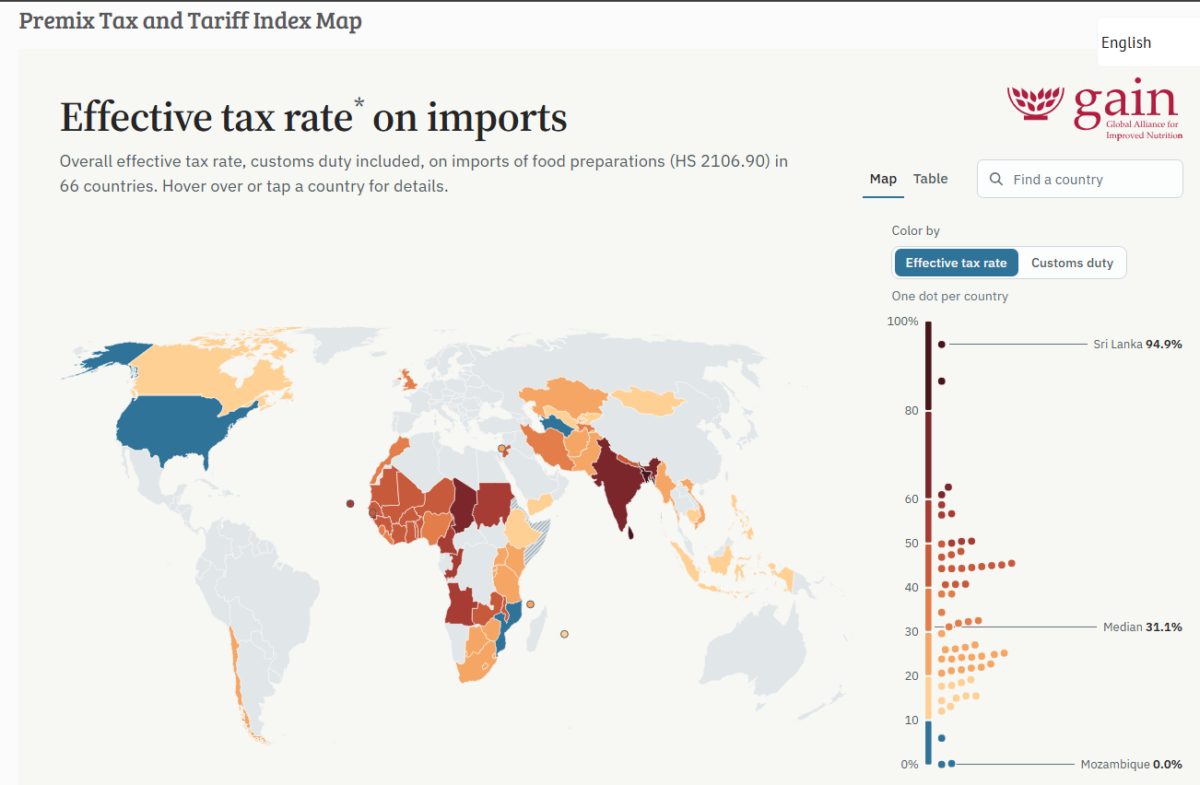
November 8, 2026     The aid organization, GAIN, the Global Alliance for Improved Nutrition, is promoting waivers of the tarrifs, VATs, and other charges for entry into countries of life-saving vitamin and mineral “premixes” that are used to fortify foods on a large scale, public-health basis.

The map displayed above, showing the current taxes on these imports, is from:  https://www.fortificationdata.org/premix-taxes/#toc_Premix_Tax_and_Tariff_Index_Map

Details of the tarrifs are found in the new “Premix Tax and Tariffs Index”  at GAIN Premix Tax and Tariff Index .

Presmix is manufacturered by a few global companies and the total market value is about $8 billion a year.  Premix is manufactured by Archer Daniels Midland, DSM-Fermenich, Cargill, Blanbia Nutritionals, Trouw Nutrition, Sternvitamin, Vitablend Nederland Prinova Group, Addisseo, and a few others.

Premix taxation is a public health issue:  As GAIN notes, tarrifs, VATs and other charges on premix is a charge on essential ingredients that make food fortification possible to reduce the massive scale of micronutrient deficiency diseases (vitamins and minerals) throughout the developing world.  Taxes and tariffs increase the cost of fortification for food producers,  making it harder to deliver essential vitamins and minerals to the populations who need them.

The World Customs Organization, WCO, oversees a Harmonized System of codes to track tarrifs.  Premix now has a dedicated code:  2106.20 for the first time.  WCO adopted the amendments, including provision 2106.20 are set to be global standards, including the regional EAC, ECOWAS, CEMAC and SACU regional trade groups.

GAIN’s goal is to reduce duties from 30% to zero as poor countries strive to prevent micronutrient deficiency diseases.  They ask advocacy support from all stakeholders to educate governments.

By engaging governments as they update their tariff schedules, advocates can help shape the cost of food fortification for years to come.

To support this advocacy effort, contact:   Florencia Vasta vasta@gainhealth.org and Kristin Sundell ksundell@gainhealth.org

see also:  Premix Taxes and Tariffs Intro Video

and PTTI Country Profiles

for more country by country data:

Contributed by WHES board member, Steven Hansch

American Tariffs Hurt Poorest Nations

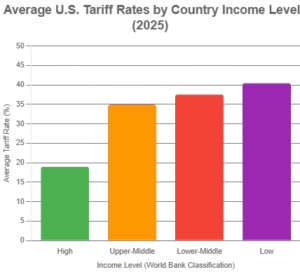
Recent tariffs imposed by the U.S. President in 2025 have been much in the news.  What has been less reported is how tarrifs more severely affect the poorest nations, with some countries facing tariffs 40% or higher.  These high tariffs will cripple some poorer nations’ export industries and lead to significant economic and human harm.  New American tariffs on poorer nations are 2 – 5 times higher than those placed on wealthier countries, potentially reversing decades of poverty reduction through trade.

Countries such as Vietnam, Bangladesh, South Africa, and Iraq now confront tariffs of 20% or more.  Poorer nations such as Laos are subjected to tariffs as high as 40%.  Burma which is recovering from a devastating earthquake, was hit with a 45% duty.  These countries have economies that are heavily reliant on a few key export sectors, such as textiles, garments, or agricultural products. A high tariff on these goods can have a devastating effect on their entire economy, leading to job losses and a decline in national income.

U.S. tariff rates now on Cambodia are 49%, on Angola 32%, on Mozambique 47%, on Syria 41%, on India 50%.   The tariff on Bosnia is 30% and Moldova 25%.  This represents a regressive policy shift that will un-develop countries, worsten debt crises and lead to higher unemployment.

The U.S. President has demanded in recent months that trading partners invest in the U.S., but few developing countries have anything near the finance to match the hundreds of billions of dollars that Japan, South Korea and the EU have pledged to sink into the American economy.

Wealthier nations generally have more diversified economies and greater resources to negotiate with the U.S. or to find new markets for their goods. In some cases, they have been able to reach agreements that result in lower tariff rates than initially threatened.  As seen in the chart at right, U.S. tariffs are lower for wealthier countries and higher for lower-income populations.

UNCTAD estimates that developing countries could see export losses of up to 15-20% to the U.S., worsening poverty and growth prospects. Wealthier nations, with diversified economies and stronger bargaining power, have secured exemptions or lower rates through “mini-deals,” mitigating impacts. For instance, the EU’s rate is 15% for most goods, reflecting pre-existing low mutual tariffs (around 1.4% average before 2025).

By: WHES Board