
Initiatives to Make Nutrient Premix More Affordable

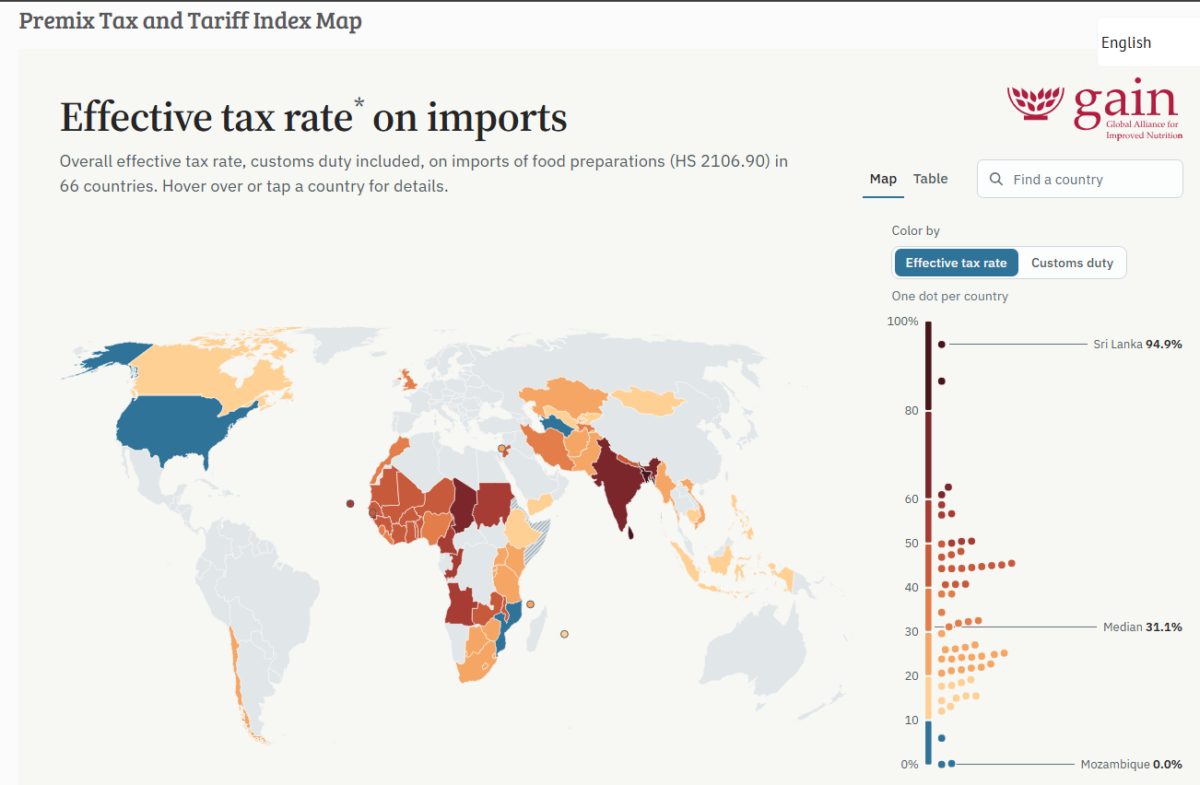
November 8, 2026     The aid organization, GAIN, the Global Alliance for Improved Nutrition, is promoting waivers of the tarrifs, VATs, and other charges for entry into countries of life-saving vitamin and mineral “premixes” that are used to fortify foods on a large scale, public-health basis.

The map displayed above, showing the current taxes on these imports, is from:  https://www.fortificationdata.org/premix-taxes/#toc_Premix_Tax_and_Tariff_Index_Map

Details of the tarrifs are found in the new “Premix Tax and Tariffs Index”  at GAIN Premix Tax and Tariff Index .

Presmix is manufacturered by a few global companies and the total market value is about $8 billion a year.  Premix is manufactured by Archer Daniels Midland, DSM-Fermenich, Cargill, Blanbia Nutritionals, Trouw Nutrition, Sternvitamin, Vitablend Nederland Prinova Group, Addisseo, and a few others.

Premix taxation is a public health issue:  As GAIN notes, tarrifs, VATs and other charges on premix is a charge on essential ingredients that make food fortification possible to reduce the massive scale of micronutrient deficiency diseases (vitamins and minerals) throughout the developing world.  Taxes and tariffs increase the cost of fortification for food producers,  making it harder to deliver essential vitamins and minerals to the populations who need them.

The World Customs Organization, WCO, oversees a Harmonized System of codes to track tarrifs.  Premix now has a dedicated code:  2106.20 for the first time.  WCO adopted the amendments, including provision 2106.20 are set to be global standards, including the regional EAC, ECOWAS, CEMAC and SACU regional trade groups.

GAIN’s goal is to reduce duties from 30% to zero as poor countries strive to prevent micronutrient deficiency diseases.  They ask advocacy support from all stakeholders to educate governments.

By engaging governments as they update their tariff schedules, advocates can help shape the cost of food fortification for years to come.

To support this advocacy effort, contact:   Florencia Vasta vasta@gainhealth.org and Kristin Sundell ksundell@gainhealth.org

see also:  Premix Taxes and Tariffs Intro Video

and PTTI Country Profiles

for more country by country data:

Contributed by WHES board member, Steven Hansch
Book Review: “Food Fight” by Stuart Gillespie

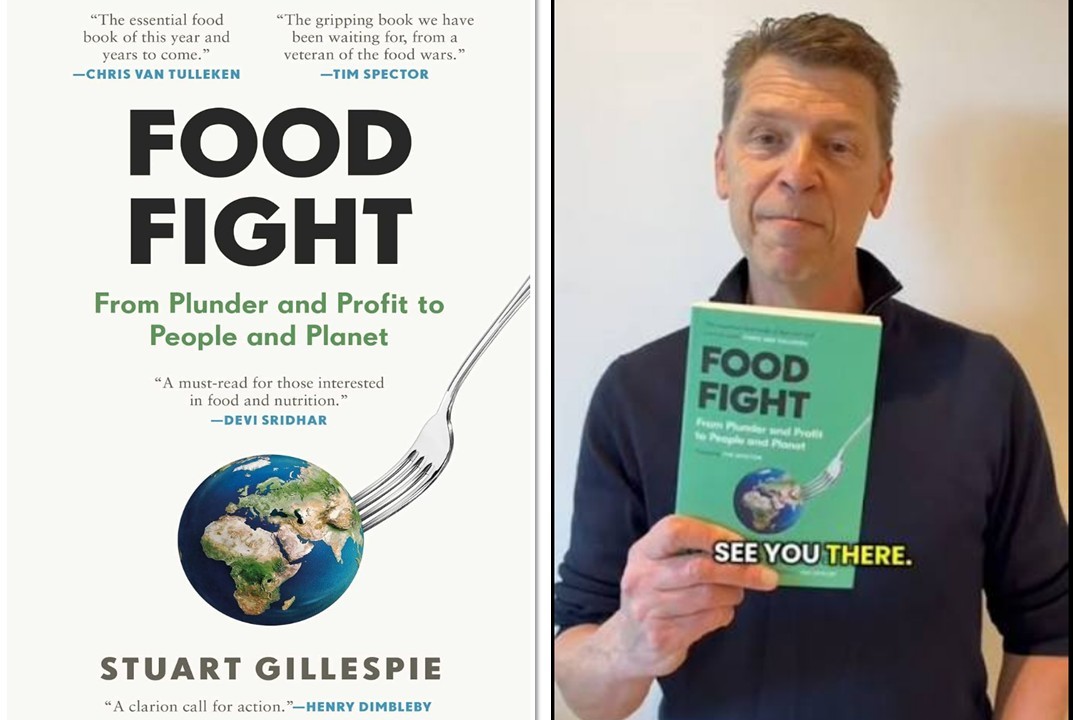
August 14, 2026     Agribusiness is out of control, according to  “From Plunder and Profit to People and Planet”, Stuart Gillespie’s 2025 book, “Food Fight” which argues for a new, common vision of human and planetary health in where power over food systems is better balanced.  He writes building on a tradition, which he cites, from Susan George’s “How the Other Half Dies.“

Gillespie argues that the modern food system, as shaped after World War II to mass-produce cheap calories and avert famine (with geopolitical aims), has become a major driver of harm.

His main criticism is aimed at the concentration of food companies on a global scale:  “Five companies – ADM, Bunge, Cargill, Cofco and Louis Dreyfus – control 70-90% of the global grain trade… Never before have we seen such a hyper-concentration of power at all points from farm to fork… Another four companies – ChemChina, Corteva, Bayer and BASF – control 66% of the world’s agricultural chemicals market, while a similar cluster… owns 53% of the global seed market.”   Gillespie details corporate political tactics (analogous to those historically used by the tobacco industry) and policy inertia, while highlighting citizen movements, local successes (e.g., city-level strategies), and practical levers for change such as public procurement, taxes with revenue recycling, marketing restrictions, conflict-of-interest rules, and broader mobilization.  The book mixes exposé with a call for structural transformation toward a system that prioritizes people and planet.  He concludes:  “The large-scale damage done to people and planet is a feature of our food system, not a bug.”

He particularly criticizes global trends in the consumption of ultra-processed foods.

“Governments need to act because malnutrition represents what economists call a market failure, a negative externality – and what the rest of us call an injustice.”    He adds that “malnutrition is multi-causal in nature,” requiring a whole of government response, and “Economic growth won’t fix it.  nor will technology.”

He criticizes nutritionists who promote national food fortification schemes or other efforts to provide vitamin and mineral supplements for involving the private sector (corporations).  Yet he explains the importance of micronutrients:  “micronutrient malnutrition also travels through generations.  A lack of essential vitamins and minerals can be devestating for a pregnant woman and her unborn child.  The micronutrient-deficient mother is more likely to have complications in pregnancy and more likely to die giving birth.  Iron-deficiency anemia causes one in four maternal deaths around the world.”

Some of his history is confusing, such as when he writes about the Bay of Bengal famine “starting” in 1943, when the conditions leading to it began in 1942, and he refers to the United Nations in the same breath, though the U.N. was not founded until 1945.  Yet, he is critical of the donors and aid agencies helping, referring to “white saviourism.”

He correctly critiques an obsession in the 1950s and 1960 with a “protein gamp” and notes how in 1974, Donald McLaren “blew the protein obsession out of the water.”

His recommendations span all of society to take more responsibility and he addresses NGOs like Save the Children, and repeatedly UNICEF.  He seeks a revolution in the governance of for-profit corporations.  Though citing examples in a few countries, his book is generic, about the world.  Though a preponderance of his interviews, analyses and criticisms are targeted to one country, the United Kingdom.

He recommends four “Ins” incentives, institutions, information and interests.  He recommends the use of taxes and subsidies to reshape the food environment.  Governments should tax products and practices that damage health or the environment, especially ultra-processed foods and sugary drinks, and earmark the proceeds to make nutritious foods more affordable for low-income households.

–  Contributed by WHES board member, Steven Hansch