


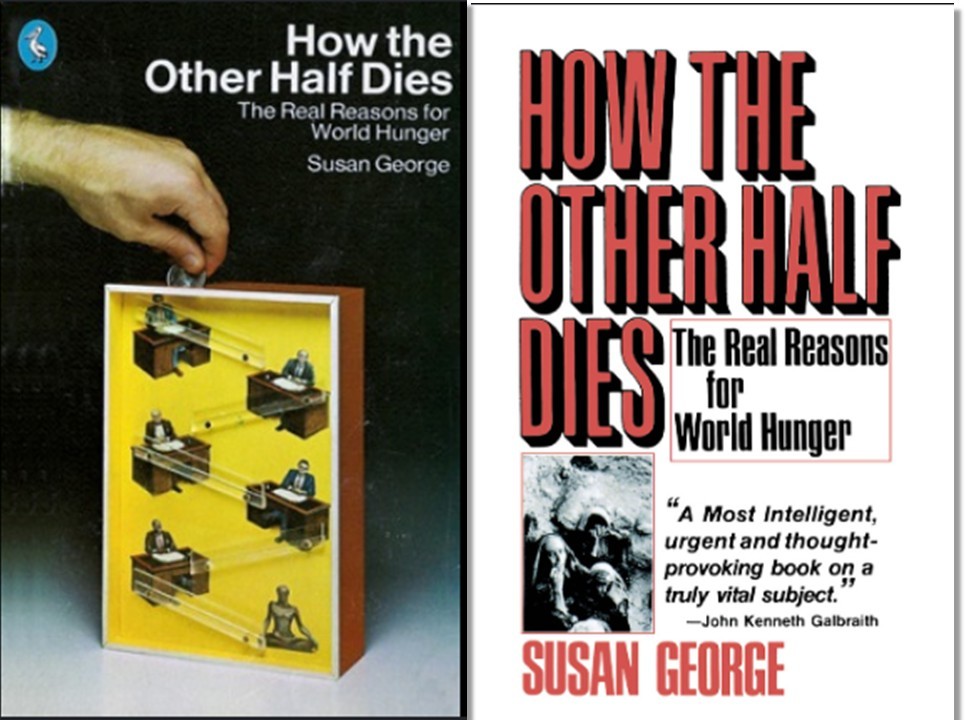
How the Other Half Dies, Book Classic
Aug 18, 2026 A key author about world hunger, Susan George, passed away earlier this year, having fought extensively against world hunger and calling for radical global economic reform. Born in Ohio she moved to France and wrote often about the UK. All of her writing expanded on her thesis that hunger and poverty are due to unequal distributions of power and the international economics of agribusiness. Her work inspired Stuart Gillespie, whose book “Food Fight” was reviewed recently.
A staple of college reading about world hunger was Susan George’s classic, “How the Other Half Dies”, a title which was a take on a classic book about poverty in New York tenements, “How the Other Half Lives,” by Jacob Riis, published in 1890.
She wrote: “Hunger is not a scourge but a scandal.”
That scandal, in her account, begins on the farm itself. Farming, she argues, had become “a highly sophisticated, highly energy-intensive system for transforming one series of industrial products into another series of industrial products which happen to be edible.” The Green Revolution, Western technology transfers, World Bank projects, and Food Aid are shown to enrich local elites and integrate countries into markets they don’t control, not to feed the poorest half. She favors global land reform but ignores the lessons of how that has not worked.
That economic critique, however, blurs into a broader and less careful political one. Her book vacillates between criticizing capitalism, the United States and colonialism, as if all three are identical, often confusing America’s foreign engagement with her home country, the U.K. Despite living in France, the weight of her criticisms are toward the US and UK. The only aid groups she likes are in the UK.
That same imprecision carries over into her use of evidence. She gives no credence to the history of poverty that dates back thousands of years. Her focus is on how current access to food is unfair. Little of her book involves original field research or case studies from Africa or Latin America, as she draws more on headlines and studies of agribusiness.
The lack of rigor is most visible in her treatment of population and food supply. At times she seems to not take seriously actual food shortages or hunger. Citing only one speculative source, she claims the Earth can feed 50 billion people comfortably (never mind environmental destruction and climate effects), and criticizes efforts to empower women over their reproductive choices, arguing that family planning programs were in some cases ineffective. She claims that poor families have to have larger families for labor income. She ignores the most effective family planning program of all, the reduction in child mortality worldwide from public health programs.
Aid programs fare no better in her account. She writes that if any of the emergency food aid provided by donors have reduced malnutrition it was inadvertent, criticizing the work of dozens of nonprofits that work to build local trust and measure anthropometrics of children. She similarly ignores all “economic development” programs by governments and aid agencies. She favors small-scale technology. She critiques the Green Revolution by quoting Lester Brown’s Seeds of Change at length.
Her skepticism of institutions extends to USAID specifically. Having only academic knowledge of USAID programs, she criticizes USAID’s program in the 1960s and 1970s that trained tens of thousands of people from lower income countries for establishing an elite establishment. She similarly criticizes the World Bank and most NGOs.
For all these criticisms, though, she does offer a prescription. Her solution to hunger is to organize, to create local groups to study hunger and bring systemic change.
Further reading:
https://www.jstor.org/stable/4366469
https://en.wikipedia.org/wiki/How_the_Other_Half_Dies
– Contributed by WHES Board member, Steven Hansch
-
 World Hunger Education
Service
P.O. Box 29015
Washington, D.C. 20017 -