

AI for Food Security: New Insights

September 15, 2026    The use of artificial intelligence to improve food security is the focus of an increasing number of problem solvers.  On September 15, the International Food Policy Research Institute presented a series of speakers who gave examples of applications of AI, and emerging trends in their potential in a webinar, “AI Policy Considerations for Food, Land, and Water Systems.”

IFPRI argues that AI has significant potential to transform policy research in food, land, and water systems by enhancing accessibility, efficiency, and responsiveness in policy analysis, only if tools are rigorously tested, made transparent, and appropriately integrated into research and decision-making processes.  AI-enabled economic models can make complex policy analysis more accessible by allowing users to simulate shocks or investments conversationally and rapidly interpret effects on poverty, diets, production, and other outcomes, but their outputs still require expert scrutiny.  Speakers shared how:

  • AI offers important opportunities to improve food security, from modeling the consequences of price shocks and agricultural investments to supporting crop breeding, advisory services, and policy decisions.

  • Accessible AI interfaces can lower the technical barriers to using complex economy-wide models, enabling a wider range of users to explore policy scenarios and identify trade-offs among growth, poverty reduction, nutrition, and environmental goals.  These tools should not be treated as automatic policy engines: users need access to underlying assumptions, data, simulation files, uncertainty, and reproducible workflows, while human analysts remain responsible for validating conclusions.
  • Agricultural AI often fails when models trained on curated or internet-sourced data are deployed in real farming conditions involving low-cost devices, variable lighting, differing crop varieties, changing seasons, and diverse ecological zones.

  • Effective systems should therefore be co-designed and trained with farmers, local organizations, agronomists, and governments, using contextual data and delivering information in local languages and accessible formats such as voice.  Accurate advice alone is insufficient, because farmers can act on recommendations only when they can obtain affordable inputs, credit or vouchers, market access, follow-up support, and trusted channels for discussion and learning.

  • AI’s greatest value may be as part of an integrated delivery system—for example, combining fertilizer recommendations with government action to expand product availability and programs that enable farmers to afford the recommended inputs.

  • Governments and development partners have a crucial role in setting responsible-AI rules, interoperability and data-sharing arrangements, evaluation standards, connectivity and maintenance systems, and targeted support for groups the market is least likely to serve.  Ultimately, combating hunger with AI requires judging success by real changes in farmer decisions, livelihoods, equity, and food security.

See also:  https://www.ifpri.org/topic/artificial-intelligence-ai/

AI and EARLY WARNING

Separately, a new article in Nature Food journal, by Weston Anderson et al., “Responsible Use of Aritificial Intelligence and Machine Lerning for Food Security Early Warning Systems

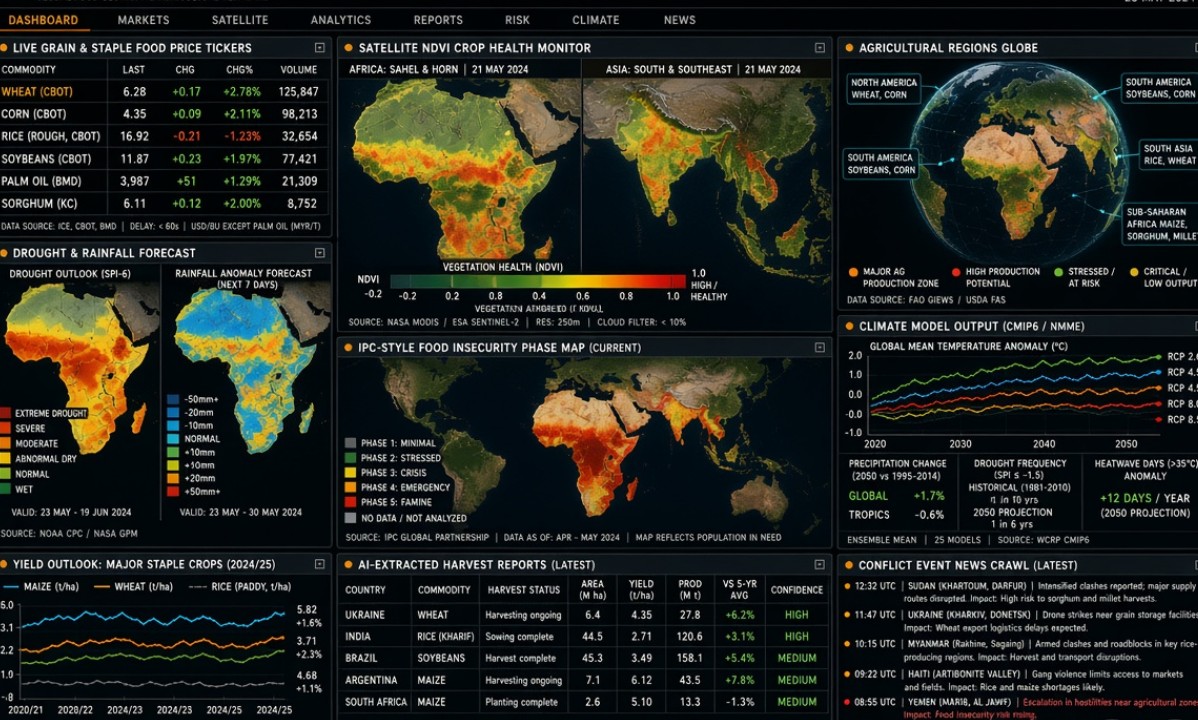
Food-security early-warning systems such as FEWS NET and the IPC already guide billions of dollars in aid that can avert or shorten famines. The article argues that AI and machine learning can strengthen those systems and therefore reduce hunger, when they are used to speed up data collation, remote-sensing monitoring of crops and hazards, and short-term weather or yield forecasts. Faster, more complete information on prices, conflict events, and production shortfalls lets analysts issue earlier, more precise alerts so that limited humanitarian resources reach the populations most at risk before a crisis becomes a famine.
The same article, however, warns that replacing expert judgment with unvetted AI models would undermine rather than advance famine prevention. Direct machine-learning predictions of food-insecurity phases still show only modest skill, struggle with data-scarce or rapidly changing settings, and lack the accountability mechanisms (such as famine-review committees) that currently prevent erroneous public declarations. Mis-targeted or delayed aid that results from such errors could leave people without food at critical moments or waste scarce funds, thereby increasing rather than reducing the risk of famine.

The practical implication is therefore selective, analyst-in-the-loop adoption: use AI to free experts from repetitive digitization and search tasks so they can concentrate on reconciling conflicting evidence and issuing accountable forecasts. Combined with continued investment in the underlying data infrastructure, this approach offers the best chance of making early-warning systems more timely and cost-effective without sacrificing the human oversight that remains essential for life-saving decisions.

See:  https://www.nature.com/articles/s43016-026-01400-6

FUNDING

Also this week, the Gates Foundation committed $1 billion to expanding access to AI.  Their announcement notes:  “Doctors, farmers, teachers, and developers need opportunities to learn how to evaluate AI tools and adapt what works to their own contexts. They also need affordable access to the technology, which will require action from technology companies as well as investment from governments and philanthropy.”

See:  https://www.gatesfoundation.org/ideas/media-center/press-releases/2026/09/goalkeepers-report-equitable-ai

-contributed by WHES board member, Steven Hansch

Book Review: “Food Fight” by Stuart Gillespie

August 14, 2026     Agribusiness is out of control, according to  “From Plunder and Profit to People and Planet”, Stuart Gillespie’s 2025 book, “Food Fight” which argues for a new, common vision of human and planetary health in where power over food systems is better balanced.  He writes building on a tradition, which he cites, from Susan George’s “How the Other Half Dies.“

Gillespie argues that the modern food system, as shaped after World War II to mass-produce cheap calories and avert famine (with geopolitical aims), has become a major driver of harm.

His main criticism is aimed at the concentration of food companies on a global scale:  “Five companies – ADM, Bunge, Cargill, Cofco and Louis Dreyfus – control 70-90% of the global grain trade… Never before have we seen such a hyper-concentration of power at all points from farm to fork… Another four companies – ChemChina, Corteva, Bayer and BASF – control 66% of the world’s agricultural chemicals market, while a similar cluster… owns 53% of the global seed market.”   Gillespie details corporate political tactics (analogous to those historically used by the tobacco industry) and policy inertia, while highlighting citizen movements, local successes (e.g., city-level strategies), and practical levers for change such as public procurement, taxes with revenue recycling, marketing restrictions, conflict-of-interest rules, and broader mobilization.  The book mixes exposé with a call for structural transformation toward a system that prioritizes people and planet.  He concludes:  “The large-scale damage done to people and planet is a feature of our food system, not a bug.”

He particularly criticizes global trends in the consumption of ultra-processed foods.

“Governments need to act because malnutrition represents what economists call a market failure, a negative externality – and what the rest of us call an injustice.”    He adds that “malnutrition is multi-causal in nature,” requiring a whole of government response, and “Economic growth won’t fix it.  nor will technology.”

He criticizes nutritionists who promote national food fortification schemes or other efforts to provide vitamin and mineral supplements for involving the private sector (corporations).  Yet he explains the importance of micronutrients:  “micronutrient malnutrition also travels through generations.  A lack of essential vitamins and minerals can be devestating for a pregnant woman and her unborn child.  The micronutrient-deficient mother is more likely to have complications in pregnancy and more likely to die giving birth.  Iron-deficiency anemia causes one in four maternal deaths around the world.”

Some of his history is confusing, such as when he writes about the Bay of Bengal famine “starting” in 1943, when the conditions leading to it began in 1942, and he refers to the United Nations in the same breath, though the U.N. was not founded until 1945.  Yet, he is critical of the donors and aid agencies helping, referring to “white saviourism.”

He correctly critiques an obsession in the 1950s and 1960 with a “protein gamp” and notes how in 1974, Donald McLaren “blew the protein obsession out of the water.”

His recommendations span all of society to take more responsibility and he addresses NGOs like Save the Children, and repeatedly UNICEF.  He seeks a revolution in the governance of for-profit corporations.  Though citing examples in a few countries, his book is generic, about the world.  Though a preponderance of his interviews, analyses and criticisms are targeted to one country, the United Kingdom.

He recommends four “Ins” incentives, institutions, information and interests.  He recommends the use of taxes and subsidies to reshape the food environment.  Governments should tax products and practices that damage health or the environment, especially ultra-processed foods and sugary drinks, and earmark the proceeds to make nutritious foods more affordable for low-income households.

–  Contributed by WHES board member, Steven Hansch
On Resilience: What is Resilience in Anti-Hunger Aid?

July 1, 2026     This ongoing column in Hunger Notes was created to explore the fascination aid agencies have with the term “resilience,” which to some degree has replaced other broad, aspirational buzzwords like “development”, “sustainability,” and “empowerment.”  Like those other terms, resilience has become a goal of many aid programs, both development and humanitarian.  Yet, there has never been concensus about how to measure if and when resilience is achieved.  This is because resilience means as many different things as there are programs addressing it.

Food, nutrition and other anti-hunger aid programs have been under the banner of resilience for most of the last decade.  Today, the US Department of Agriculture is seeking inputs about its Food for Peace programming including lessons about the large “Resilience Food Security Activities”, or RFSAs whereby diverse NGOs aimed to foster resilience with food aid.  So, sharpening and clarifying the relationship between resilience and hunger is timely.

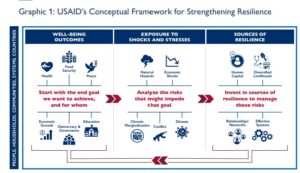
Key donors, including the European Union and US Government, as well as the Red Cross, tend to view resilience as “capacity under stress.”  The International Food Policy Research Institute and key advisors to the former USAID posited resilience as the ability of households, communities or systems to “withstand, adapt to, and recover from shocks.”

In practice, for any given program, what does this mean?  The EU representative in Juba, South Sudan, was very clear in defining resilience as the rate of acute malnutrition among children.  Other programs measure resilience as essentially being the same thing as sustainability (do the program’s outcomes or systems persist after the end of funding?).

When USAID had an office of resilience, it promoted resilience primarily in terms of household livelihoods, community cohesion and food security throughout cycles of drought and floods, measuring:

  • ♦  Resilience capacities (absorptive, adaptive, transformative)
  • ♦  Well‑being outcomes (food security, nutrition, income stability)
  • ♦  Shock severity and frequency
  • ♦  Longitudinal household surveys to observe recovery patterns.

The Rockefeller Foundation has defined resilience as the capacity of cities, communities, and systems to survive, adapt, and grow despite chronic stresses and acute shocks, and in this includes good, inclusive governance, leadership, and urban planning.

The Red Cross has been piloting resilience measures for many years, focusing on “risk” assessment.  It has developed a dashboard which measures resilience across 11 dimensions: disaster/risk management, health, water and sanitation, shelter, food and nutrition security, social cohesion, inclusion, economic opportunities, infrastructure and services, natural resource management, and connectedness. It allows resilience comparisons by community and by demographic categories such as gender and education.

These approaches to resilience are oriented largely toward relief-to-development programming, assuming recurring disasters at the population level.

“Resilience” is widely used but used differently for measuring ecological and environmental change as well as human psychology.  Meanwhile, engineers and architects measure resilience in precise ways such as structural integrity.

A decade ago, a large roundtable, or symposium, of 100 experts from government agencies, NGOs, and academia was held to share progress in measuring resilience.  The summary can be found here.  Among its conclusions:  “There are no single metrics. There is a need for evaluations to tell us what resilience is and what works. So far — “Resilience has been episodic and serendipitous through extraordinary people in missions.” (The symposium was hosted by American University, World Vision, Mercy Corps, Catholic Relief Services, the American Red Cross, IBTCI, the Wilson Center, and Management Systems International.)

USAID’s last resilience policy update, building on a legacy focused on disaster risk reduction, was updated in 2024, here  It covers a wide range of sectors and topics:  “USAID long ago recognized that resilience is not simply a food security issue; it is essential for managing risks across a range of goals across the areas of climate, health, peace, education, democracy and governance, poverty alleviation, and economic growth. While earlier resilience efforts focused on community-level programming, this policy emphasizes that we are also now investing more in host-country and local systems, with an eye toward development, diplomacy and policy solutions such as expanding social protection systems, enabling displaced persons to access jobs, and reforming national policies to better serve marginalized groups. So, what resilience means in practice will continue to evolve and will be revisited in this column.”

As the USG reboots its foreign aid, it will be challenged to define resilience more cleanly and usefully, or it will fall out of use.