




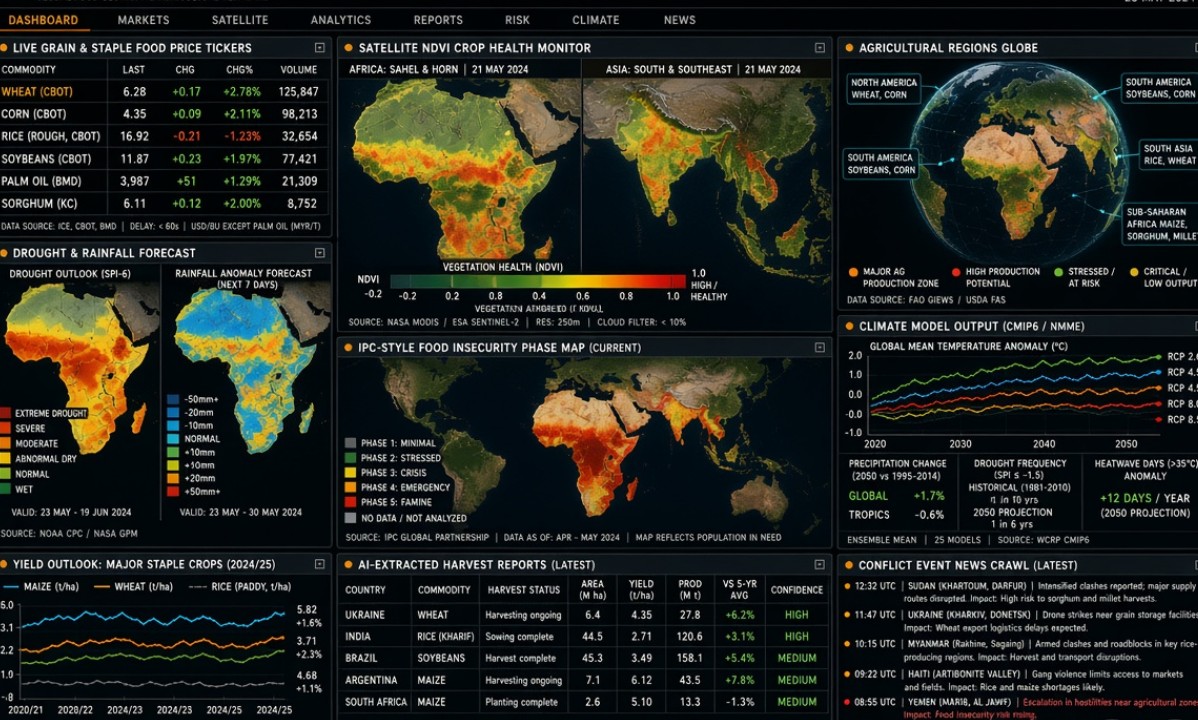
September 15, 2026 The use of artificial intelligence to improve food security is the focus of an increasing number of problem solvers. On September 15, the International Food Policy Research Institute presented a series of speakers who gave examples of applications of AI, and emerging trends in their potential in a webinar, “AI Policy Considerations for Food, Land, and Water Systems.”
IFPRI argues that AI has significant potential to transform policy research in food, land, and water systems by enhancing accessibility, efficiency, and responsiveness in policy analysis, only if tools are rigorously tested, made transparent, and appropriately integrated into research and decision-making processes. AI-enabled economic models can make complex policy analysis more accessible by allowing users to simulate shocks or investments conversationally and rapidly interpret effects on poverty, diets, production, and other outcomes, but their outputs still require expert scrutiny. Speakers shared how:
-
AI offers important opportunities to improve food security, from modeling the consequences of price shocks and agricultural investments to supporting crop breeding, advisory services, and policy decisions.
-
Accessible AI interfaces can lower the technical barriers to using complex economy-wide models, enabling a wider range of users to explore policy scenarios and identify trade-offs among growth, poverty reduction, nutrition, and environmental goals. These tools should not be treated as automatic policy engines: users need access to underlying assumptions, data, simulation files, uncertainty, and reproducible workflows, while human analysts remain responsible for validating conclusions.

-
Agricultural AI often fails when models trained on curated or internet-sourced data are deployed in real farming conditions involving low-cost devices, variable lighting, differing crop varieties, changing seasons, and diverse ecological zones.
-
Effective systems should therefore be co-designed and trained with farmers, local organizations, agronomists, and governments, using contextual data and delivering information in local languages and accessible formats such as voice. Accurate advice alone is insufficient, because farmers can act on recommendations only when they can obtain affordable inputs, credit or vouchers, market access, follow-up support, and trusted channels for discussion and learning.
-
AI’s greatest value may be as part of an integrated delivery system—for example, combining fertilizer recommendations with government action to expand product availability and programs that enable farmers to afford the recommended inputs.
-
Governments and development partners have a crucial role in setting responsible-AI rules, interoperability and data-sharing arrangements, evaluation standards, connectivity and maintenance systems, and targeted support for groups the market is least likely to serve. Ultimately, combating hunger with AI requires judging success by real changes in farmer decisions, livelihoods, equity, and food security.
See also: https://www.ifpri.org/topic/artificial-intelligence-ai/
AI and EARLY WARNING
Separately, a new article in Nature Food journal, by Weston Anderson et al., “Responsible Use of Aritificial Intelligence and Machine Lerning for Food Security Early Warning Systems
Food-security early-warning systems such as FEWS NET a nd the IPC already guide billions of dollars in aid that can avert or shorten famines. The article argues that AI and machine learning can strengthen those systems and therefore reduce hunger, when they are used to speed up data collation, remote-sensing monitoring of crops and hazards, and short-term weather or yield forecasts. Faster, more complete information on prices, conflict events, and production shortfalls lets analysts issue earlier, more precise alerts so that limited humanitarian resources reach the populations most at risk before a crisis becomes a famine.
The same article, however, warns that replacing expert judgment with unvetted AI models would undermine rather than advance famine prevention. Direct machine-learning predictions of food-insecurity phases still show only modest skill, struggle with data-scarce or rapidly changing settings, and lack the accountability mechanisms (such as famine-review committees) that currently prevent erroneous public declarations. Mis-targeted or delayed aid that results from such errors could leave people without food at critical moments or waste scarce funds, thereby increasing rather than reducing the risk of famine.
The practical implication is therefore selective, analyst-in-the-loop adoption: use AI to free experts from repetitive digitization and search tasks so they can concentrate on reconciling conflicting evidence and issuing accountable forecasts. Combined with continued investment in the underlying data infrastructure, this approach offers the best chance of making early-warning systems more timely and cost-effective without sacrificing the human oversight that remains essential for life-saving decisions.
See: https://www.nature.com/articles/s43016-026-01400-6
FUNDING
Also this week, the Gates Foundation committed $1 billion to expanding access to AI. Their announcement notes: “Doctors, farmers, teachers, and developers need opportunities to learn how to evaluate AI tools and adapt what works to their own contexts. They also need affordable access to the technology, which will require action from technology companies as well as investment from governments and philanthropy.”
-contributed by WHES board member, Steven Hansch