




May 5, 2026
The think tank, CSIS, held a forum on April 30, 2026 about “Artificial Intelligence (AI) and Food Security,” bringing together policymakers, agronomists, geospatial data scientists, representatives of multilateral institutions, private-sector technologists, and implementing NGOs to discuss the emerging technical, institutional, and geopolitical dimensions of AI deployment that are increasingly affecting global food systems.
A webcast of the event is available at: https://www.csis.org/events/ai-food-security-forum.
Through panels of and demonstrations by some 26 experts, the forum examined agrifood value chains, from upstream crop phenotyping and remote-sensing-based yield forecasting to downstream supply chain logistics, market access, and anticipatory humanitarian financing.
Application areas included forecasting hunger with early warning systems, leveraging machine learning in research to develop more climate-resilient crops, and using AI to minimize food waste, track food from farm to table, and optimize delivery, all of which are crucial for reducing costs and improving efficiency.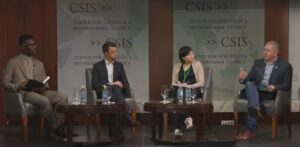
Speakers and panelists came from IFPRI, the World Food Programme, NASA Harvest, the Gates Foundation, Bayer, Google (a sponsor of the event), the World Bank’s AI unit, and the Bezos Earth Fund. They spoke about how machine learning architectures, large language models (LLMs), and Earth observation platforms have advanced at an ever-increasing pace, while the constraints on how AI can support food security remain “non-algorithmic.” These constraints include the scarcity of geographically granular and ground-truthed agronomic datasets; the absence of robust digital public infrastructure in low- and middle-income countries (LMICs); the chronic underfunding of national agricultural extension systems; and language homogeneity, which remains disproportionately English-centric in geographies with thousands of local dialects and hyper-localized agricultural terms.
A few demonstrations reinforced these themes, including ZeroHungerAI’s news-ingestion model for anticipatory crisis detection, CGIAR’s BriAPI-enabled phenotyping acceleration platform, TomorrowNow’s next- generation smallholder weather forecasting stack, and NASA Harvest’s Harvest2Market tool, which uses satellite images to understand market linkages. Each of these holds promise for improving food systems through AI.
Discussions also considered the duality of AI: it promises large efficiency gains, while at the same time introducing risks related to data bias, privacy, and inequality in data collection.
The forum’s final panel emphasized the need for harmonized regulatory frameworks, multi-level impact evaluation methodologies, and demand-driven AI procurement models that prioritize localization and farmer-centered design over purely technological approaches.
Videos, transcripts and more information are available here.

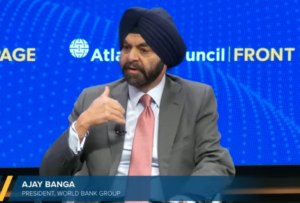 ransformation, citing examples of women farmers using “Small AI” to identify crop diseases, and expressed a desire to scale this technology in emerging markets.