



June 24, 2026 by Kirsten Roe Often, when people think of hunger or food insecurity, they may think about food availability (e.g., sufficient food), access (e.g., able to afford food or access it in the market), and nutrition (e.g., sufficient nutrients to prevent stunting, wasting, or obesity), as described by the 1996 World Food Summit. However, researchers and international development practitioners are learning that water security might be essential to food security and prevent malnutrition
A June 2026 paper in Nature Food found that people who lack safe drinking water are significantly more likely to experience food insecurity and food safety concerns (Bruine de Bruin et al., 2026). Drawing on data from 121 countries, the study demonstrates that water insecurity and food insecurity are deeply interconnected global challenges. While that conclusion may seem obvious when talking about more poor areas, the findings showed that even richer countries show a strong relationship between water and food insecurity. The study found that insufficient access to clean drinking water is also associated with having inadequate food, more food safety risks, and challenges with nutrition. This means that reducing hunger requires not only improving food access or availability but also ensuring reliable access to safe drinking water, sanitation, and hygiene. There are several key interactions between water and food security. The first seems the most obvious: humans need water to grow crops through irrigation and livestock, thus providing food security. To produce sufficient food, people need reliable sources of water or the ability to store or use it efficiently through irrigation. Fruits and vegetables as well as livestock require more water compared to cereals and legumes. However, it is important that the water is also safe, since contaminated water can leave bacteria on crop surfaces and cause food poisoning as well as harming livestock. Even contaminants like heavy metals can be transferred through crops and livestock to those who consume them. With insufficient water for food production, there is both a total reduction in food produced, and a reduction of limited water needed for crop diversity.
Second, contaminated water can affect human nutrition by causing water-borne illnesses such as diarrhea, cholera, and parasites. Excessive diarrhea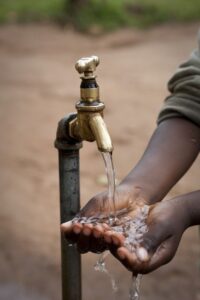 and vomiting can lead to short-term malnutrition due to not being able to keep food or water down while losing electrolytes and energy. It can also lead to long-term or chronic malnutrition through permanent damage to and inflammation of the intestines, causing a disorder called Environmental Enteric Dysfunction (EED). Children may eat enough calories and nutrients but may not be able to absorb them due to the damaged intestines. Repeated episodes of diarrheal disease, especially of children under the age of 5, can contribute to stunting, permanent nutritional imbalance, and impaired cognitive development (Gizaw, Yalew, and Bitew; 2022). A study in 2025 demonstrated that children drinking contaminated water had 3.3X higher risk of experiencing stunting compared to those drinking safe water (when comparing water that would be classified as unsafe based on the number of bacteria present) (Nugraheni et al. 2025). It is a vicious cycle: diarrheal episodes lead to insufficient nutrition, then intestinal damage, reduced appetite, and weaker immune systems, which can lead to more diarrheal episodes.
Third, safe water is essential for food preparation, both for cooking and hygiene. Water is necessary for many forms of cooking, but it is vital to have safe water to wash produce, cook meals, prepare infant foods, and eat meals with clean hands. Otherwise, there is an increase in disease risk. Even simple things like sanitizing toys and floors, ensuring animal waste does not get into the house, having animals remain outside the home, having concrete floors, and having suitable latrines and handwashing stations with soap can reduce diarrheal episodes. One study found that these actions can reduce diarrheal episodes and EED incidence and/or lead to linear child growth increases (Budge et al. 2019). While combined WASH plus nutrition-specific interventions (such as IYCF, complementary feeding, etc.) show even more promise.
Fourth, older children and adults also endure effects from unsafe water. Sick adults may be weakened and unable to function for a period of time which can affect their own food security but also preventing care for young children such as farming or cooking. An indirect result occurs when adults get sick from contaminated water and are unable to work to earn money to purchase food Additionally, when someone is sick in the family, they may have to spend their income on health care, rather than being able to use funds for purchasing food or inputs for a farm.
In conclusion, increasing food availability or access may not be able to solve food insecurity or malnutrition on its own. As the figure shows, water and food insecurity can and should not be treated separately. Instead, international development practitioners should begin looking at integrated programs that combine water and food security.
See also:
World Bank. https://www.worldbank.org/en/topic/agriculture/brief/food-security-update/what-is-food-security
Clark, G. and R. Egan. “Clean drinking water gaps linked to hunger and unsafe food worldwide.” Phys.org.
Gizaw, Z., Yalew, A.W., Bitew, B.D. et al. Stunting among children aged 24–59 months and associations with sanitation, enteric infections, and environmental enteric dysfunction in rural northwest Ethiopia. Sci Rep 12, 19293 (2022). https://doi.org/10.1038/s41598-022-23981-5
Nugraheni, Arwinda et al. “Investigating the Impact of Drinking Water on Urban Stunting in Indonesia.” Yonago acta medica vol. 68,4 306-314. 7 Nov. 2025
UNICEF/WHO, WHO/UNICEF Joint Monitoring Programme (JMP) – latest reports (essential baseline data)
https://phys.org/news/2026-06-gaps-linked-hunger-unsafe-food.html

 ns over millions of years were primarily hunter gatherers. Meat consumpion increased after domestication of animals (beginning around 10,000 years ago), “though it became more stratified by social class over time.”
