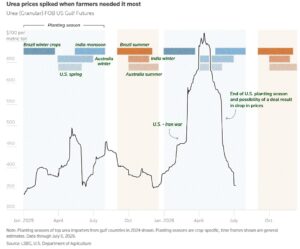
“The Iran War threatened a food crisis. The next Gulf conflict could do the same: Modern farming depends on cheap fertilizer. The war made fertilizer more expensive, with ships trapped, fertilizer plants shut down, farmers panicking and world food production thrown into peril”By Travis Hartman, Anurag Rao, Kripa Jayaram and Ed White.
The authors cite Vaclav Smil about how the world’s food production seen enormous gains in food production over a relatively short period of history, thanks to the processing of nitrogen into ammonia and then urea to fertilize croplands. (see Hunger Notes review of Smil’s book about global food). Reuters traces the history of trade and the chemical processes for generating fertilizer.
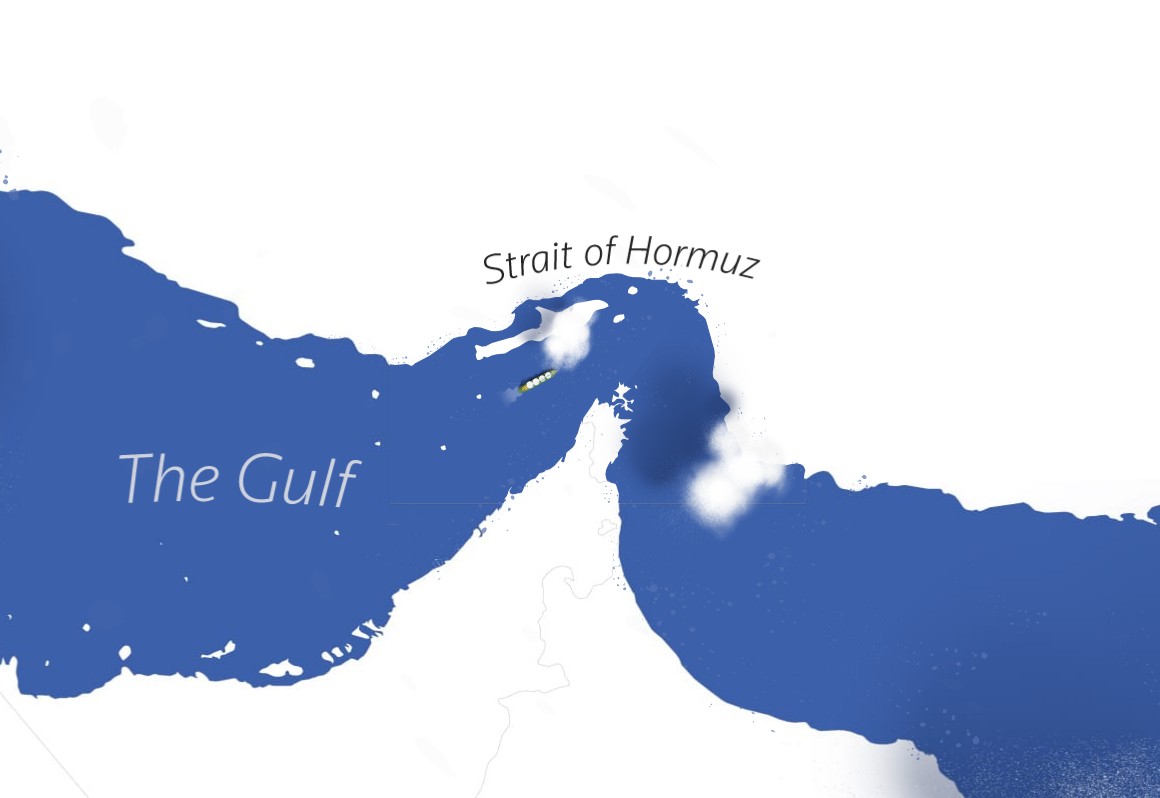
Reuter’s analysis explains why India, Africa, Brazil and other countries were the most vulnerable to this year’s sharp increases in fertilizer pricing. Reuters agrees with the Financial Times, as well as Hunger Notes articles that came immediately after the war in the Middle East began, and after seeing the price changes. Other analysts have pointed out that 35% of global crude oil exports, 20% of LNG exports, 20-30% of global fertilizer exports, and about 50% of global sulfur exports transit the strait of Hormuz, pictured above. Nitrogen fertilizer is more exposed as Gulf countries are major producers of nitrogen fertilizers, which depend on natural gas burned at high pressure to synthesize ammonia. Fertilizer producers in other countries also lack key feedstock inputs from the Middle East.
In terms of increases in malnutrition, the World Economic Forum describes this as a staged shock: it begins with energy-price spikes and logistics disruptions, moves to fertilizer shortages, then lower yields, with delayed transmission eventually producing higher food prices and market volatility months later. Cereal producers could face income losses of up to 5% in 2026, with effects lasting through 2030.
The Reuters analysis concludes that “The Iran war supply shock and the El Nino weather pattern could keep prices high for some time to come, a strain for vulnerable populations struggling to meet their daily needs.”
Vaclav Smil has produced an increasing repertoire of books summarizing how humans consume different resources. Over four decades he has visited many topics including food availability and its constraints. His latest 2025 book, “How to Feed the World: The History and Future of Food“ stands as his summum opus, and is the best current survey about the tension between human needs and food supplies, comparing key options and constraints. Therefore it is highly recommended to students, scientists, aid workers and general readers alike. The first section of his book tracks the inevitability of humans to depend on grains and legumes.
Smil highlights the paradox that some of the world’s largest food producers, like India, have significant undernourished populations. He attributes this to unequal “global entitlements to food” rather than insufficient production, pointing to economic, political, and social barriers that prevent equitable distribution. But he also is concerned with the ability of societies to grow enough food for a population growing toward 10 billion persons, particularly in Africa where crop yields are low and water/irrigation is limited.
Smil causes particular attention to food waste. He emphasizes the colossal scale of food waste, approximately 1,000 kcal per person daily in Western countries, with a third of food produced (around 3,300 kcal per person per day) wasted, including a quarter of unopened food in places like Britain. This inefficiency exacerbates hunger by reducing available food and straining resources, a critical issue as populations grow.
Much of the book tries to explain why certain crops and animals are produced and others are not, and why a few specific foodstuffs provide the majority of the world’s calories today, and how hard it would be to shift away from those key crops.
The book reviews the history of the human race and how most humans over millions of years were primarily hunter gatherers. Meat consumpion increased after domestication of animals (beginning around 10,000 years ago), “though it became more stratified by social class over time.”
The book also covers related topics like the dominance of a few staple crops (rice, wheat, maize, etc.) for global calories, the history of animal domestication, fertilizer revolutions (e.g., Haber-Bosch nitrogen), and incremental paths forward like precision agriculture, nutrient recycling, and population stabilization via development. Smil is patient in educating readers about the molecule cycles (such as nitrogen) involved in food ecology.
Much of the book may foment controversy. For instance, Smil directly poses and scrutinizes the questions: “Could the whole planet go vegan and be healthy? Should it?” His data-driven analysis highlights that many promoted plant foods (e.g., nuts, certain fruits, or intensive plant-based systems) carry high energy and resource inputs. Such a shift to veganism may ignore human metabolic realities, historical dietary patterns (meat consumption rose with domestication ~10,000 years ago and became stratified), and practical trade-offs. Similarly, Smil is skeptical of the scale-up prospects of laboratory-grown meat (without animals). He notes their high energy demands, costs, infrastructure needs, and biophysical realities that make rapid large-scale deployment unfeasible. This differs sharply from narratives positioning cultured meat as a near-term revolution for sustainability or feeding the world.
Organic farming also is seen as having limits. Smil acknowledges the upsides such as improved soil health but emphasizes scalability limits: heavy reliance on finite or unevenly distributed resources like animal manure and leguminous nitrogen fixation, lower yields compared to conventional systems, high labor demands, and nutrient-cycling bottlenecks. Proposals like massive double-cropping or cover-crop expansion overlook second-order effects (e.g., extra land needed for seeds).
Looking to the future, he recommends:
Improve Agricultural Efficiency: Boost crop productivity (especially in developing nations) through better agronomic practices (precision farming, optimized irrigation, soil health management) rather than just expanding farmland.
Reduce waste: About 30–40% of food is lost post-harvest or wasted in distribution and consumption. Smil advocates for better storage, transport, and consumer habits.
Reduce Meat Consumption: Shift toward less resource-intensive diets—Smil stresses that industrial meat production (especially beef) is grossly inefficient in terms of land, water, and feed use.
Reform Fertilizer Use: Nitrogen efficiency is key. Synthetic fertilizers (especially nitrogen) revolutionized agriculture, but overuse causes pollution (e.g., algal blooms, GHG emissions). Smil advocates for precision application and organic amendments. Recycle nutrients—Better utilize manure and food waste to close nutrient loops.
Don’t expect magical silver bullets: No single solution will “fix” global hunger. Smil critiques techno-optimism, arguing that diverse, incremental improvements are more reliable than radical shifts. Lab-grown meat & plant-based substitutes may help but will likely remain a niche solution in the near term.
Stabilize Population Growth: Slowing population via education, women’s empowerment, and economic development, which reduces future food demand.
Reduce Biofuel Mandates: channeling crops (corn, soy) into biofuels is inefficient which competes with food production and should be minimized.
Adapt to Climate Change by prioritizing resilient crops and farming systems over geoengineering or untested techno-fixes. Smil observes that rising temperatures and CO₂ changes will unevenly affect staple crops like rice and corn, especially in Asia and Latin America.
Smil has written often about food and history. Smil’s work on food production and agriculture emphasizes the intersections of energy, environment, and human systems, often highlighting the challenges of feeding a growing global population sustainably. He explores topics like the efficiency of food systems, the environmental impacts of dietary choices, and the role of technological innovations in agriculture. He obtained a Ph.D. in geography from Pennsylvania State University in 1971 and joined the University of Manitoba in 1972, where he became Distinguished Professor Emeritus in the Faculty of Environment.
– steve hansch, WHES
World Hunger Education
Service
P.O. Box 29015
Washington, D.C. 20017
For the past 50 years, since its founding in 1976, the mission of World Hunger Education Service is to undertake programs, including Hunger Notes, that
Educate the general public and target groups about the extent and causes of hunger and malnutrition in the United States and the world
Advance comprehension which integrates ethical, religious, social, economic, political, and scientific perspectives on the world food problem
Facilitate communication and networking among those who are working for solutions
Promote individual and collective commitments to sustainable hunger solutions.





 ns over millions of years were primarily hunter gatherers. Meat consumpion increased after domestication of animals (beginning around 10,000 years ago), “though it became more stratified by social class over time.”