




Reuters Analyzes Global Vulnerability to Fertilizer Prices & Hunger

July 10, 2026 Reuters news service posted a new infographic-rich analysis of how the world became dependent on fertilizer trade and the risks of Middle East conflict to world hunger at: https://www.reuters.com/graphics/IRAN-WAR/FERTILIZER/zjvqgwgakvx/
“The Iran War threatened a food crisis. The next Gulf conflict could do the same: Modern farming depends on cheap fertilizer. The war made fertilizer more expensive, with ships trapped, fertilizer plants shut down, farmers panicking and world food production thrown into peril” By Travis Hartman, Anurag Rao, Kripa Jayaram and Ed White.
The authors cite Vaclav Smil about how the world’s food production seen enormous gains in food production over a relatively short period of history, thanks to the processing of nitrogen into ammonia and then urea to fertilize croplands. (see Hunger Notes review of Smil’s book about global food). Reuters traces the history of trade and the chemical processes for generating fertilizer.
Reuter’s analysis explains why India, Africa, Brazil and other countries were the most vulnerable to this year’s sharp increases in fertilizer pricing. Reuters agrees with the Financial Times, as well as Hunger Notes articles that came immediately after the war in the Middle East began, and after seeing the price changes. Other analysts have pointed out that 35% of global crude oil exports, 20% of LNG exports, 20-30% of global fertilizer exports, and about 50% of global sulfur exports transit the strait of Hormuz, pictured above. Nitrogen fertilizer is more exposed as Gulf countries are major producers of nitrogen fertilizers, which depend on natural gas burned at high pressure to synthesize ammonia. Fertilizer producers in other countries also lack key feedstock inputs from the Middle East.
In terms of increases in malnutrition, the World Economic Forum describes this as a staged shock: it begins with energy-price spikes and logistics disruptions, moves to fertilizer shortages, then lower yields, with delayed transmission eventually producing higher food prices and market volatility months later. Cereal producers could face income losses of up to 5% in 2026, with effects lasting through 2030.
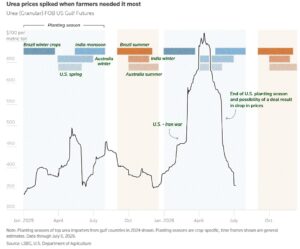
The Reuters analysis concludes that “The Iran war supply shock and the El Nino weather pattern could keep prices high for some time to come, a strain for vulnerable populations struggling to meet their daily needs.”
-Reported by WHES board member, Steven Hansch
-
 World Hunger Education
Service
P.O. Box 29015
Washington, D.C. 20017 -