


“Coming Food Crisis” Predicted in Financial Times Essay
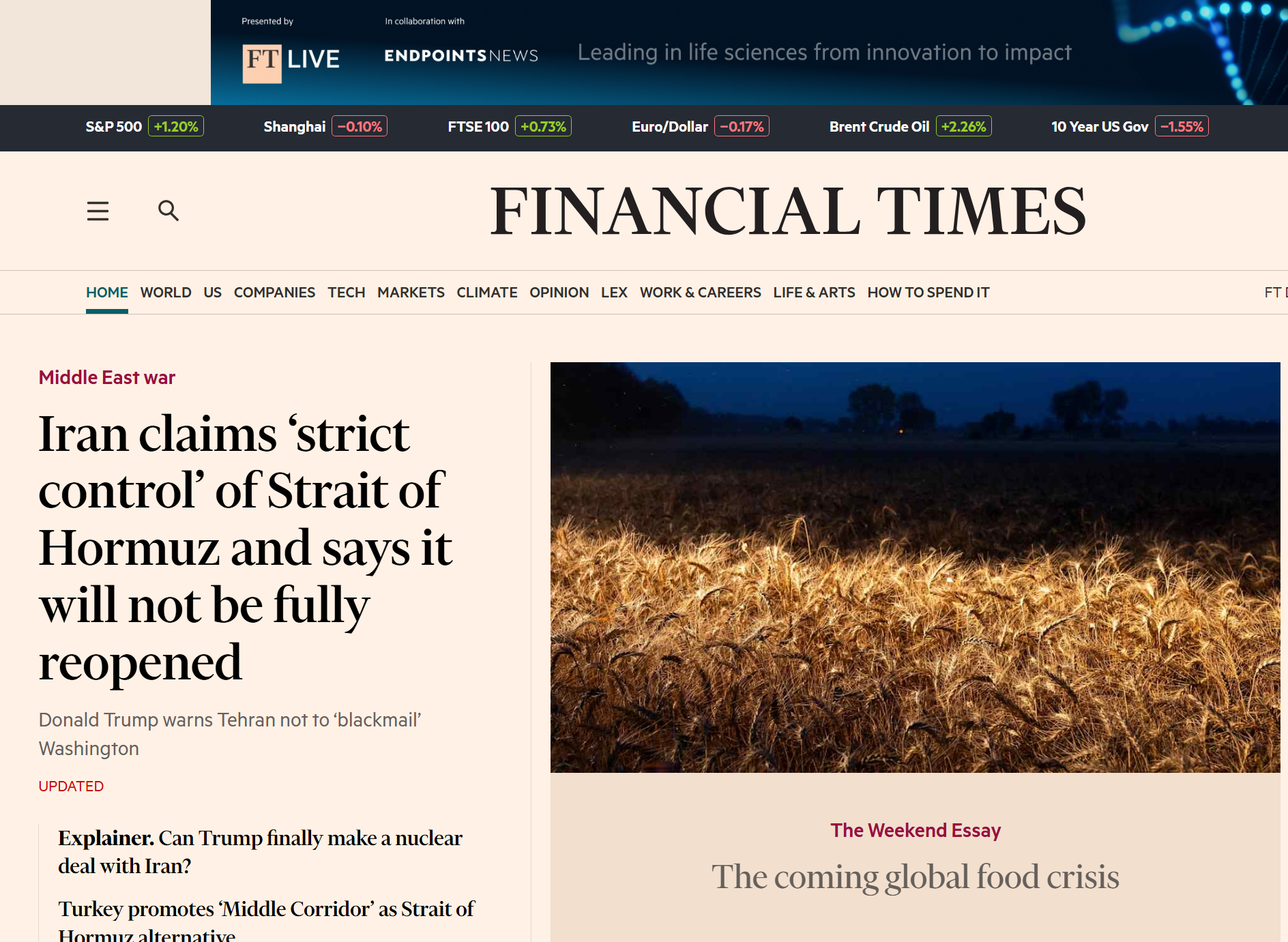
April 18, 2026 In a major Weekend Essay, Adam Hanieh, writing in the Financial Times British newspaper on April 17 2025, warns that the current Middle East conflict will cause a world food crisis. Hunger and even famine are foreseeable consequences of the war on Iran. The world should act to shield the poorest from effects that will continue long after the fighting stops.
The contraction in exports from the Middle East is not just a short-term increase in price for agricutural inputs; it risks actual production shortfalls in upcoming harvests. Rising energy prices always raise food prices.
Referring to how many countries have improved their food production over the last fifty years, the Financial Times essay explains how inter-connected today’s farms are with products from the Middle East, explaining how the the ‘Green Revolution’ of crop research established a link between food production & the fossil fuel industry across every stage of farming and “pushing back famine” across much of Asia and Latin America. Since many of these fertilisers are derived from natural gas, the Green Revolution meant that the world’s food production became ever more closely tied to a constantly increasing supply of hydrocarbon inputs.
The author details how sulfur, urrea, and ammonia from the Middle East are key components of farm inputs in China, India, Brazil, Morocco, Indonesia, Australia, the United States and other countries.
This Financial Times piece also explains how trans-shipment hubs, such as Dubai have become important for humanitarian supply chains, which will hinder aid to countries like Somalia and Sudan.
The essay argues that this is a slow-moving yet systemic crisis as farmers plant less now, with resulting smaller harvests months ahead, leading to further increases in food prices later this year. FT recognizes that poor countries will be hit harvest. While wealthier countries will experience inflation, low income countries may face famine.
The original author of the FT essay, Adam Hanieh is the director of the SOAS Middle East Institute and professor of political economy.
Note: This and other Financial Times articles are behind a paywall and not readily accessed absent a subscription. The link to the article is:
https://www.ft.com/content/36343e24-b06f-434d-a7e5-6046e7bcf3df
-Reported by Steven Hansch for Hunger Notes
-
 World Hunger Education
Service
P.O. Box 29015
Washington, D.C. 20017 -