Economic Sanctions Create Hunger, But Not Political Change

September 3, 2026      An analysis published in the New Arab explains that economic sanctions, part of economic warfare, disproportionately hurt the poorest segments of populations, while rarely achieving intended political goals.  It cites decades of research about how sanctions increase hunger among the most vulnerable citizens.

The authors, Jamal I. Haidar and Seyed M. Karimi on Sept 1 describe how economic sanctions make foods unaffordable for the already-worst-off.  “These are not abstractions. They represent real losses in nutrition, health, education, and dignity for millions of families who have no voice in the geopolitical disputes that triggered their impoverishment.”

The article, “The Sanctions Illusion” elaborates that “anyone who claims to care about the ethics of coercive statecraft must confront its distributional realities with the same rigour applied to questions of military tactics.  …Cross-country research spanning decades has documented that economic sanctions reduce GDP growth, widen income inequality, increase child mortality, limit access to health care, and expand food insecurity in target states. These are not marginal effects.  …Another documented that UN sanctions reduced life expectancy by 1.2–1.4 years. These are statistics of mass harm, describing damage done to households, not palaces.”

The research of Sylvanus Afesorgbo is referenced.  Looking at global experiences, he finds:  “Sanctions significantly increases the composite index of global hunger index (GHI), and also adversely affect the availability and stability dimensions of food security.”

The authors note that the theory of sanctions is to pressure target governments in ways that do not happen.  Contrary to theory, authoritarian governments avoid the pains falling on their hungriest citizens.  “The question is not whether states should have foreign-policy tools, but whether any tool that imposes the scale of civilian harm documented in the sanctions literature can be considered legitimate under the same ethical and legal frameworks we apply to armed conflict.”

The authors argue that the laws of war do not allow disproportionate targeting of the poor, and therefore economic sanctions should be held to the same scrutiny.   “The civilian harm they inflict is treated as regrettable collateral damage rather than a direct moral consequence of the sanctioning state’s choices.”

The authors’ argument:  “financial sanctions, as currently practised, rarely achieve their strategic objectives, and they inflict predictable, severe, and regressive harm on civilian populations who bear no responsibility for the policies sanctions are meant to punish. Such harms are not more humane; they are harder to see and easier to ignore.”

About the authors: Jamal Haidar is the Chair of the Economics Dept. at the Lebanese American University (chartered in New York); and Seyed  Karimi is Chair of the Department of Health Management and Systems Sciences at the University of Louisville, based in Kentucky.


– Contributed by Steven Hansch


Update about Hunger & War in Iran

July 26, 2026   By Stephen Sellers        What began as a single day of strikes on February 28, 2026 has become one of the longest and costliest U.S. military engagements in decades, and the humanitarian toll on Iran’s youngest children has deepened rather than resolved. Nearly five months on, the threat to child nutrition described in our initial briefing has moved from a fear we anticipated to documented reality, compounded by a currency collapse, a leadership crisis, and a war whose ceasefire has repeatedly failed to hold.

Hunger Notes reported large-scale population displacements in February.  Most of 3.2 million Iranians who were displaced have returned home.  A residual caseload of displaced remains from destroyed housing: 149,528 civilian units damaged (according to the Iranian Red Crescent, in June); ~400,000 people had homes directly affected. Only ~9,000 were still in tracked shelters in June.

Iran’s safety net appears to be effective at reaching vulnerable children, and preventing rates of wasting from increasing.  The Iranian Welfare Ministry food-basket program, Phase 34 (17–18 July 2026), which provides the most recent concrete figure, identifies 180,826 malnourished children aged 5–59 months who are enrolled for subsidized food baskets (152,788 in “very needy” households + 28,038 “moderate need”).

Malnutrition is worsening in the provinces Hunger Notes flagged as most vulnerable

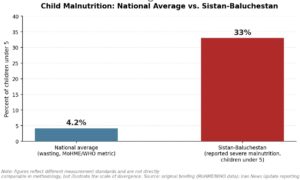
Sistan-Baluchestan, which was named in our February briefing as an already-strained border province, remains the hardest hit by hunger.  Up to one-third of children under five in the province now face severe malnutrition. Many families subsist on little more than bread and tea, and the loss of free school meal programs has left some students too depleted to concentrate in class or attend at all. Nationally, child stunting continues to concentrate in Sistan-Baluchestan, Kerman, and Hormozgan, alongside a parallel crisis of; roughly 30% of pregnant women are failing to gain sufficient weight during pregnancy.

The war has not ended — it has cycled through ceasefires that collapsed

After more than five weeks of fighting, the United States and Iran agreed on April 7–8 to a ceasefire that also encompassed Israel.  U.S. President Trump extended it indefinitely on April 21, but both sides violated it almost immediately. A June memorandum of understanding sought to reopen the Strait of Hormuz and formally end the war within 60 days. Instead, fighting resumed in July after Iran struck three commercial vessels that had bypassed its pre-approved shipping route. By mid-July, the U.S. President had declared the ceasefire over following a new round of strikes after Tehran targeted vessels in the strait, and as of July 18 there was no sign the renewed fighting would end soon; a week of intensified strikes had left the ceasefire in tatters. Adding to the instability, Iran’s Supreme Leader Ali Khamenei was killed and buried after marathon funeral ceremonies. His son and successor, Mojtaba, has not appeared publicly since taking over leadership.

Overall food production is up this year, or near average according to the U.N. Food and Agriculture Organization.  The Government is purchasing large amounts of wheat, but remains constrained in being able to pay farmers.  Iran has imported 22 Metric Tons of food, with Russia as the main source.

Iran’s food supply (production plus imports) has recovered  over the six months, while household food security has deteriorated sharply due to inflation and the collapsing value of the Iranian currency, the rial.

A collapsing currency has turned food into a luxury for many

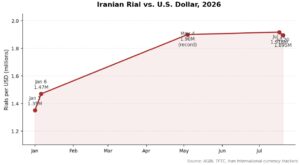
The economic backdrop against which malnutrition is now unfolding is far worse than in February. Iran’s currency, the rial, approached 1.95 million to the dollar on July 20  down in value by roughly a third since January,with the IMF projecting nearly 69% average inflation and a contracting economy for 2026, leaving the official minimum wage worth only about $87 a month. Iran has not published GDP data since 2024, and a nationwide internet blackout has made even the country’s own statistics hard to verify from outside.

Food prices have increased 140% year-on-year, with flour up 170% and rice up 220%.  One dollar bought roughly 1,350,500 rials on January 1; by July 20 it bought nearly 1.9 million.  This means a  household purchasing-power collapse layered directly on top of the wartime disruption to food imports described in our original briefing.

The blockade of the Strait of Hormuz is squeezing food and fertilizer supply chains region-wide

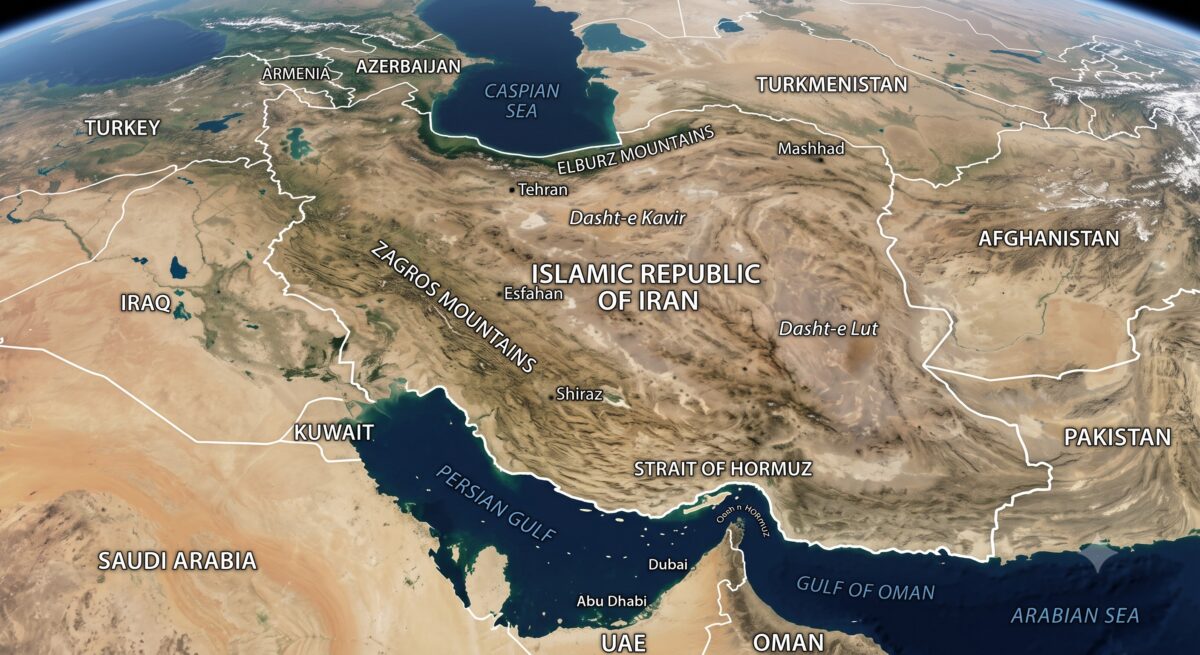
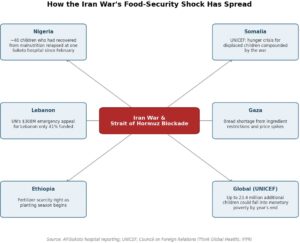
More than 90% of Iran’s annual trade passes through the Strait of Hormuz. The strait’s effective closure, combined with a subsequent U.S. blockade, has cut off up to 70% of Iran’s export revenue. The damage is not confined to Iran. Since the end of February, roughly 3.9 million tons of fertilizer exports, about 30% of the Gulf states’ annual fertilizer trade, have been suspended, and shortage risk keeps rising the longer the strait stays closed. The war continues to choke deliveries of fuel, fertilizer, medicine, and aid shipments transiting the Middle East, forcing the World Food Program and Save the Children to reroute aid around restricted waterways, adding weeks of delay and millions of dollars in cost.

The war’s humanitarian shockwaves have reached far beyond Iran’s borders

Perhaps the starkest change since February is how far the malnutrition impact has traveled. This past March, Hunger Notes projected that increases in fertilizer prices would result in reduced food production worldwide, and resulting hunger.

Save the Children, the nonprofit, projects that every $5 rise in oil prices tied to the conflict wipes out a month’s worth of life-saving humanitarian aid for nearly 40,000 children. . In Nigeria, children who had recovered from malnutrition are relapsing: hospital records in Sokoto show nearly 40 children previously treated since February back under treatment, with many more undocumented, as families lose income to war-driven fuel price increases. Hunger Notes,  UNICEF, Reuters, and the Financial Times have warned that a continued war will likely  push up to 23.4 million additional children worldwide into monetary poverty by year’s end.

What has changed, and what hasn’t

The core vulnerabilities identified in February include Iran’s large under-five population, pre-existing pockets of wasting and stunting concentrated in Sistan-Baluchestan and other border provinces, a food supply chain dependent on imports now vulnerable to blockade, and a government historically wary of Western humanitarian NGOs — have all held true and intensified. What has changed is the scale and duration: a war many observers once expected to last days or weeks instead approaches its fifth month with no durable ceasefire, a currency in freefall, a change in the country’s top leadership, and malnutrition effects now documented as far away as Nigeria and Somalia. Without a lasting cessation of hostilities and a functioning channel for food and medical imports, the compounding crisis facing Iran’s youngest children, and the children of countries dependent on the same shipping lanes and aid budgets, shows no sign of leveling off.

Humanitarian aid to Iran is relatively small.  Domestic organizations, such as the Iranian Red Crescent Society, provide most aid.  In April 2026, the ICRC delivered more than 170 tons of relief supplies, followed by another 18-ton shipment in June, UNICEF continues to provide child health, nutrition, vaccines and hygiene.

Further Reading:

FAO’s Global Information and Early Warning System

World Food Programme


Fertilizer Prices and Hunger Increase from Middle East War

March 20, 2026      Malnutrition rates are likely to increase worldwide due to fertilizers becoming less available.  The primary driver for  significant increases in fertilizer prices is the disruption of nitrogen and phosphate production from the current war in the Middle East.

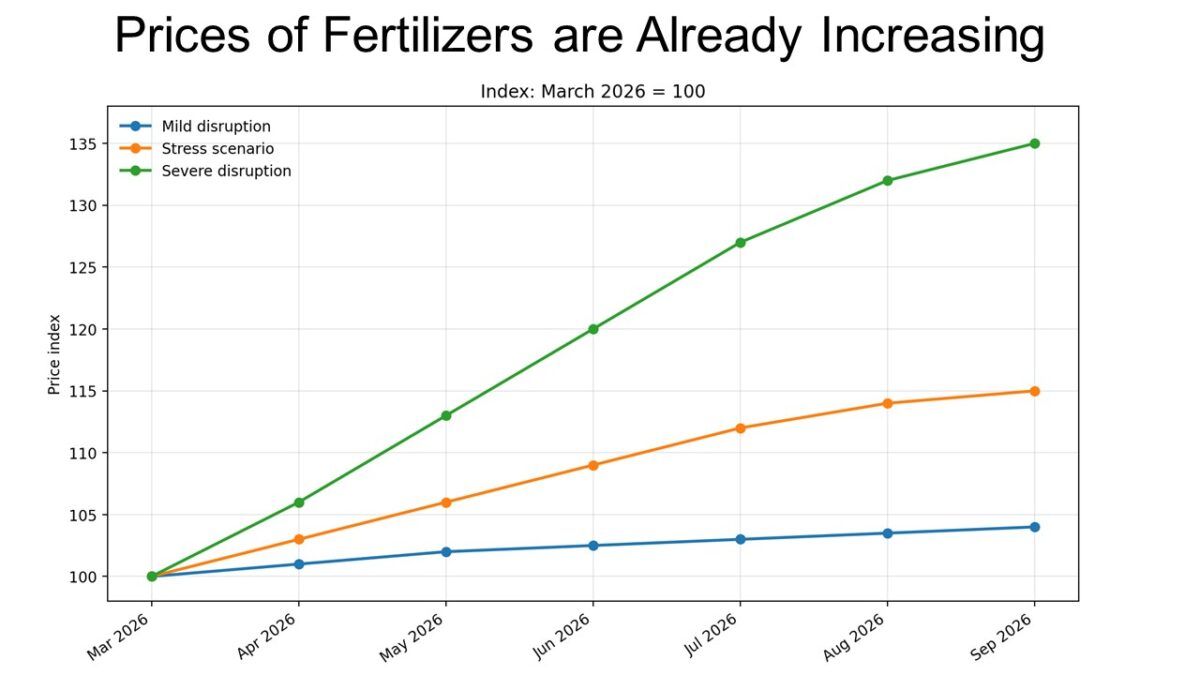
The Middle East is a critical hub, accounting for roughly 10-50% of the world’s urea production and nearly half of the global tradable supply of sulfur (an essential input for phosphate). Furthermore, record-high natural gas prices in early 2026 have pushed the variable costs of ammonia production significantly higher.  Fertilizer prices were already rising in early 2026, while major upside risks include conflict-related shipping disruption, tighter nitrogen and phosphate exports, and natural-gas uncertainty.  The WorldBank reported that fertilizer prices gained 6.5% in February 2026.  Other groups, such as the FAO, Argus, and CRU have each flagged conflict-related risks to fertilizer and energy flows, especially through the Middle East and shipping routes.

The two charts shown, that are modeled on current trends suggest that key fertilizer prices may double in the coming 6 months.

The critical chokepoint has been the Strait of Hormuz. Following the war in late February 2026, the Hormuz waterway, which is responsible for a third of the world’s seaborne fertilizer trade, has closed, sending urea prices at NOLA up roughly 30% in the first two weeks of March alone.  Shipping costs through the Red Sea have also risen more than 50%, further compressing margins across the supply chain.

The World Economic Forum adds:  “It’s not just shipping that’s been disrupted. Qatar was forced to halt production at one of the world’s biggest urea plants last week, in the midst of what is planting season in much of the world.  As of 2022, Qatar’s exports of synthetic nitrogen fertilizers including urea were keeping nearly 43 million people fed in the US, Brazil, and India alone.

Sustained 40-to-60% price increases cause farmers, including  smallholders, to under-apply nutrients, which translates into yield losses 6–12 months downstream. That lag is what makes the current moment especially dangerous for food insecure populations heading into late 2026.  In other words, malnutrition is projected to increase after a lag time.  Malnutrition will be widespread and diffuse, not localized to one area.


–  Contributed by WHES board member, Steven Hansch


Increased Hunger and Conflict in Afghanistan

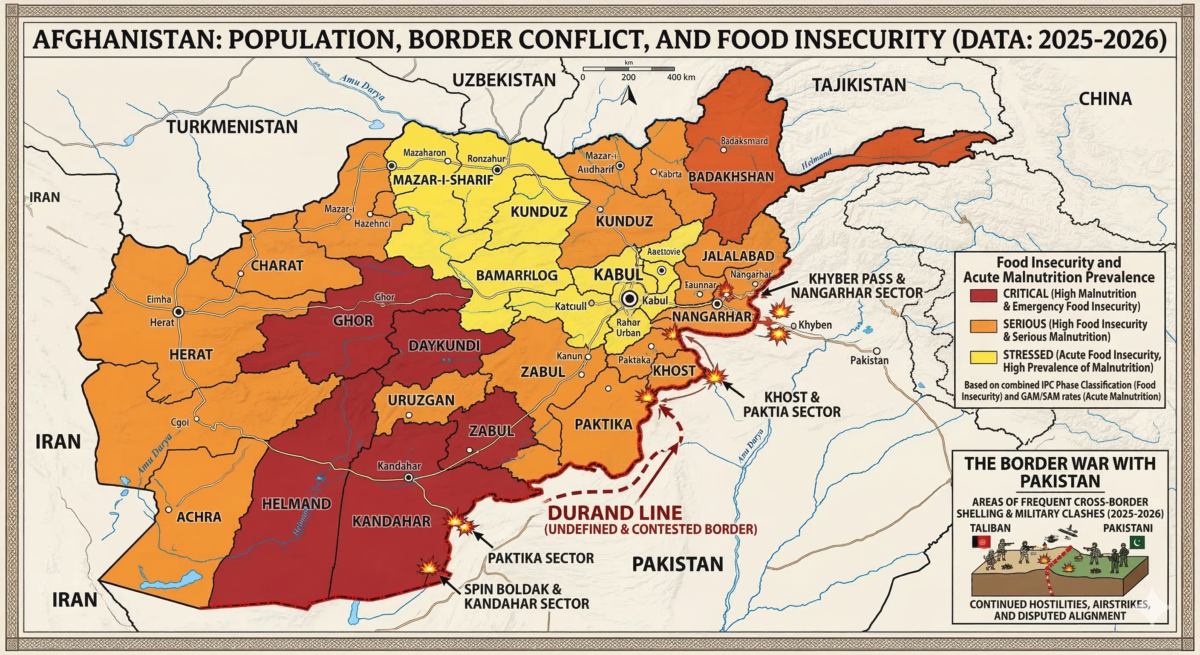
Afghanistan is currently facing a severe food insecurity crisis driven by several compounding factors. According to the UNHCR,  in 2025, both Pakistan and Iran tightened their migration policies, forcing large numbers of Afghan refugees to return to Afghanistan.

The Pakistan–Afghanistan border has become a combat zone, and Pakistan has conducted airstrikes inside Afghanistan along with ground operations, displacing 66,000 Afghan civilians.  As of mid-March, armed clashes continue in several Afghan provinces (Khost, Paktia, Paktika, Kunar, Nangarhar, Kandahar), with both sides reporting heavy losses. Pakistan claims to have destroyed militant infrastructure, while Afghanistan accuses Pakistan of targeting civilians and civilian areas.

An estimated 2.7 million Afghan refugees were forced back to Afghanistan in 2025 from Pakistan and Iran, straining Afghan public services. Pakistan has also closed the border and suspended trade, a devastating blow to the landlocked Afghan economy.  Many of these returnees are struggling to reintegrate due to limited employment opportunities and the lack of basic services such as food, clothing, and shelter. In addition, many refugees sold their homes when they fled Afghanistan and are now returning with no place to live.

Making things worse, major border crossings have been closed since late 2025 due to the conflict with Pakistan, interrupting food trade.  Compounded by its war with the U.S., Iran (Afghanistan’s western neighbor) has halted exports to Afghanistan of some food products, worsening Afghan food shortages and raising prices.   As a result, Afghanistan is shifting toward northern suppliers.

Kazakhstan nearly doubled grain exports to Afghanistan between late 2025 and early 2026.  Afghanistan cannot produce enough staple food domestically.  For example, wheat consumption for its population of 45 million is roughly 6.8 million metric tons per year, whereas domestic wheat production is about 4.8 million tons, with the shortfall made up through imports from Russia, Kazakhstan, and Central Asia.

The influx of returning refugees is placing additional strain on already scarce resources. At the same time, Afghanistan is experiencing a severe water shortage caused by a drought that has persisted for more than four years. The FAO estimates that snowfall during the 2025–2026 winter is at a 25-year low, significantly affecting agriculture and livestock production. As a result, it is estimated that roughly half of Afghanistan’s population is facing severe food insecurity and poverty.

The prevalence of malnutrition has increased over the last year, reaching record highs.  Acute malnutrition for children under five increased by approximately 7% compared to early 2025. In 2026, an estimated 3.7 to 4 million children are projected to suffer from acute malnutrition, with nearly 1 million of those facing Severe Acute Malnutrition.  Approximately 1.2 million pregnant and breastfeeding women are also expected to be acutely malnourished this year.

Afghanistan’s per capita GDP is estimated at about $400 per year and has declined by 20% from a few years ago.  By this measure, the Afghan people are the poorest in Asia.  The chart at right compares the prevalence of undernutrition in Afghanistan to some of its neighboring countries.

Children are still being measured to identify malnutrition, but the system is under immense strain.  Families stopped taking children to health centers as they knew that supplies of recovery foods would not be available.  Many children are “dying silently at home” because families cannot afford the transport to clinics, or facilities have closed due to earthquake damage and lack of staff funding.

The departure of U.S. troops in August 2021 and the subsequent 2025 cessation of all USAID aid to Afghanistan fundamentally broke the primary supply and distribution model.  Last winter, the WFP provided aid for 6 million people but have cut that back to only 1 to 2 million people.

In addition to UNICEF and WFP, nonprofits who are responding to hunger in Afghanistan are:  Action Against Hunger (ACF), Concern Worldwide, CARE, Norwegian Refugee Council, Save the Children, International Rescue Committee, Mercy Corps, Islamic Relief Worldwide, MSF, and World Vision.

The war is being fought over Pakistan’s demand for Afghanistan to eliminate militant safe havens and Afghanistan’s refusal to comply, compounded by historical grievances and border disputes. Pakistan is accusing Afghan forces of drone attacks on its civilians.  The human cost is mounting daily, with civilians bearing the brunt of the violence and displacement.  The Durand Line, the contested border between the two countries, has long been a flashpoint. Both sides accuse each other of violating sovereignty and supporting insurgent activities across the border.  Recently, China publicly urged both sides to hold face-to-face talks and seek a ceasefire. Turkey has also offered to promote a ceasefire.

Update:   As of March 16, Al Jazeera reports that Afghanistan accused Pakistan’s military of launching an airstrike on Kabul’s Omar Addiction Treatment Hospital, a 2,000-bed facility, killing at least 400 people.  Pakistan dismissed the claim as “false and aimed at misleading public opinion,” saying it only targeted military installations.  The attack entered its third week of the deadliest fighting between the two countries in years.

Humanitarian Impact:  Nearly 66,000 people were displaced in Afghanistan as of early March, with the UN’s International Organization for Migration warning of the “growing humanitarian impact on civilians.”  Schools and markets in several border districts remain closed, mortar fire has forced families to flee villages in northwest Pakistan, and aid operations in parts of Khyber Pakhtunkhwa have been temporarily suspended.

For further learning:

https://fews.net/middle-east-and-asia/afghanistan?utm_source=chatgpt.com

https://reliefweb.int/report/afghanistan/afghanistanpakistan-conflict-update-situation-report-1-march-10-2026?utm_source=chatgpt.com

https://www.fao.org/emergencies/where-we-work/AFG/en?utm_source=chatgpt.com

Threat of Child Malnutrition in Iran Amid U.S.–Iran Conflict

February 28, 2026       The U.S.–Iran war that began today, 28 February 2026, threatens to sharply worsen malnutrition among children under five in low-income urban neighborhoods of strike zones (Tehran, Isfahan, Kermanshah) and in rural border provinces (e.g., Sistan-Baluchestan and Kurdistan) that already experience high malnutrition rates.

Iran, with a total population of 93 million people, has 7 ½ million children under five years of age, which is more children than Germany, the UK, Canada, Iraq, Syria, Italy, Turkey, or France.

Over the last few decades the occurrence of childhood stunting (a form of long-term malnutrition) and of wasting (short-term) malnutrition have declined in Iran, reflected by the government’s attention to treating malnutrition.   However, studies in southern Iran from 2018 to 2023 show a significant increase in underweight and wasting among young children, with the annual % change of severe wasting increasing by 8.9%.  Nationally, the rate of wasting has averaged 4.2%, which is medium for regional and peer countries.  Iran’s Ministry of Health and Medical Education (MoHME) manages child malnutrition programs through primary healthcare centers, hospitals, and nutrition initiatives.  Treatment follows protocols similar to WHO/UNICEF guidelines for community-based management of acute malnutrition, which emphasize outpatient therapeutic care using Ready-to-Use Therapeutic Food (RUTF) for severe malnutrition.

The most widespread micronutrient deficiency diseases in Iran include vitamin D (rickets), iron (anemia), vitamin A, and zinc deficiency.  Iran addresses these through national programs (e.g., supplementation, fortification of foods like flour with iron/folate, salt iodization, and targeted UNICEF-supported interventions in high-risk provinces), but challenges persist due to economic factors, dietary habits, and regional disparities.

Even before the current war threats, Iran’s food economy was struggling under the weight of international sanctions and mismanagement.  The conflict will further reduce Iranian families’ ability to afford food.  In fact, the protests that broke out in December 2025 were in part over increased food prices after the rial plunged against the U.S. dollar.   There has been criticism by Iranians that their government has failed to present a clear emergency response plan, leaving citizens to fend for themselves. 

Iran produces much of its own wheat, dates, barley, rice, pistachios, walnuts, citrus fruits, and saffron.  It imports rice, cooking oils, soybeans, sugar, tea, and dairy.  The fighting will disrupt Iran’s ability to import food commodities, tightening supply.  Agricultural supply chains, transportation networks, storage facilities, and water infrastructure are all vulnerable.  Damaged roads and ports will impede food distribution across the country.

Urban bombardment now underway in Tehran and other major cities will displace families.  Reuters today reports that Iranians have fled cities in search of safety, rushed to stock up on food, and formed long queues at fuel stations as attacks by the United States and Israel spread fear and panic throughout the country.  Iranian government messages have explicitly encouraged people to leave Tehran and other targeted cities to avoid attacks.  This kind of internal displacement typically leads to overcrowded towns, strain on services, and informal settlements on the periphery of safer cities.

Internally displaced populations lose access to stable food sources, income, and caregiving routines.  Young children are disproportionately harmed by the disruption of feeding practices and by unhygienic displacement conditions that compound malnutrition with infectious disease.

Iran is known as a country that takes care of refugees.  Estimates vary, but UNHCR and other agencies report roughly some 3.8 million refugees and people in refugee-like situations in Iran as of 2025, overwhelmingly from Afghanistan and a smaller number from Iraq and other countries.

Iran has been prone to disasters due to large earthquakes and famines.  As well, in February 1972, a week-long series of storms  brought up to 26 feet (8 meters) of snow in rural areas of western Iran which buried over 200 villages, killing thousands.

Iran also suffered severe famines in 1870-72 and during the First and Second World Wars.  The most recent UN Food and Agriculture Organization report about Iran (November 2025) notes that persistent dry weather has hampered winter wheat plantings, leading to an estimated cereal production nearly 10% below the five-year average in 2025.  It found that wheat prices in Tehran had risen 50% and rice prices had tripled, compared to the previous year.

Iran has a fairly extensive domestic social protection system by regional standards, though it has faced significant strains in recent years.  The Imam Khomeini Relief Committee (IKRC) is one of the largest non-governmental charitable organizations in the world by some measures. It operates under government supervision and provides cash transfers, food assistance, healthcare subsidies, and vocational training to millions of low-income Iranians. It draws on religious endowments (waqf) and public donations alongside state funding.   The State Welfare Organization (SWO) handles a broader range of social services including disability support, elderly care, and assistance for vulnerable families.

International aid agencies help Iran in disasters, including the Red Cross.  The national Red Crescent society of Iran, part of the global IFRC network, has deep roots in domestic disaster relief, rescue, and healthcare operations.  The International Committee of the Red Cross (ICRC) has been working in Iran since the late 1970s.  The ICRC provides humanitarian services related to conflict-affected populations, health, and protection.

Médecins Sans Frontières (also known as Doctors without Borders) has been operating health programs in Iran.  Many other international NGOs have been hesitant to work in Iran, where the government distrusts Western organizations.  An exception has been Relief International (RI), which was founded in 1990 following the catastrophic Manjil–Rudbar earthquake in northern Iran.

The convergence of active conflict, pre-existing economic strain, and disrupted supply chains creates a compounding crisis for Iran’s most vulnerable — particularly children under five.  International humanitarian organizations face their own obstacles operating in Iran, given longstanding government suspicion of Western NGOs. The children most at risk — those in strike zones like Tehran and Isfahan, and those in already-malnourished border provinces like Sistan-Baluchestan — are precisely the populations least able to weather further disruption to food access, clean water, and caregiving. Without rapid and coordinated humanitarian response, the malnutrition crisis that predates this conflict will deepen sharply, with consequences that will outlast the fighting itself.


–  Contributed by WHES board member, Steven Hansch