
Ethiopia’s Decades-Long Malnutrition Crises

June 16,2026      In Ethiopia, Africa’s second-most populous country, roughly one in eight Ethiopians suffer food shortages in mid-2026 in many region-specific overlapping crises caused by fighting, drought, population displacements, refugees, sky-high prices, and sudden cuts in international aid.

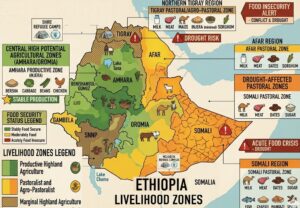
A 2026 humanitarian analysis citing FEWS NET projected about 15. to 16 million Ethiopians in acute food insecurity, with IPC Phase 3 Crisis and Phase 4 Emergency conditions expected in parts of the country by this coming July 2026.  Large parts of eastern and southern Ethiopia are at “Crisis” level, meaning families are skipping meals, selling their animals, and running out of options. Some pockets near Harar, Dire Dawa, and the lowlands of East Hararghe in the east are Emergency level. Conflict-hit areas in Amhara and Tigray are also food insecure.

Children suffer most. Many are “wasted” (too thin for their height), which weakens their immune systems and can cause lifelong problems. In treatment centers in Gambella, the death rate for severely malnourished children reached 3.2%. . Similar death rates appear in Benishangul-Gumuz (2.7%) and South Ethiopia (2.8%). These are regions with almost no aid organizations working on nutrition, even though the need is urgent.

Tigray has repeatedly been a particular famine zone. SMART surveys and rapid nutrition assessments in Tigray and Amhara found child acute malnutrition above 15%, and 20% in four Tigray woredas.  From 2020 to 2022, a war between the government of Ethiopia and Tigray created a humanitarian crisis in Tigray.   Nutrition reporting from Tigray during the war was sparse.  Estimates of famine and civilian deaths during the war range from 96,000 to 378,000.
Causes for Ethiopia’s food crisis today:

  1. Conflict and displacement Fighting in Amhara, parts of Oromia (especially Wellega zones), and earlier wars in Tigray have forced more than 1.5 million people from their homes in Amhara and Afar alone. When people flee, they lose their farms, livestock, and access to clinics. Many health centers were looted or destroyed, so children cannot be screened or treated for malnutrition.
  2. Drought and climate shocks Pastoral communities in the Somali region (especially Doolo and Korahe zones), Afar, and South Ethiopia have suffered years of failed rains. Herders lose their animals — their main source of food and income. Some areas also face floods that destroy crops. These zones are often remote and “data-dark,” meaning they have not been properly surveyed recently, so the true scale of suffering is hidden.
  3. Aid cuts and supply breaks In 2023 a major scandal over stolen food aid led to a nationwide pause in deliveries. In 2025, big funding cuts (especially from the United States) caused the main program that feeds moderately malnourished children to stop across the entire country. Special peanut-paste treatment for severely malnourished kids also ran short. Refugee camps in Gambella region saw nutrition services shut down in several camps.

Foreign Assistance

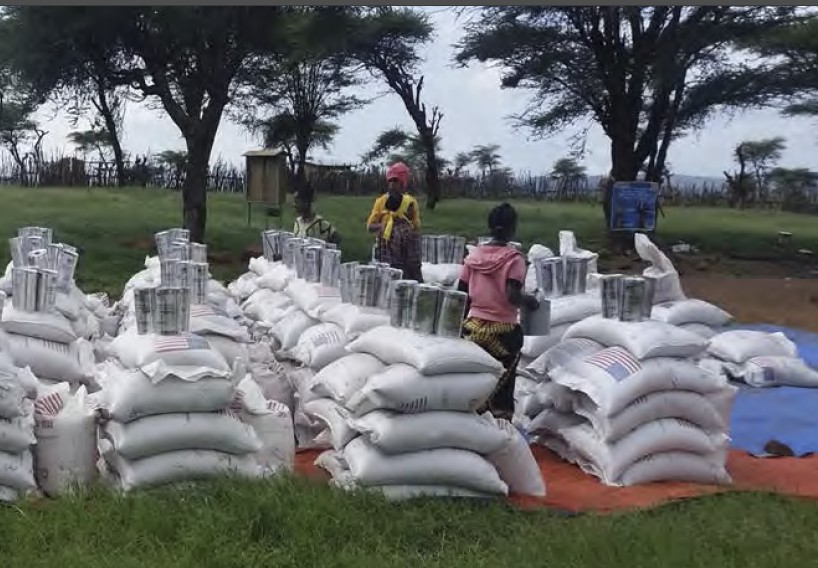
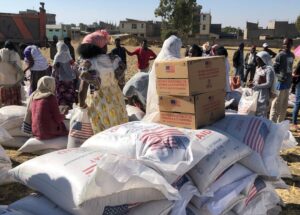
Over the last fourty years, Ethiopia has received more food aid than any other country, around $20 billion worth, about half of it from the United States.  Most of the food aid has been to avert malnutrition among children or respond to famine.  Food aid was interrupted in 2023 over findings of food theft.

In the last decade, the U.S. Government has invested heavily in a single country-wide program called the Joint Emergency Operations Program (JEOP), led by Catholic Relief Services and including CARE, World Vision, Save the Children, Food for Hungry, ORDA, and REST.  Currently, the US Department of Agriculture is funding WFP in Ethiopia and reviewing proposals for new NGO emergency food and nutrition assistance, likely in the $80 million range.

Separately, the Joint UN Initiative for the Prevention of Wasting was launched in Ethiopia in August 2025 by the Federal Ministry of Health with WHO, UNICEF, and WFP, supported by FCDO. It is a five-year, multisectoral effort to prevent wasting among children 0–18 months in food-insecure settings.
The Ethiopia Nutrition Cluster (a group of UN agencies and NGOs) coordinates humanitarian assistance. dozens of high-need zones, especially in Gambella, South Ethiopia, parts of Somali, and conflict areas of Amhara and Oromia, have zero or only one nutrition partner. These “neglected gap zones” are the places where extra help could save the most lives.

In addition to the agencies mentioned above, aid nonprofits (NGOs) that address food and nutrition in Ethiopia include:  Oxfam, Welthungerhilfe, GOAL, Mercy Corps, Action Against Hunger, Project Hope, Tearfund, Plan International, Concern Worldwide, Islamic Relief, Cordaid, Terre des Hommes, and Norwegian Church Aid.

Many aid agencies work via networks such as the half-century-old  Consortium of Christian Relief and Development Associations (CCRDA).   In Tigray, a long-term relief agency that managed food aid in multiple famines is the Relief Society of Tigray, known as REST.


In Memoriam: Mohamed Warsame Dualeh

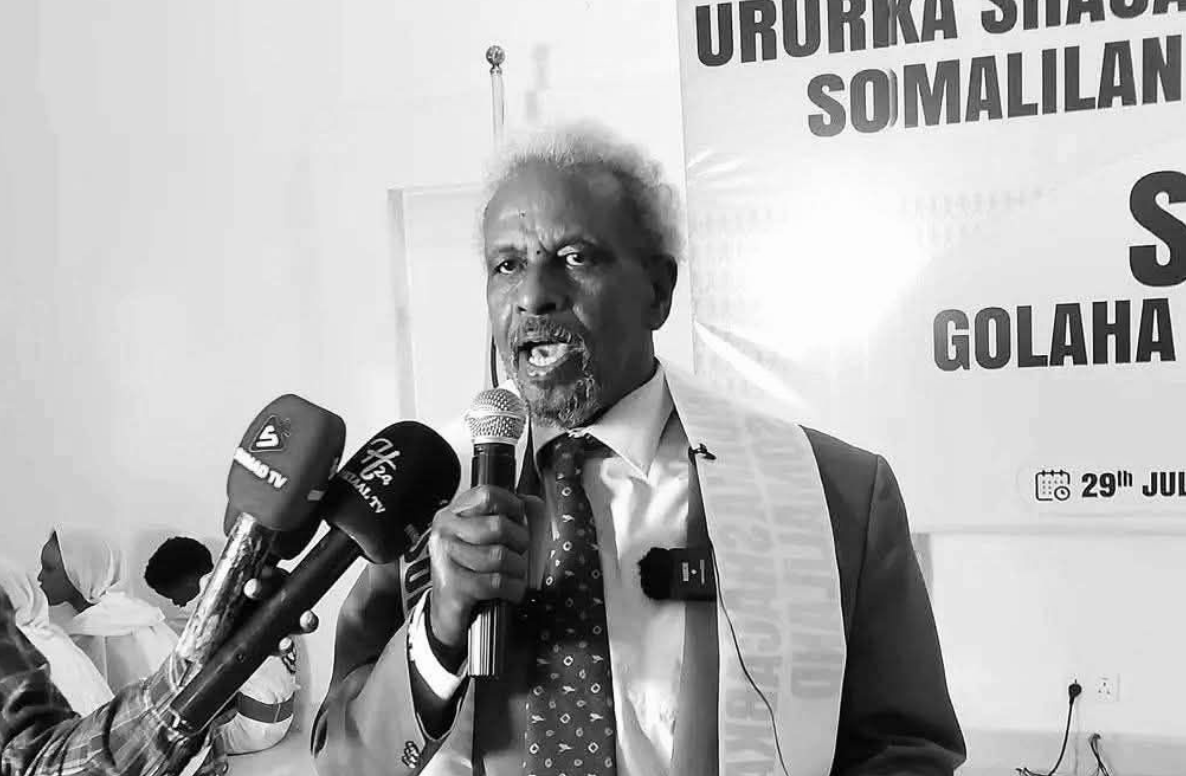
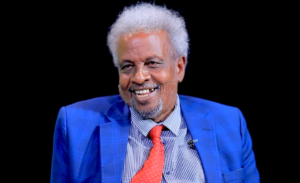
May 3, 2026         Dr. Mohamed Warsame Dualeh, a Somali physician, refugee-health leader, humanitarian official, and later diplomat, died on April 25, 2026 in Germany.  He is survived by his wife, Marie Therese Lenz, and children, Amalie, Issa, and Edna.  Among the positions he held during his distinguished career were Head of Operations in Darfur for UNHCR and Director of the Somalia Refugee Health Unit.

Over a career that spanned public health, refugee operations, and international diplomacy, he served vulnerable communities across Somalia, the Horn of Africa, Sudan, and beyond.  He retired in 2014 and became adviser to the President’s office in Somaliland, working hard to get the new nation organized in public health and soliciting international recognition and support.  He continued to offer his services to the UN into 2025.

He was born on April 14, 1954.  He graduated from the Benadir Medical School in Mogadishu and the University of Sydney where he obtained a Master’s degree in Public Health, writing his thesis on maternal and community health worker care for diarrheal diseases of children in rural Somalia.   As Dr. Ahmed Magan remembers: “Dr. Warsame was my medical school classmate and graduated with distinction. He was a pioneer in Somalia, recognizing early on that public health and Primary Health Care (PHC) were the most effective ways to serve a community with limited resources and a high disease burden.”

His formative experience was with the Refugee Health Unit in Mogadishu, which coordinated care for Ethiopian refugees who had fled to Somalia.  That early work grounded the rest of his career:  he belonged to the generation of Somali doctors whose medical service quickly became inseparable from conflict, displacement, and the survival of uprooted families.  The RHU oversaw up to 35 camps of Ethiopian refugees.  Dr. Dualeh wrote: “It is extremely important to take health care to the refugees – to have an outreach program.”

Mike Toole recalls: “I worked with Mohamed Warsame Dualeh in Somalia in 1981 and 1982 when I was the senior medical adviser in the Refugee Health Unit (RHU) within the Somali Ministry of Health. The RHU coordinated the health programs within … camps for one million ethnic Somali refugees from Ethiopia scattered throughout the country…Mohamed eventually became the RHU director, based in Mogadishu. He was a major force in establishing the RHU as a unique national unit that based the Refugee Health program on epidemiological evidence, primary health care, community participation, standard treatment protocols, and prevention. …He was a trailblazer in Refugee Health …[in] a stellar career in the UNHCR.”

Beverly Snell explains about the RHU: “It was the first …primary health care (PHC), community-based approach to refugee camp health management…. Traditionally refugee health care had been very top down and often dependent on foreign professionals. …it was the leadership of people like Mohamed Warsame that made it work.  So much so that the host population was complaining that refugees had better health care than they did.  And that led to starting the PHC approach in the host population to, (a harbinger for the policy adopted by the Sphere Handbook).  Mohamed Warsame’s contribution in the leadership of both RHU and national PHC made a huge impact.”

Kate Burns remembers: “He was always Warsame to me.  Great guy.  Very easy to get along with…we met again when I joined UNHCR’s Health Unit in 1995/6 in Geneva…a really lovely man.  I loved greeting him in the few Somali words I remembered.  ‘Nabad, Suba Wanagsan, Nabad Geleyo’.”

With the RHU, Dr. Warsame oversaw an historically important model refugee health team, a model that merited being replicated around the world.  It was an all-star team of experts who created standards such as serial surveys of malnutrition among children in the camps to identify changes in the rates of malnutrition, knowledge of breastfeeding and oral rehydration, and other life-saving measures.

Surveillance in the camps in the early-80s revealed an outbreak of scurvy, a vitamin C deficiency disease, caused by a lack of camel’s milk in the refugees’ diet, an overdependence on standard rations provided by donors, and an accompanying lack of access to local markets where they might have bartered for fresh vegetables such as tomatoes and onions.

Dr. Jama Gulaid recalls:  “I will remember Mohamed for his devotion to the health and welfare of refugees. I travelled hundreds of miles with him while doing refugee work. Our challenges were many — heat, dust, and poor accommodation and food — but still immensely better than those facing refugees. Mohamed was undaunted, his energy undiminished, a spark in his eyes as he engaged vulnerable people as warmly as a physician in a comfortable office in a developed country.”

In a 1994 UNHCR paper about refugee family health, Dr. Warsame argued for a practical and humane principle that seems to capture his whole approach: “It is extremely important to take health care to the refugees – to have an outreach program. It has to be easily accessible.”  In the same piece, he recalled conditions in Hartisheik, of Somalis in Ethiopia, this is incomplete in 1988, where mortality among children under age five was exceptionally high in part due to inadequate food rations, and inadequate provision of water and sanitation compounded the crisis. He advocated for training refugees as health workers and birth attendants, and bringing care closer to families instead of forcing desperate mothers to travel long distances for help.

He served in multiple roles for the United Nations High Commissioner for Refugees (UNHCR), including as its focal point for HIV/AIDS and chair of IAAG, serving in the Programme and Technical Support Section in Geneva.

CDC’s Brent Burkholder remembers “I remember him as being a kind, quiet person but very committed to refugee health”

UNHCR Nutritionist Angela Berry Koch remembers: “He was always with a great sense of humor. Very warm and amiable. He had strong humanitarian instincts and argued against the limitations of institutions when they were less than humane. In that sense he showed a subtle kind of leadership   was astute politically, knowing when to push and when to fall back on diplomacy. Very smart guy.”

In the RHU and at UNHCR, he cared about refugee access to health care, distances to clinics, camp layout, and the daily burdens placed on women and children.

Angela Berry:  “Mohamed came with extensive field experience in primary health care… he was always willing to support our field colleagues, always cheerful and joking. He had a very warm personality. He was very tolerant of everyone from whatever background or culture. He was extremely generous and selfless, highly dedicated in all his endeavors.  He never hesitated in being placed in the worst type of conditions while expertly negotiating and spearheading the repatriation program… often found in isolated areas with landmine risks. He showed great courage and flexibility in his work. Always highly intelligent… loved field work. He always had a jovial spirit and a twinkle in his eye.”
Ron Waldman: “I first met Warsame when he was a young, recent medical graduate working for the Somali Refugee Health Unit in refugee camps in what is now Somaliland.  He rose rapidly up the ranks to become the Director of the RHU and went on from there to have a long career at UNHCR.  Throughout he was modest, spoke softly, but had a major impact.  He was a quick learner and what he learned early in his career was the importance of community-oriented primary health care.  Having seen the success of this approach during his RHU years, he continued to advocate for it on behalf of all of the vulnerable and marginalized populations he worked with in East Africa for the following decades.  He was always a pleasure to work with, a great listener who asked insightful questions and then questioned the answers he received.  And always with that quizzical smile and a twinkle in his eye.    He was an important figure in the development of the way we think about refugee and humanitarian health today.”

Rita Bhatia met him in Ethiopia and served a decade with him in Geneva at UNHCR:  “I admired Mohamed’s humility, simplicity & warmth and respect for people…[he] will be deeply missed, but never forgotten. Om shanti.”

In later years, he also moved into diplomacy and public advocacy. He served as Special Envoy of the Republic of Somaliland to the United Nations and other international organizations, while remaining a trustee of AHA.   Matt Bryden says he “will miss his great warmth, humor and intelligence.”

Looking back, Dr. Warsame said “Africa, as a whole, is a great continent welcoming refugees.”

He also said, “Sudan is in my heart. I dream of the great days and friends that I met in Kassala, Khartoum and Al Fasher.”

Dr. Magan reflects: “As a close friend for many decades, I remember Mohamed as a down-to-earth, exceptionally kind, and selfless person. He had a remarkable ability to connect with people and maintained a wide circle of friends globally. He was wonderful company, and whenever he was present, the room was always filled with laughter and jokes.”

He was a doctor shaped by the Horn of Africa, committed to refugees, and convinced that humanitarian work had to begin with dignity, proximity, and respect for the lives people were actually living. His career joined clinic and camp, epidemiology and diplomacy, Somalia and the wider refugee world. He appears to have been one of those indispensable officials whose name was not widely known outside professional circles, but whose work touched thousands of lives.


Increased Hunger and Conflict in Afghanistan

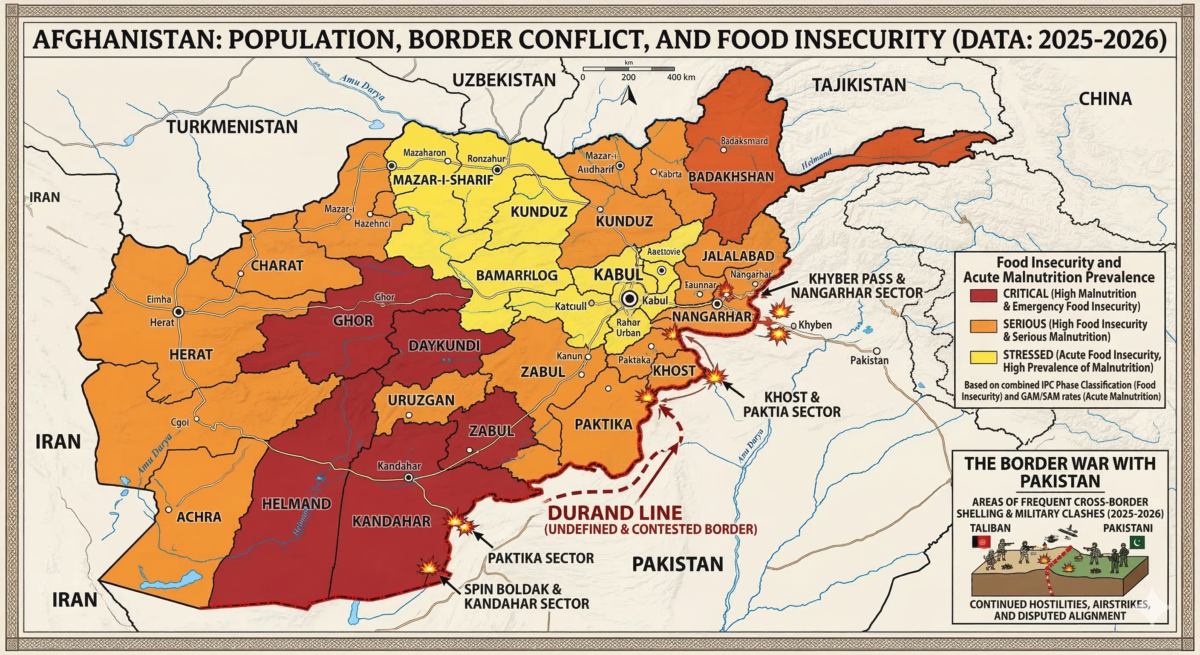
Afghanistan is currently facing a severe food insecurity crisis driven by several compounding factors. According to the UNHCR,  in 2025, both Pakistan and Iran tightened their migration policies, forcing large numbers of Afghan refugees to return to Afghanistan.

The Pakistan–Afghanistan border has become a combat zone, and Pakistan has conducted airstrikes inside Afghanistan along with ground operations, displacing 66,000 Afghan civilians.  As of mid-March, armed clashes continue in several Afghan provinces (Khost, Paktia, Paktika, Kunar, Nangarhar, Kandahar), with both sides reporting heavy losses. Pakistan claims to have destroyed militant infrastructure, while Afghanistan accuses Pakistan of targeting civilians and civilian areas.

An estimated 2.7 million Afghan refugees were forced back to Afghanistan in 2025 from Pakistan and Iran, straining Afghan public services. Pakistan has also closed the border and suspended trade, a devastating blow to the landlocked Afghan economy.  Many of these returnees are struggling to reintegrate due to limited employment opportunities and the lack of basic services such as food, clothing, and shelter. In addition, many refugees sold their homes when they fled Afghanistan and are now returning with no place to live.

Making things worse, major border crossings have been closed since late 2025 due to the conflict with Pakistan, interrupting food trade.  Compounded by its war with the U.S., Iran (Afghanistan’s western neighbor) has halted exports to Afghanistan of some food products, worsening Afghan food shortages and raising prices.   As a result, Afghanistan is shifting toward northern suppliers.

Kazakhstan nearly doubled grain exports to Afghanistan between late 2025 and early 2026.  Afghanistan cannot produce enough staple food domestically.  For example, wheat consumption for its population of 45 million is roughly 6.8 million metric tons per year, whereas domestic wheat production is about 4.8 million tons, with the shortfall made up through imports from Russia, Kazakhstan, and Central Asia.

The influx of returning refugees is placing additional strain on already scarce resources. At the same time, Afghanistan is experiencing a severe water shortage caused by a drought that has persisted for more than four years. The FAO estimates that snowfall during the 2025–2026 winter is at a 25-year low, significantly affecting agriculture and livestock production. As a result, it is estimated that roughly half of Afghanistan’s population is facing severe food insecurity and poverty.

The prevalence of malnutrition has increased over the last year, reaching record highs.  Acute malnutrition for children under five increased by approximately 7% compared to early 2025. In 2026, an estimated 3.7 to 4 million children are projected to suffer from acute malnutrition, with nearly 1 million of those facing Severe Acute Malnutrition.  Approximately 1.2 million pregnant and breastfeeding women are also expected to be acutely malnourished this year.

Afghanistan’s per capita GDP is estimated at about $400 per year and has declined by 20% from a few years ago.  By this measure, the Afghan people are the poorest in Asia.  The chart at right compares the prevalence of undernutrition in Afghanistan to some of its neighboring countries.

Children are still being measured to identify malnutrition, but the system is under immense strain.  Families stopped taking children to health centers as they knew that supplies of recovery foods would not be available.  Many children are “dying silently at home” because families cannot afford the transport to clinics, or facilities have closed due to earthquake damage and lack of staff funding.

The departure of U.S. troops in August 2021 and the subsequent 2025 cessation of all USAID aid to Afghanistan fundamentally broke the primary supply and distribution model.  Last winter, the WFP provided aid for 6 million people but have cut that back to only 1 to 2 million people.

In addition to UNICEF and WFP, nonprofits who are responding to hunger in Afghanistan are:  Action Against Hunger (ACF), Concern Worldwide, CARE, Norwegian Refugee Council, Save the Children, International Rescue Committee, Mercy Corps, Islamic Relief Worldwide, MSF, and World Vision.

The war is being fought over Pakistan’s demand for Afghanistan to eliminate militant safe havens and Afghanistan’s refusal to comply, compounded by historical grievances and border disputes. Pakistan is accusing Afghan forces of drone attacks on its civilians.  The human cost is mounting daily, with civilians bearing the brunt of the violence and displacement.  The Durand Line, the contested border between the two countries, has long been a flashpoint. Both sides accuse each other of violating sovereignty and supporting insurgent activities across the border.  Recently, China publicly urged both sides to hold face-to-face talks and seek a ceasefire. Turkey has also offered to promote a ceasefire.

Update:   As of March 16, Al Jazeera reports that Afghanistan accused Pakistan’s military of launching an airstrike on Kabul’s Omar Addiction Treatment Hospital, a 2,000-bed facility, killing at least 400 people.  Pakistan dismissed the claim as “false and aimed at misleading public opinion,” saying it only targeted military installations.  The attack entered its third week of the deadliest fighting between the two countries in years.

Humanitarian Impact:  Nearly 66,000 people were displaced in Afghanistan as of early March, with the UN’s International Organization for Migration warning of the “growing humanitarian impact on civilians.”  Schools and markets in several border districts remain closed, mortar fire has forced families to flee villages in northwest Pakistan, and aid operations in parts of Khyber Pakhtunkhwa have been temporarily suspended.

For further learning:

https://fews.net/middle-east-and-asia/afghanistan?utm_source=chatgpt.com

https://reliefweb.int/report/afghanistan/afghanistanpakistan-conflict-update-situation-report-1-march-10-2026?utm_source=chatgpt.com

https://www.fao.org/emergencies/where-we-work/AFG/en?utm_source=chatgpt.com

Five years after independence, South Sudan faces myriad challenges

South Sudan has a population of just over 11 million people, 2.3 million of whom have fled their homes due to ongoing violence. About 1.61 million South Sudanese are displaced within South Sudan, and over 720,000 have sought refuge in neigbouring countries according to the UN Office for the Coordination of Humanitarian Affairs (UNOCHA).