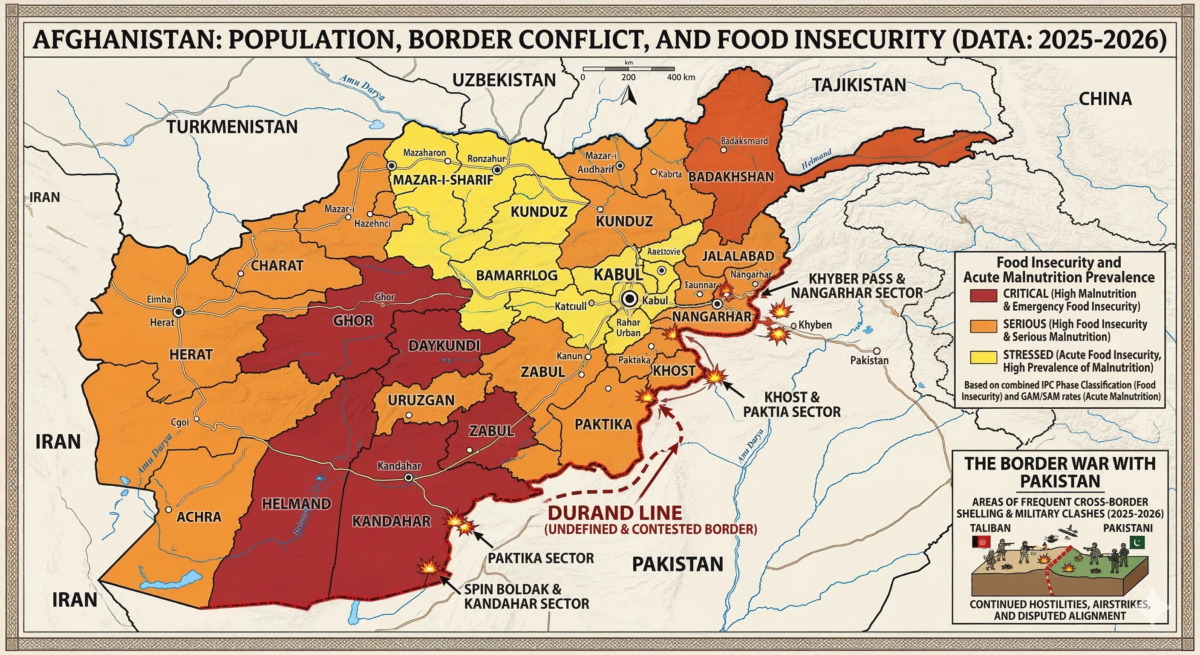
Afghanistan is currently facing a severe food insecurity crisis driven by several compounding factors. According to the UNHCR, in 2025, both Pakistan and Iran tightened their migration policies, forcing large numbers of Afghan refugees to return to Afghanistan.
The Pakistan–Afghanistan border has become a combat zone, and Pakistan has conducted airstrikes inside Afghanistan along with ground operations, displacing 66,000 Afghan civilians. As of mid-March, armed clashes continue in several Afghan provinces (Khost, Paktia, Paktika, Kunar, Nangarhar, Kandahar), with both sides reporting heavy losses. Pakistan claims to have destroyed militant infrastructure, while Afghanistan accuses Pakistan of targeting civilians and civilian areas.
An estimated 2.7 million Afghan refugees were forced back to Afghanistan in 2025 from Pakistan and Iran, straining Afghan public services. Pakistan has also closed the border and suspended trade, a devastating blow to the landlocked Afghan economy. Many of these returnees are struggling to reintegrate due to limited employment opportunities and the lack of basic services such as food, clothing, and shelter. In addition, many refugees sold their homes when they fled Afghanistan and are now returning with no place to live.
Making things worse, major border crossings have been closed since late 2025 due to the conflict with Pakistan, interrupting food trade. Compounded by its war with the U.S., Iran (Afghanistan’s western neighbor) has halted exports to Afghanistan of some food products, worsening Afghan food shortages and raising prices. As a result, Afghanistan is shifting toward northern suppliers.
Kazakhstan nearly doubled grain exports to Afghanistan between late 2025 and early 2026. Afghanistan cannot produce enough staple food domestically. For example, wheat consumption for its population of 45 million is roughly 6.8 million metric tons per year, whereas domestic wheat production is about 4.8 million tons, with the shortfall made up through imports from Russia, Kazakhstan, and Central Asia.
The influx of returning refugees is placing additional strain on already scarce resources. At the same time, Afghanistan is experiencing a severe water shortage caused by a drought that has persisted for more than four years. The FAO estimates that snowfall during the 2025–2026 winter is at a 25-year low, significantly affecting agriculture and livestock production. As a result, it is estimated that roughly half of Afghanistan’s population is facing severe food insecurity and poverty.
The prevalence of malnutrition has increased over the last year, reaching record highs. Acute malnutrition for children under five increased by approximately 7% compared to early 2025. In 2026, an estimated 3.7 to 4 million children are projected to suffer from acute malnutrition, with nearly 1 million of those facing Severe Acute Malnutrition. Approximately 1.2 million pregnant and breastfeeding women are also expected to be acutely malnourished this year.
Afghanistan’s per capita GDP is estimated at about $400 per year and has declined by 20% from a few years ago. By this measure, the Afghan people are the poorest in Asia. The chart at right compares the prevalence of undernutrition in Afghanistan to some of its neighboring countries.
Children are still being measured to identify malnutrition, but the system is under immense strain. Families stopped taking children to health centers as they knew that supplies of recovery foods would not be available. Many children are “dying silently at home” because families cannot afford the transport to clinics, or facilities have closed due to earthquake damage and lack of staff funding.
The departure of U.S. troops in August 2021 and the subsequent 2025 cessation of all USAID aid to Afghanistan fundamentally broke the primary supply and distribution model. Last winter, the WFP provided aid for 6 million people but have cut that back to only 1 to 2 million people.
In addition to UNICEF and WFP, nonprofits who are responding to hunger in Afghanistan are: Action Against Hunger (ACF), Concern Worldwide, CARE, Norwegian Refugee Council, Save the Children, International Rescue Committee, Mercy Corps, Islamic Relief Worldwide, MSF, and World Vision.
The war is being fought over Pakistan’s demand for Afghanistan to eliminate militant safe havens and Afghanistan’s refusal to comply, compounded by historical grievances and border disputes. Pakistan is accusing Afghan forces of drone attacks on its civilians. The human cost is mounting daily, with civilians bearing the brunt of the violence and displacement. The Durand Line, the contested border between the two countries, has long been a flashpoint. Both sides accuse each other of violating sovereignty and supporting insurgent activities across the border. Recently, China publicly urged both sides to hold face-to-face talks and seek a ceasefire. Turkey has also offered to promote a ceasefire.
Update: As of March 16, Al Jazeera reports that Afghanistan accused Pakistan’s military of launching an airstrike on Kabul’s Omar Addiction Treatment Hospital, a 2,000-bed facility, killing at least 400 people. Pakistan dismissed the claim as “false and aimed at misleading public opinion,” saying it only targeted military installations. The attack entered its third week of the deadliest fighting between the two countries in years.
Humanitarian Impact: Nearly 66,000 people were displaced in Afghanistan as of early March, with the UN’s International Organization for Migration warning of the “growing humanitarian impact on civilians.” Schools and markets in several border districts remain closed, mortar fire has forced families to flee villages in northwest Pakistan, and aid operations in parts of Khyber Pakhtunkhwa have been temporarily suspended.
For further learning:
https://fews.net/middle-east-and-asia/afghanistan?utm_source=chatgpt.com
https://reliefweb.int/report/afghanistan/afghanistanpakistan-conflict-update-situation-report-1-march-10-2026?utm_source=chatgpt.com
https://www.fao.org/emergencies/where-we-work/AFG/en?utm_source=chatgpt.com