



Economic Sanctions Create Hunger, But Not Political Change
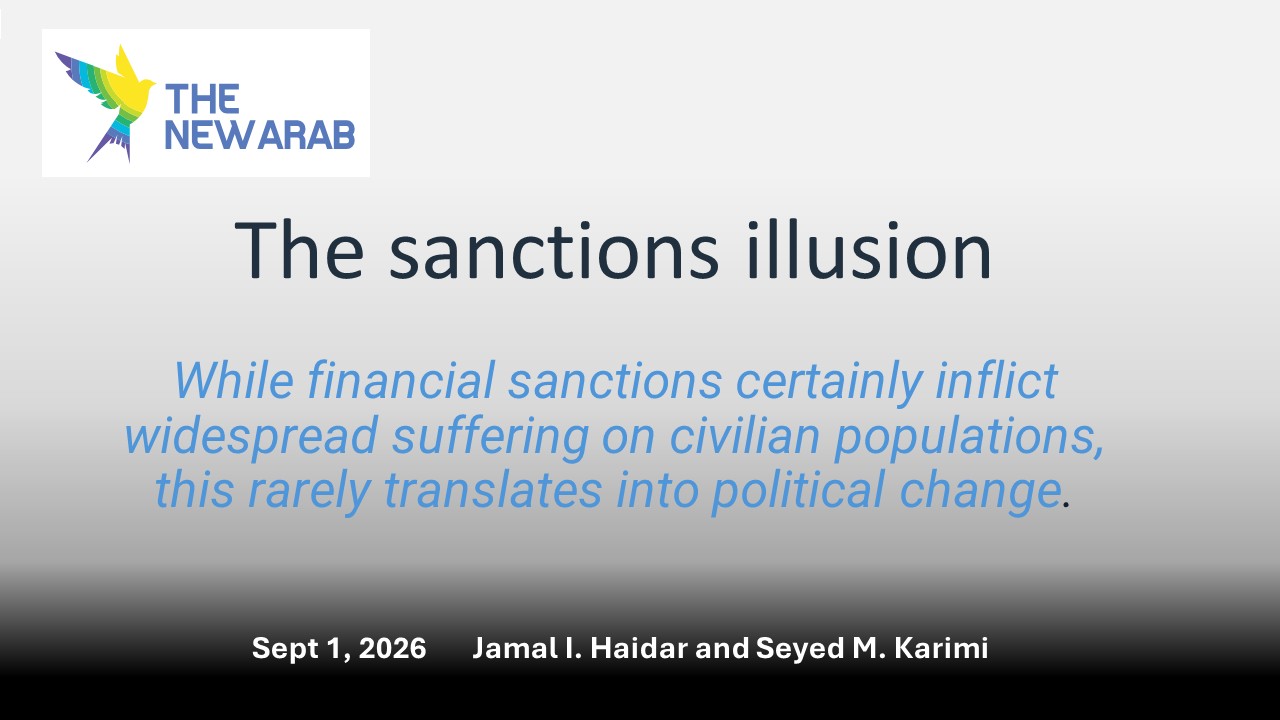
September 3, 2026 An analysis published in the New Arab explains that economic sanctions, part of economic warfare, disproportionately hurt the poorest segments of populations, while rarely achieving intended political goals. It cites decades of research about how sanctions increase hunger among the most vulnerable citizens.
The authors, Jamal I. Haidar and Seyed M. Karimi on Sept 1 describe how economic sanctions make foods unaffordable for the already-worst-off. “These are not abstractions. They represent real losses in nutrition, health, education, and dignity for millions of families who have no voice in the geopolitical disputes that triggered their impoverishment.”
The article, “The Sanctions Illusion” elaborates that “anyone who claims to care about the ethics of coercive statecraft must confront its distributional realities with the same rigour applied to questions of military tactics. …Cross-country research spanning decades has documented that economic sanctions reduce GDP growth, widen income inequality, increase child mortality, limit access to health care, and expand food insecurity in target states. These are not marginal effects. …Another documented that UN sanctions reduced life expectancy by 1.2–1.4 years. These are statistics of mass harm, describing damage done to households, not palaces.”
The research of Sylvanus Afesorgbo is referenced. Looking at global experiences, he finds: “Sanctions significantly increases the composite index of global hunger index (GHI), and also adversely affect the availability and stability dimensions of food security.”
The authors note that the theory of sanctions is to pressure target governments in ways that do not happen. Contrary to theory, authoritarian governments avoid the pains falling on their hungriest citizens. “The question is not whether states should have foreign-policy tools, but whether any tool that imposes the scale of civilian harm documented in the sanctions literature can be considered legitimate under the same ethical and legal frameworks we apply to armed conflict.”
The authors argue that the laws of war do not allow disproportionate targeting of the poor, and therefore economic sanctions should be held to the same scrutiny. “The civilian harm they inflict is treated as regrettable collateral damage rather than a direct moral consequence of the sanctioning state’s choices.”
The authors’ argument: “financial sanctions, as currently practised, rarely achieve their strategic objectives, and they inflict predictable, severe, and regressive harm on civilian populations who bear no responsibility for the policies sanctions are meant to punish. Such harms are not more humane; they are harder to see and easier to ignore.”
About the authors: Jamal Haidar is the Chair of the Economics Dept. at the Lebanese American University (chartered in New York); and Seyed Karimi is Chair of the Department of Health Management and Systems Sciences at the University of Louisville, based in Kentucky.
– Contributed by Steven Hansch
-
 World Hunger Education
Service
P.O. Box 29015
Washington, D.C. 20017 -