
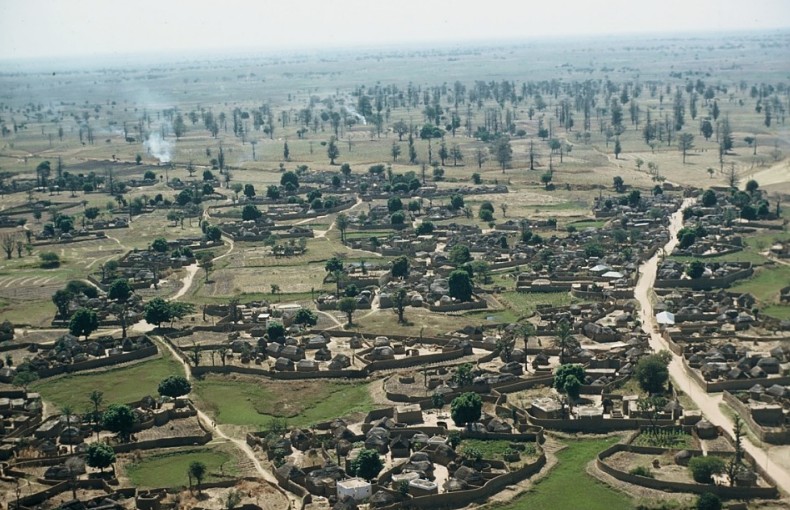
Nigeria’s Ongoing Nutrition Crises

July 4, 2026    In Nigeria, some 35 million people are projected to experience acute and severe food insecurity during the 2026 lean season, according to the most recent Cadre Harmonisé, representing the worst levels of hunger recorded in a decade.  The hunger crisis is worst in the country’s northeast, where an estimated 15,000 people in Borno State are at risk of catastrophic hunger.

In 2026, about 3 million children under five in Nigeria are projected to suffer from life-threatening severe acute malnutrition.  One million of these children are in the cluster of northeastern BAY States.  In addition to conflict and displacement, overcrowding, low maternal income and the use of infant formula are associated with a higher prevalence of wasting.  Nigeria has experienced near 30‑year‑high inflation, driven by rising food prices, supply‑side constraints, and exchange‑rate depreciation.  Food inflation has historically been the dominant driver of headline inflation.  The Government of Nigeria eliminated fuel subsidies and tightened monetary policy; these reforms may improve long‑term economic growth but have raised short‑term living costs.

Recently, displacement and flooding have also fueled cholera and measles outbreaks, with damaged water and sanitation infrastructure and low immunization coverage accelerating transmission.  In North and Central Nigeria, armed groups, rural bandits, and farmer-herder clashes have forced thousands of producers off their land, disrupting farming cycles and leaving large portions of farmland unused. Between 2022 and 2024, farmer-herder conflicts were recorded in 31 states, kidnappings in 10 states, and crop theft in 20 states. Over two million hectares of farmland in northern Nigeria are now inaccessible. 
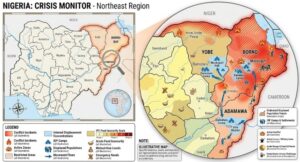
this NE region borders Lake Chad where violence has increased.   UNHCR reports that more than 77,500 people have been displaced across the Lake Chad Basin since January 2026 as violence intensifies across Nigeria, Niger, Chad and Cameroon.  According to UNHCR, incidents of violence rose by about 80 per cent between January 2024 and April 2026.  Similarly,  nearly 1,800 attacks and more than 5,700 deaths were recorded between September 2025 and May 2026 alone, reflecting what the agency described as a deepening protection crisis across the basin.

The “maize belt” (Borno, Niger, Plateau, Katsina, Gombe, Bauchi, Kogi, Kaduna, Oyo, Taraba), which produces ~44% of national maize, contains nearly half of that unused farmland.  Between April 2024 and March 2025, Nigeria spent $2.39 billion on food imports, 11.6% higher than the previous year, despite government commitments to boost local production.

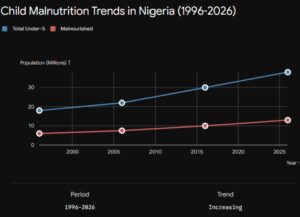
Nigeria’s population roughly doubled from ~95–97 million in 1990 to ~232–237 million by 2024–2025 (growth rate ~2.1–2.4% annually). The under-5 population surged similarly. Agriculture (now ~24–28% of GDP, down historically) has grown too slowly (~2–3% annually in recent periods) to match, leading to rising food imports, per-capita production shortfalls, and pressure on resources. Smallholder-dominated, rain-fed systems with high post-harvest losses cannot keep up.  Nigeria’s child population is so large that even a stable or slightly declining malnutrition rate can mean millions of children affected.

Stunting remained alarmingly high, ranging from 7.2% (Osun, South West) to 61% (Kaduna, North Central), while wasting was as high as 29% (FCT Abuja, Central).  Stunting (chronic malnutrition, measured as height-for-age) among children under 5 fell from around 42–45% in the early 2000s (e.g., ~43% in 2003 NDHS data) to roughly 37% in 2013–2018 surveys and around 31.5–32% in more recent UNICEF/WHO/World Bank Joint Child Malnutrition Estimates (JME).  The overall prevalence of anemia and vitamin A deficiency ranged between 55.2 to 75.1 % and 5.3 to 67.6%, respectively.
The World Bank estimated the number of impoverished Nigerians rose from 89.8 million at the start of 2023 to 104 million in roughly a year.

SOLUTIONS

The National Home-Grown School Feeding Program (NHGSFP) provides school meals.  The National Social Safety Nets Program (NASSP) Cash Transfer gives cash to poor households.  The Federal Government, with UNICEF and other partners, has committed $30 million to the Small Quantity Lipid-Based Nutrient Supplements (SQ-LNS) initiative, targeting 2 million children aged 6-23 months in high-burden states.

The U.N. Food and Agriculture Organization launched a $347 million Emergency and Resilience Plan (2026–2028). The strategy combines rapid agricultural assistance with long-term climate resilience, aiming to restore food production and reduce dependency on food aid for 12.6 million people across the north.

Médecins Sans Frontières (MSF) runs nutrition projects in seven states in Nigeria: Borno, Bauchi, Katsina, Kano, Sokoto, Zamfara, and Kebbi. IOM tracks displacement and manages humanitarian hubs; UNHCR co-leads protection and durable-solutions work; Intersos and Helen Keller Intl operate where others have withdrawn.

Other NGOs with long-standing programs in Nigeria include Action Against Hunger, Partners for Development, Malteser, Christian Blind Mission, Save the Children, Plan International, and Catholic Relief Services.
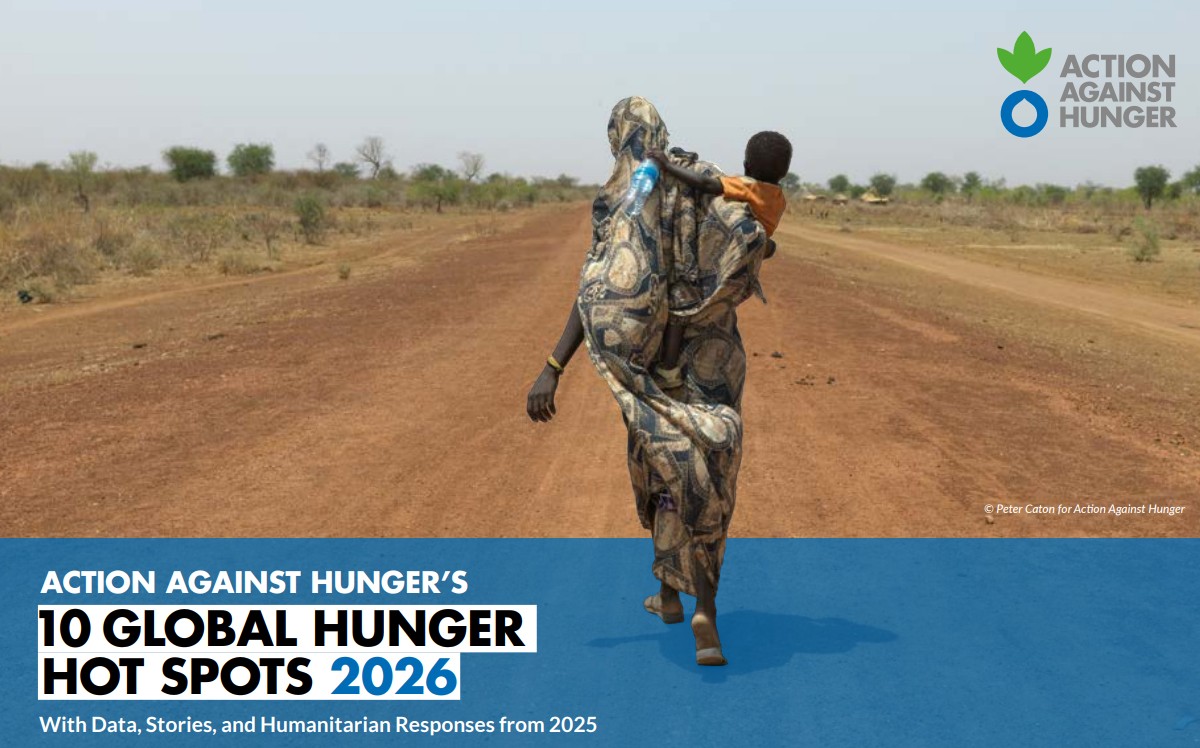
 

Action Against Hunger 10 Global Hunger Hot Spots

May 6, 2026    This year, as in the past, the international aid agency “Action Against Hunger” (also known as ACF, or Action Contre la Faim) released their annual hunger report, titled “10 Global Hunger Hot Spots.”  This year the report describes a compound crisis model as causing hunger.  The compound crises are: conflict, displacement, climate shocks, inflation, market collapse, disease, and weak public institutions all stack on top of each other. Its real message is that famine is rarely just about food.  Rather, hunger is usually the endpoint of different social and economic crises.

Action Against Hunger estimates that 30 million children are acutely malnourished today, including about 8.5 million severely malnourished children, and at least 13 million pregnant or breastfeeding women are malnourished. That makes this as much a maternal-and-child survival crisis as a food-security crisis.

The report also makes an unusually strong argument that humanitarian access and humanitarian financing are now central determinants of mortality.

The report seeks to quantify the impact of global reducations in aid during the last year in various ways.  It highlights the 65% funding shortfall for hunger-related humanitarian programming and notes that the United States announced an 83% cut to humanitarian support, alongside cuts by several European donors. it explains the cascading effects of these cut-backs (e.g., 300+ nutrition centers closed in Afghanistan).  It cites the  Lancet-linked estimate that USAID-funded programs saved over 90 million lives over 20 years, warning that sustaining cuts through 2030 could lead to 14 million preventable deaths, including 4.5 million children under five. That is one of the report’s most consequential arguments.

It recommends:

  1.  Ensure full and safe humanitarian access of aid to needy people, and prevent the use of hunger as a weapon of war;
  2.  Integrate climate and food security: 3. Focus on women and children.
  3.  Donor funds should be addequate, flexible and multi-sectoral
  4.  Support local and inclusive solutions
  5.  Strengthen prevention: Every strategy should include nutrition, food security, and access to basic health services, aiming to prevent hunger rather than just manage it.
  6.  Uphold adequate nutrition as a fundamental human right,
    ensuring that the right to food is respected and protecte

According to ACF, the top ten countries today in terms of total numbers of  people in acute food insecurity (at risk of hunger) are:

    • → Nigeria: 31.8 million:  “The nutritional crises are exacerbated by prolonged conflicts in the northeast of the country (Boko Haram and ISWAP), which make large areas virtually inaccessible to relief and food supplies, creating a vicious cycle of food insecurity and malnutrition.”
    • →  Sudan: 25.6 million:  Sudan is facing the world’s most severe food and displacement crisis, but the scale of the suffering remains underestimated and underfunded.
    • → The DRC: 25.6 million:  “This is not just a matter of a lack of funds: it is a matter of life and death.”
    • → Bangladesh: 23.6 million:  “Bangladesh faces recurring extreme weather events, demographic pressures, economic instability, and vulnerability of urban and rural infrastructure.”
    • → Ethiopia: 22 million
    • → Yemen: 16.7 million
    • → Afghanistan: 15.8 million
    • → Myanmar: 14.4 million
    • → Pakistan: 11.8 million
    • → Syria: 9.2 million

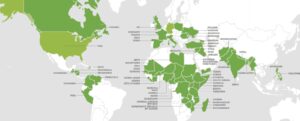
The report includes the map at right showing the countries where ACF, seen here.:

To assist journalists and researchers, the report has chapters by country. The country-specific “Inside Look” sections (written by Action Against Hunger directors) provide expert analysis on barriers like bureaucratic delays (Sudan), siege conditions (Gaza), or climate adaptation (Bangladesh).

For example:  “South Sudan continues to experience levels of malnutrition that reach emergency thresholds, with a steady downward trend each year. Local communities face multiple and interconnected crises, including the collapse of basic services, recurrent displacement due to conflict and flooding, and widespread food insecurity caused by climate shocks and economic
instability. In this context, the difficulties for humanitarian organizations are
multiplying…”

These chapters combine direct stories from affected communities (e.g., Zuwaira in Nigeria, Yasir in Sudan, Fatima in Afghanistan) and operational insights from Action Against Hunger’s country directors. These add emotional depth and ground-level reality to the statistics.

At the same time, the chapters include technical indicators such as population estimates, HDI rank, internally displaced persons, refugees, people in need, Humanitarian Response Plan funding requirements, HRP funding gaps, health-facility functionality, WASH access, cholera cases, food-price inflation, currency depreciation, hectares/crop losses from floods, and ACF operational outputs such as children treated for severe malnutrition, water points rehabilitated, cash assistance, and psychosocial support beneficiaries.

ACF (Action Against Hunger) has published many important publications for many years, such as “the Justice of Eating” shown here.  “The Justice of Eating – the Struggle For Food and Dignity in Recent Humanitarian Crises” was a 2007-08 Hunger Watch Report by Action Against Hunger.  It positioned the right to food as an essential human right and a matter of justice, not charity, arguing that failing to address hunger is a violation of human dignity.  The report, edited by Samuel Hauenstein Swan and Bapu Vaitla, documents the struggles for food access during humanitarian crises and emphasizes that fighting hunger is about upholding human dignity.
see:  https://www.actionagainsthunger.org/app/uploads/2026/01/2025_GlobalEmergencies_Map_v3-compressed.pdf

and:  https://www.actioncontrelafaim.org/

https://accioncontraelhambre.org/en

Global Food Crisis Opinion in Irish Times

April 30, 2026

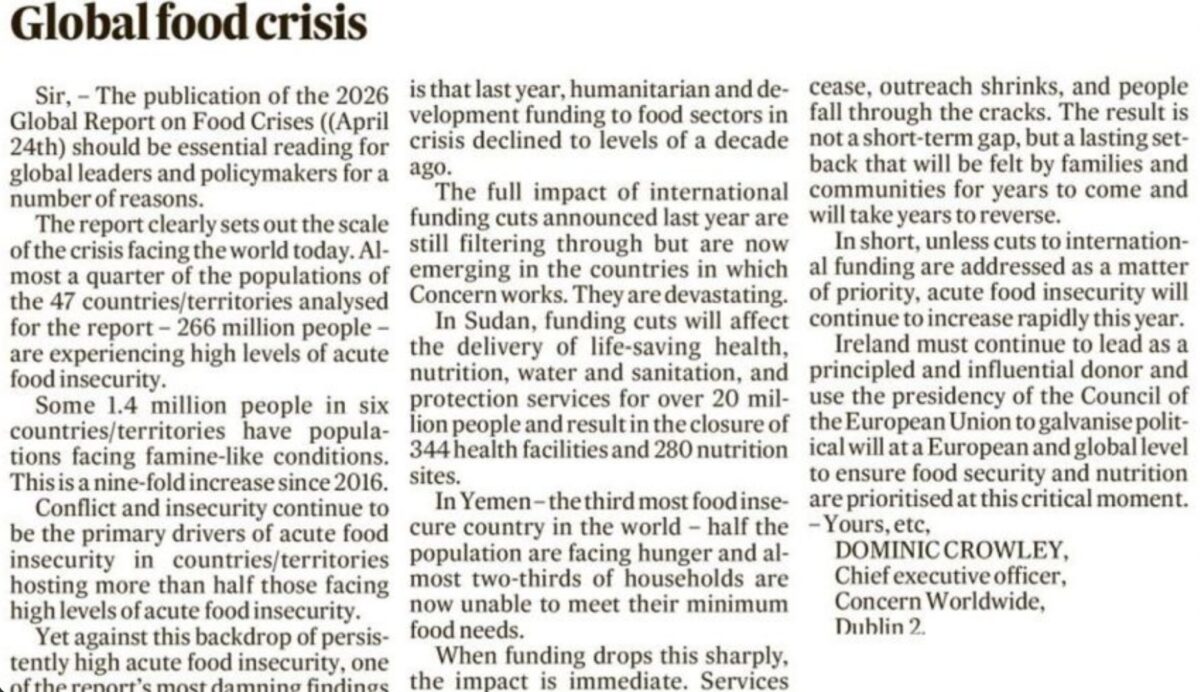
The Executive Director of Concern Worldwide, Dominic Crowley, published in the Irish Times to amplify the findings of the 2026 Global Report on Food Crises, noting how “in total, 266 million people in 47 countries/territories experienced high levels of acute food insecurity in 2025. Nearly one quarter of the population in these countries/territories are acutely food … This acute food insecurity is mostly concentrated in just ten countries.”

He adds that “reflecting our focus on food insecurity, Concern Worldwide works in eight of these countries: Afghanistan, Bangladesh, the DRC, Pakistan, South Sudan, Sudan, Syria and Yemen. Over the past twelve months, Concern has also supported a response to the March 2025 earthquake in a ninth country in the list – Myanmar.”

He writes:  “These figures could get even worse. Harsh reductions in aid and the ongoing conflict in Iran and the Gulf States threatens to push more vulnerable people into poverty and acute food insecurity….It is vital that governments and donors scale up aid and investment in resilient food systems and support safe humanitarian access to prevent further catastrophe.”

Also at:

https://www.threads.com/@concernworldwide/post/DXpDe8ilAvZ/humanitarian-and-development-funding-for-food-sectors-in-crisis-fell-last-year

https://x.com/Concern/status/2048869861472764152