


Action Against Hunger 10 Global Hunger Hot Spots
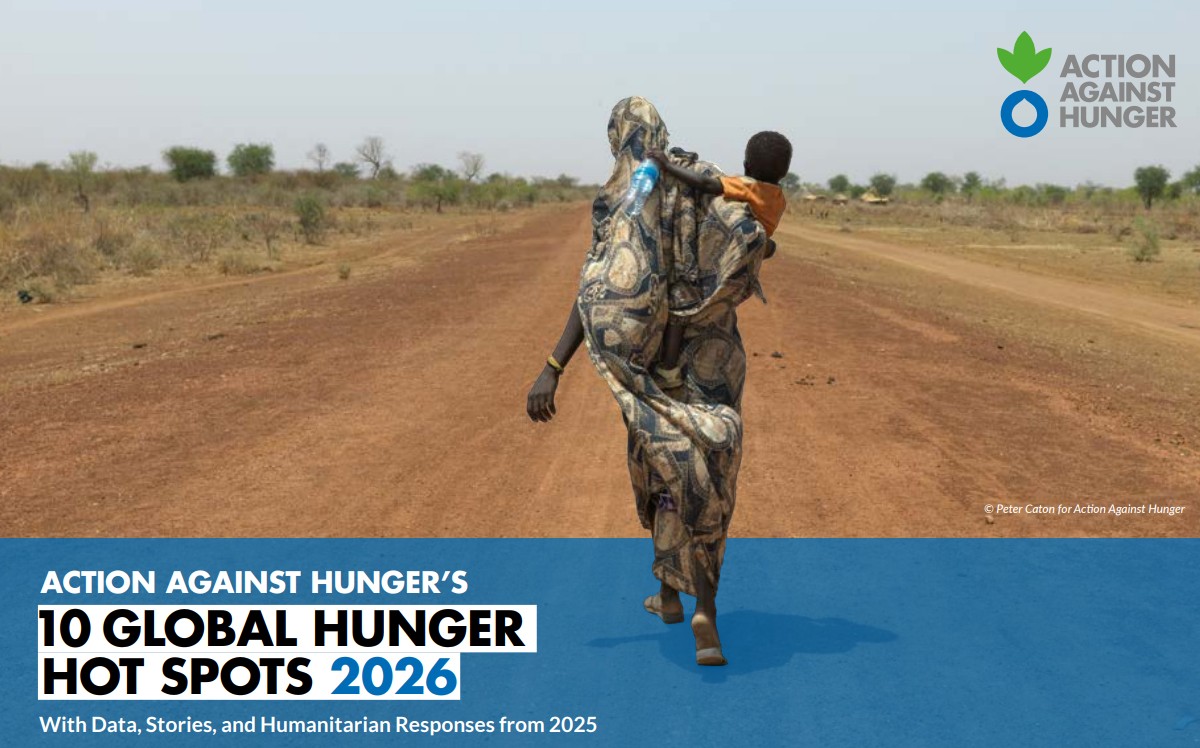
May 6, 2026 This year, as in the past, the international aid agency “Action Against Hunger” (also known as ACF, or Action Contre la Faim) released their annual hunger report, titled “10 Global Hunger Hot Spots.” This year the report describes a compound crisis model as causing hunger. The compound crises are: conflict, displacement, climate shocks, inflation, market collapse, disease, and weak public institutions all stack on top of each other. Its real message is that famine is rarely just about food. Rather, hunger is usually the endpoint of different social and economic crises.
Action Against Hunger estimates that 30 million children are acutely malnourished today, including about 8.5 million severely malnourished children, and at least 13 million pregnant or breastfeeding women are malnourished. That makes this as much a maternal-and-child survival crisis as a food-security crisis.
The report also makes an unusually strong argument that humanitarian access and humanitarian financing are now central determinants of mortality.
The report seeks to quantify the impact of global reducations in aid during the last year in various ways. It highlights the 65% funding shortfall for hunger-related humanitarian programming and notes that the United States announced an 83% cut to humanitarian support, alongside cuts by several European donors. it explains the cascading effects of these cut-backs (e.g., 300+ nutrition centers closed in Afghanistan). It cites the Lancet-linked estimate that USAID-funded programs saved over 90 million lives over 20 years, warning that sustaining cuts through 2030 could lead to 14 million preventable deaths, including 4.5 million children under five. That is one of the report’s most consequential arguments.
It recommends:
- Ensure full and safe humanitarian access of aid to needy people, and prevent the use of hunger as a weapon of war;
- Integrate climate and food security: 3. Focus on women and children.
- Donor funds should be addequate, flexible and multi-sectoral
- Support local and inclusive solutions
- Strengthen prevention: Every strategy should include nutrition, food security, and access to basic health services, aiming to prevent hunger rather than just manage it.
- Uphold adequate nutrition as a fundamental human right,
ensuring that the right to food is respected and protecte
According to ACF, the top ten countries today in terms of total numbers of people in acute food insecurity (at risk of hunger) are:
-
- → Nigeria: 31.8 million: “The nutritional crises are exacerbated by prolonged conflicts in the northeast of the country (Boko Haram and ISWAP), which make large areas virtually inaccessible to relief and food supplies, creating a vicious cycle of food insecurity and malnutrition.”
- → Sudan: 25.6 million: “Sudan is facing the world’s most severe food and displacement crisis, but the scale of the suffering remains underestimated and underfunded.”
- → The DRC: 25.6 million: “This is not just a matter of a lack of funds: it is a matter of life and death.”
- → Bangladesh: 23.6 million: “Bangladesh faces recurring extreme weather events, demographic pressures, economic instability, and vulnerability of urban and rural infrastructure.”
- → Ethiopia: 22 million
- → Yemen: 16.7 million
- → Afghanistan: 15.8 million
- → Myanmar: 14.4 million
- → Pakistan: 11.8 million
- → Syria: 9.2 million
-
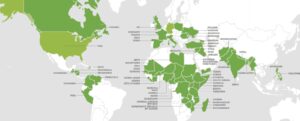
The report includes the map at right showing the countries where ACF, seen here.:
To assist journalists and researchers, the report has chapters by country. The country-specific “Inside Look” sections (written by Action Against Hunger directors) provide expert analysis on barriers like bureaucratic delays (Sudan), siege conditions (Gaza), or climate adaptation (Bangladesh).
For example: “South Sudan continues to experience levels of malnutrition that reach emergency thresholds, with a steady downward trend each year. Local communities face multiple and interconnected crises, including the collapse of basic services, recurrent displacement due to conflict and flooding, and widespread food insecurity caused by climate shocks and economic
instability. In this context, the difficulties for humanitarian organizations are
multiplying…”
These chapters combine direct stories from affected communities (e.g., Zuwaira in Nigeria, Yasir in Sudan, Fatima in Afghanistan) and operational insights from Action Against Hunger’s country directors. These add emotional depth and ground-level reality to the statistics.
At the same time, the chapters include technical indicators such as population estimates, HDI rank, internally displaced persons, refugees, people in need, Humanitarian Response Plan funding requirements, HRP funding gaps, health-facility functionality, WASH access, cholera cases, food-price inflation, currency depreciation, hectares/crop losses from floods, and ACF operational outputs such as children treated for severe malnutrition, water points rehabilitated, cash assistance, and psychosocial support beneficiaries.
ACF (Action Against Hunger) has published many important publications for many years, such as “the Justice of Eating” shown here. “The Justice of Eating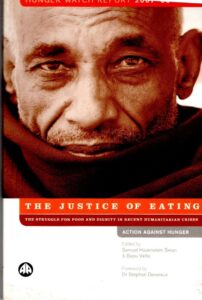 – the Struggle For Food and Dignity in Recent Humanitarian Crises” was a 2007-08 Hunger Watch Report by Action Against Hunger. It positioned the right to food as an essential human right and a matter of justice, not charity, arguing that failing to address hunger is a violation of human dignity. The report, edited by Samuel Hauenstein Swan and Bapu Vaitla, documents the struggles for food access during humanitarian crises and emphasizes that fighting hunger is about upholding human dignity.
see: https://www.actionagainsthunger.org/app/uploads/2026/01/2025_GlobalEmergencies_Map_v3-compressed.pdf
and: https://www.actioncontrelafaim.org/
https://accioncontraelhambre.org/en
– Contributed by WHES board member, Steven Hansch
-
 World Hunger Education
Service
P.O. Box 29015
Washington, D.C. 20017 -