As covered in a September 20 Hunger Notes article, the USDA announced that they would no longer be collecting the annual data measuring household food insecurity and cancelling the Household Food Security Reports. This means that the 2024 report will be the last under the current format. However, at the same time, food insecurity has been on the rise in the U.S. for the past two decades, 17% from 2001 to 2023. Ending this annual data collection and report will result in a critical gap in the ability to understand and address food insecurity in the U.S.
Sophie Collyer, Director of the Center on Poverty and Social Policy, at Columbia University, in a brief published Oct 22, 2025, outlines a model to predict food insecurity rates at the population level, adult, and child levels, in the absence of the USDA’s annual data set. The model uses secondary data of poverty, unemployment, specific food inflation rates, all of which are highly correlated with food insecurity. When the model was tested against the past 14 years of historical food insecurity rates, it was shown to align closely. The model was also used to predict food insecurity rates for 2024, which at the time the brief was published, the USDA report was still unavailable.
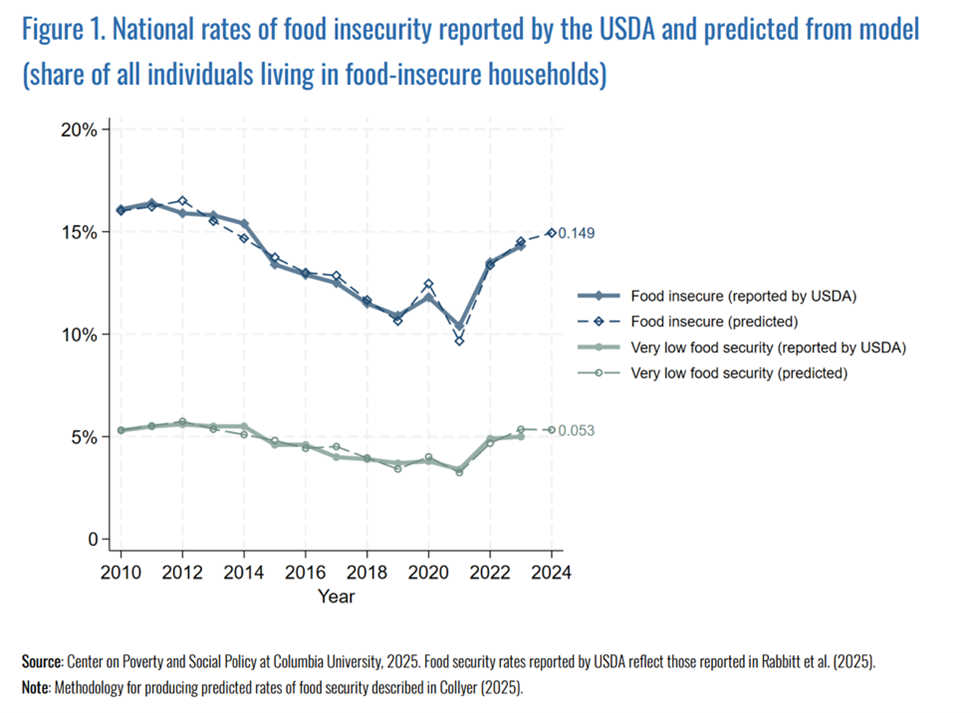
Figures 1 (above) and 2 (below) are taken from Collyer’s report and demonstrate how close the model’s predictions are to the USDA official rates among the share of all individuals, adults, and children, living in food-insecure homes.
For the results shown in Figure 1 (share of all individuals living in food-secure homes), in all but four of the years, the model was within 0.4 percentage points of the official USDA rate, with the largest difference in those four years 0.7 percentage points.
For the prediction of rates of adults, shown in Figure 2, in all but three years, the model is within 0.4 percentage points or less of the official USDA rates.

The model’s prediction of rates among children was within 0.4 percentage points in half of the years, with the largest difference 1.2 percentage points, the lowest performing among the three predictions.
Collyer indicates that the model will continue to be refined.
With the 2025 cancellation of the USDA’s historic, official household food insecurity dataset, this model offers a promising substitute for providing credible estimates of food insecurity for policy and program planning.
Reference: https://povertycenter.columbia.edu/sites/povertycenter.columbia.edu/files/content/Publications/Predicting-National-Rates-Food-Insecurity-CPSP-2025.pdf?utm_source=chatgpt.com
https://www.ers.usda.gov/publications/pub-details?pubid=109895