
New National Nutrition/Malnutrition Survey Results From Haiti

September 4, 2026      The rate of life-threatening, acute (wasting) malnutrition among children in Haiti has grown from 7.2% in 2023 to 9% in 2026, alongside worstening dietary diversity, according to the latest national survey findings which began in January and were just released.

Most of the increase in malnutrition was in the form of moderate wasting malnutrition, from which most preventable deaths occur.  Haiti’s Ministry of Public Health and Population (MSPP), through its national food and nutrition coordination unit (UCPNANu), released preliminary results of the 2026 national SMART nutrition survey on August 28.  Data were collected from 1 to 16 July 2026 across 18 strata, the nine provincial departments, eight communes of the Port-au-Prince metropolitan area, and the balance of Ouest department, from a planned sample of 16,176 households in roughly 1,206 clusters, including 105 reserve cluster.

See:  https://weshare.unicef.org/CS.aspx?VP3=SearchResult&STID=2AM40870CZ3M&_gl=&WS=SearchResults

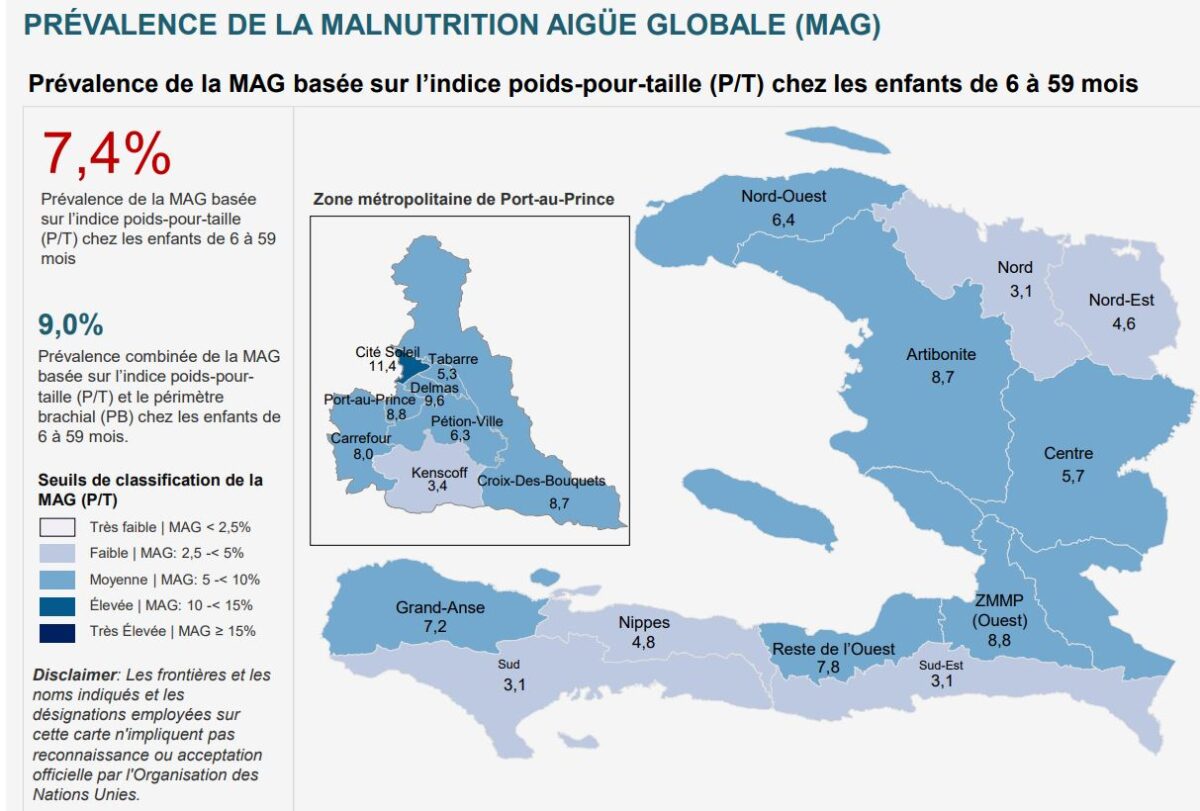
Wasting malnutrition was the worst where gangs interfere with health care.  The Port-au-Prince metropolitan area records the highest malnutrition rate of any stratum at 8.8 percent, ahead of Artibonite (8.7), Reste-Ouest (7.8), and Grande Anse (7.2).  The traditionally food-insecure Nord-Ouest sits at 6.4 percent, while Nord, Sud, and Sud-Est cluster near 3.1 percent  the “low” band.

Applied to a population of roughly 1.1 to 1.2 million children aged 6–59 months, a 7.4 percent point prevalence implies on the order of 85,000 children wasted at any moment.

The government’s nutrition report adds that “UNICEF’s Haiti appeal was 87 percent unfunded at the end of the first quarter, and the nutrition sector was funded at 16 percent in 2025.  A survey documenting a 45 percent rise in child wasting has landed in a [ongoing aid] response that cannot currently treat the [full] caseload it already knows about.”

Within the metropolitan area the gradient is steep and tracks territorial control almost exactly.  Cité Soleil (gang-controlled) has 11.4 percent malnutrition, the only zone in the country in the UN’s “high” category, with moderate malnutrition alone at 10.5 percent. Delmas follows at 9.6, Port-au-Prince commune at 8.8, Croix-des-Bouquets at 8.7, Carrefour at 8.0; Kenscoff records 3.4.

Early initiation of breastfeeding rose from 48 to 68 percent, and exclusive breastfeeding under six months nearly doubled, from 17.5 to 33 percent.

UNICEF’s latest brief about their work in Haiti reports:  “To ensure the continuity of nutrition services despite ongoing humanitarian and logistical challenges, UNICEF supported the prepositioning of 34,222 cartons of Ready-to-Use Therapeutic Food (RUTF) including those sourced by local partner Meds and Foods for Kids (MFK) and essential medicines across the country’s ten Supply and Input Distribution Centers, followed by their onward distribution to health facilities to prevent stockouts.  Of this total, 19,909 cartons were strategically pre-positioned in priority locations across the country based on humanitarian and climate-related risks, while the remaining quantities were retained to support ongoing supply needs and replenishment efforts.
“As part of preparedness, risk mitigation, and response efforts, 9,750 cartons were strategically pre-positioned in the departments of Ouest, Artibonite, and Centre, which continue to face significant access constraints and humanitarian needs due to insecurity.  In parallel, 10,159 cartons were pre-positioned across the four
departments of the Grand Sud (Grand’Anse, Nippes, Sud and Sud-Est) and the Northwest department in preparation for the hurricane season.”


– Contributed by WHES Board member Steve Hansch
Kenya’s Arid Lands Face Persistent Hunger Crisis in 2026

June 14, 2026     Kenya continues to face severe hunger and malnutrition in its arid and semi‑arid lands (ASAL), where drought, high food prices, and weakened pastoralist livelihoods have pushed millions into crisis. According to the U.S. Famine Early Warning System (FEWS NET), 2.5–2.99 million people currently need food assistance, with needs possibly declining to 1.5–1.99 million by December 2026 if weather conditions improve.

However, more recent field data from Action Against Hunger (ACF) and partners show a sharper picture:   3.7 million people are in IPC Phase 3 (Crisis) or worse, including 400,000 in IPC Phase 4 (Emergency).  This represents a dramatic increase (a 52% jump) compared to early 2025.).

Where the Crisis Is Most Severe

Northern and northeastern counties remain the hardest hit. Nutrition assessments in early 2026 classified:

  • »  Mandera, Turkana South/East, and parts of Marsabit as Extremely Critical (IPC Acute Malnutrition Phase 5)
  • »  Garissa, Wajir, Isiolo, and Samburu as Critical (Phase 4)

These counties account for about 62% of Kenya’s total malnutrition burden.

Recent data from UNICEF, the Ministry of Health, and the National Drought Management Authority (NDMA) estimate:

  • »  810,871 children under five need treatment for wasting (up from 760,488 in 2025)
  • »  116,800 pregnant and breastfeeding women also require treatment

Malnutrition Levels Remain Alarmingly High

SMART surveys and community screenings show persistently high wasting rates:

  • »  Wajir: 14.95% GAM (2023)
  • »  Baringo/Tiaty: 21% GAM
  • »  Turkana (some areas): ~33% GAM in community screenings
  • »  Turkana (2024 SMART): GAM declined from 26.4% to 21.8%—still above the 15% emergency threshold

In several northern counties—Mandera, Turkana South/East, and North Horr—analyses in late 2025 and early 2026 indicated Extremely Critical levels, meaning wasting rates of 30% or more. As your text states, “Northern areas such as Mandera, Turkana South/East, and North Horr reportedly reached Phase 5 ‘Extremely Critical’… corresponding to a rate of wasting malnutrition of 30% or more.”

A major warning sign is the collapse in mass screening coverage, which fell from 75% of hotspots in 2023 to under 15% by August 2025 due to funding shortages. This means many children with acute malnutrition are simply not being identified.

Drivers of the Crisis

The hunger emergency is fueled by overlapping shocks:

  • »  Erratic rainfall and recurring drought
  • »  High food prices
  • »  Poor livestock‑to‑cereal terms of trade
  • »» Livestock deaths and reduced milk production
  • »  Insecurity along the Kenya–Somalia border and in parts of Turkana

These factors have eroded pastoralist livelihoods and reduced household access to food.

Refugee Camps Under Severe Strain

Kenya hosts roughly 720,000 refugees in Dadaab, Kakuma, and Kalobeyei. Food rations have been cut to 28% of standard levels, worsening malnutrition among Somali and South Sudanese refugees. Funding gaps have also caused stockouts of ready‑to‑use supplementary foods (RUSF) and therapeutic foods in several hotspot counties.

Mixed Outlook for Late 2026

FEWS NET projects that food insecurity may ease by December 2026 if rainfall and harvests improve. But high prices and the upcoming lean season mean many households will remain in IPC Phase 3 (Crisis) or worse without continued support. National‑level improvements risk masking localized Phase 4–5 emergencies in remote ASAL counties and refugee settlements.

Humanitarian Response

Several NGOs continue to deliver life‑saving assistance:

  • »  Action Against Hunger (ACF) operates across Samburu, Baringo, West Pokot, Isiolo, Tana River, Kwale, Mandera, and the refugee camps, often using UNICEF and WFP supply chains for last‑mile delivery.
  •   International Rescue Committee (IRC) leads nutrition programs in Kakuma.
  • »  Médecins Sans Frontières (MSF) supports health and nutrition services in Dadaab.
  • »  World Vision, Humanity & Inclusion, Cordaid, and Kenya Red Cross work with county governments on community outreach, CMAM programs, and cash support.

These organizations coordinate through the Kenya Nutrition Cluster to address both immediate treatment needs and the underlying drivers of hunger.

– Contributed by WHES Board member Steven Hansch