
New National Nutrition Survey Results From Haiti

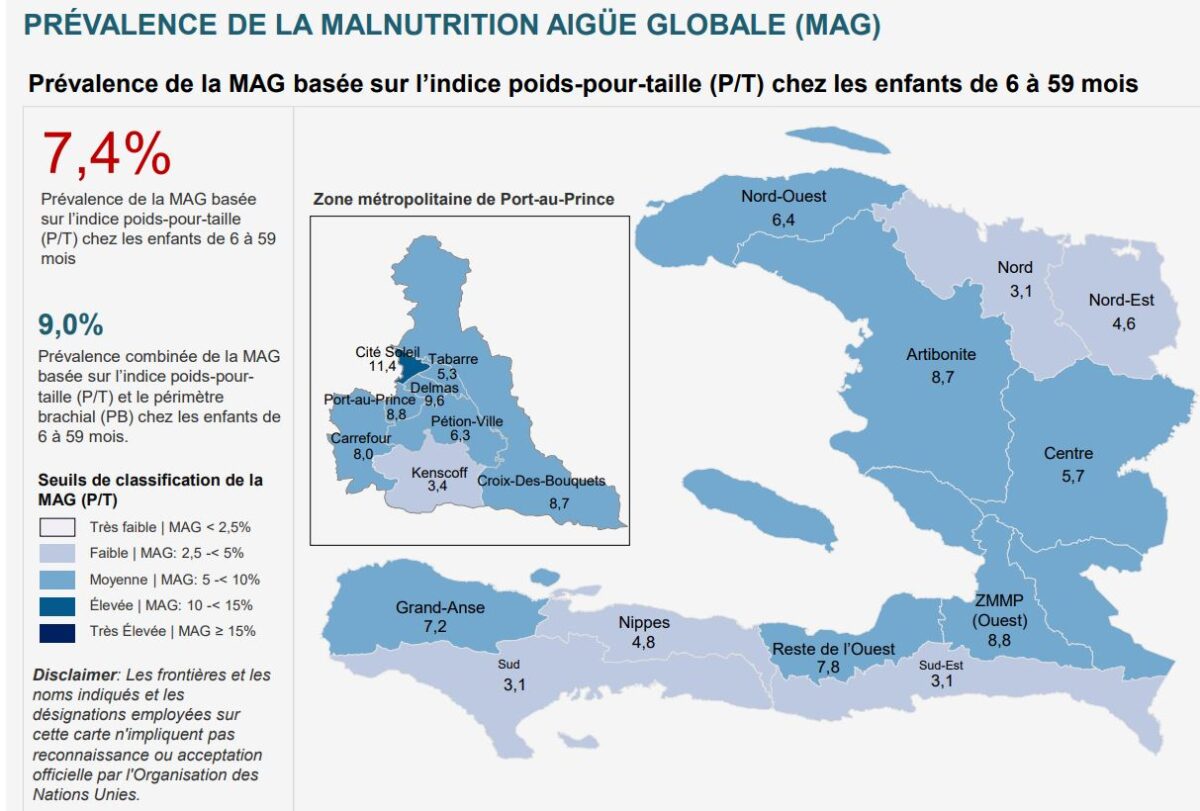
September 4, 2026      The rate of life-threatening, acute (wasting) malnutrition among children in Haiti has grown from 7.2% in 2023 to 9% in 2026, alongside worstening dietary diversity, according to the latest national survey findings which began in January and were just released.

Most of the increase in malnutrition was in the form of moderate wasting malnutrition, from which most preventable deaths occur.  Haiti’s Ministry of Public Health and Population (MSPP), through its national food and nutrition coordination unit (UCPNANu), released preliminary results of the 2026 national SMART nutrition survey on August 28.  Data were collected from 1 to 16 July 2026 across 18 strata, the nine provincial departments, eight communes of the Port-au-Prince metropolitan area, and the balance of Ouest department, from a planned sample of 16,176 households in roughly 1,206 clusters, including 105 reserve cluster.

See:  https://weshare.unicef.org/CS.aspx?VP3=SearchResult&STID=2AM40870CZ3M&_gl=&WS=SearchResults

Wasting malnutrition was the worst where gangs interfere with health care.  The Port-au-Prince metropolitan area records the highest malnutrition rate of any stratum at 8.8 percent, ahead of Artibonite (8.7), Reste-Ouest (7.8), and Grande Anse (7.2).  The traditionally food-insecure Nord-Ouest sits at 6.4 percent, while Nord, Sud, and Sud-Est cluster near 3.1 percent  the “low” band.

Applied to a population of roughly 1.1 to 1.2 million children aged 6–59 months, a 7.4 percent point prevalence implies on the order of 85,000 children wasted at any moment.

The government’s nutrition report adds that “UNICEF’s Haiti appeal was 87 percent unfunded at the end of the first quarter, and the nutrition sector was funded at 16 percent in 2025.  A survey documenting a 45 percent rise in child wasting has landed in a [ongoing aid] response that cannot currently treat the [full] caseload it already knows about.”

Within the metropolitan area the gradient is steep and tracks territorial control almost exactly.  Cité Soleil (gang-controlled) has 11.4 percent malnutrition, the only zone in the country in the UN’s “high” category, with moderate malnutrition alone at 10.5 percent. Delmas follows at 9.6, Port-au-Prince commune at 8.8, Croix-des-Bouquets at 8.7, Carrefour at 8.0; Kenscoff records 3.4.

Early initiation of breastfeeding rose from 48 to 68 percent, and exclusive breastfeeding under six months nearly doubled, from 17.5 to 33 percent.

UNICEF’s latest brief about their work in Haiti reports:  “To ensure the continuity of nutrition services despite ongoing humanitarian and logistical challenges, UNICEF supported the prepositioning of 34,222 cartons of Ready-to-Use Therapeutic Food (RUTF) including those sourced by local partner Meds and Foods for Kids (MFK) and essential medicines across the country’s ten Supply and Input Distribution Centers, followed by their onward distribution to health facilities to prevent stockouts.  Of this total, 19,909 cartons were strategically pre-positioned in priority locations across the country based on humanitarian and climate-related risks, while the remaining quantities were retained to support ongoing supply needs and replenishment efforts.
“As part of preparedness, risk mitigation, and response efforts, 9,750 cartons were strategically pre-positioned in the departments of Ouest, Artibonite, and Centre, which continue to face significant access constraints and humanitarian needs due to insecurity.  In parallel, 10,159 cartons were pre-positioned across the four
departments of the Grand Sud (Grand’Anse, Nippes, Sud and Sud-Est) and the Northwest department in preparation for the hurricane season.”


– Contributed by WHES Board member Steve Hansch
Hunger in Haiti

April 28, 2026:   Over the last six years, the food crisis in Haiti has grown steadily worse.  In 2019–2020, around 3.7 million Haitians were in food insecurity (IPC) Phase 3 or above.  By 2022–2023, that was approaching 4.7 million, nearly half the population. The most recent UN Integrated Phase Classification system analysis shows 5.7 million people (more than half the population) facing high levels of acute food insecurity, with 1.9 million in IPC Phase 4 (Emergency).

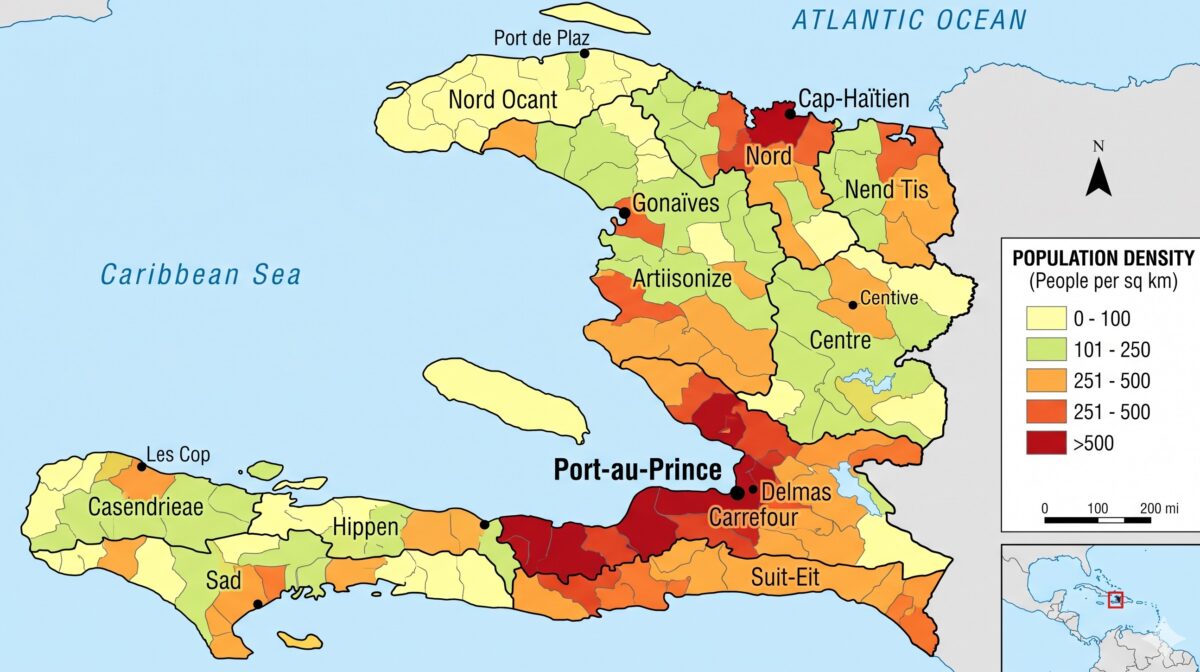
What distinguishes Haiti from other countries is the degree to which hunger is caused by gangs.  Historically, gang violence in Haiti was largely concentrated in specific slums of Port-au-Prince. While devastating for those communities, the national food supply chain, which relies heavily on imports through the capital’s port, remained somewhat functional.  Between October 2024 and June 2025, gang violence expanded westward into the Artibonite and Centre Departments, where 92,000 and 147,000 people were displaced respectively. By early 2025, the violence had also expanded into previously untouched areas of the country, and gangs began expanding north, south and east toward the Dominican Republic border, with the apparent goal of controlling key roads used for illegal weapons trafficking.

Gangs directly affect Haiti’s food economy.   Haiti imports over 70% of its rice and wheat but gangs now control key maritime and overland routes , strangling the entire country’s supply chain.  The Port of Port-au-Prince is blocked, forcing rerouting to Cap-Haïtien, raising costs.

Agricultural output in the Artibonite is down by at least 48%, according to the technical coordinator at the Artibonite Valley Development Organization. Gangs have taken over irrigation canals that feed the valley, leaving fields barren. Agriculture has stopped entirely in areas like Petite Rivière, Verrettes, and Pont-Sondé, where fields lie fallow and are overrun by weeds.   Gangs control irrigation systems (e.g., in Liancourt, Verrettes), forcing farmers to pay “taxes” for water or share their harvest.  Major markets (e.g., Croix-des-Bossales) are >80% non-functional.
UN World Food Program analysis using European Space Agency satellite imagery found up to 3,000 hectares of Artibonite farmland abandoned in 2023 compared to 2018, and hunger in these areas jumped from 40% to 57% in a single year.

According to ACLED, instances of sociopolitical violence almost doubled in three years , from 455 events in 2020 to 874 in 2023. The number of violent events in January 2024 was more than 70% higher than January 2023, and more than 60% above the five-year average.  As a result, over 1.4 million people are displaced (double the number from just a year ago), overwhelming host communities.  More than 5,600 people were killed in 2024 alone. Between October 2024 and June 2025, another 4,864 people were killed.
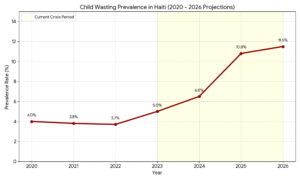
The graph at right shows how the prevalence of child malnutrition has increased over recent years.

The International Rescue Committee (IRC) reports that 75% of households cannot afford health services, and nearly 50% of the population survives on less than $3 a day.

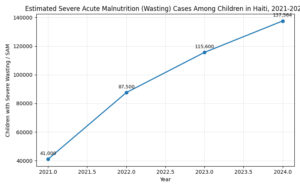
In this 2026 cycle, UNICEF has targeted over 129,000 children (aged 6–59 months) for treatment of Severe Acute Malnutrition.  UNICEF’s estimate of the increase in the number of cases of severe malnutrition is shown in the graph below.

Aid agencies have been continuously trying to provide life-saving assistance.  NGOs such as CARE, Catholic Relief Services and World Vision have led large consortia to promote nutrition in Haiti for decades, though the ability of outside agencies to operate has become constrained.  Today, agencies responding include:

  • -Action Against Hunger US is involved in Haiti. They support populations affected by violence and displacement, delivering critical food assistance and cash support in the Nord-Ouest region. In Nord-Est and Sud, their focus is on preventing malnutrition through targeted interventions. In Port-au-Prince, they provide vocational training, treat children suffering from malnutrition, and offer primary healthcare services to over 30,000 people.
  • -Catholic Relief Services (CRS) provides food assistance.
  • -CARE provides food to displaced populations.
  • -Compassion International provides food and voucher support through 365 church partners, helping children and caregivers.
  • -GOAL is providing cash for food security.
  • -Malteser International supports food security and nutrition, working with community health centers to identify and support malnourished children, pregnant women, and breastfeeding mothers.
  • -Médecins Sans Frontières (MSF/Doctors Without Borders) provides mobile and maternity clinics.
  • -Partners In Health (PIH/Zanmi Lasante): PIH deploys mobile food clinics staffed with medical professionals and community health workers to sites in the Artibonite region. They seek to identify malnourished children early so treatment can be delivered before health problems become fatal
  • -World Vision. World Vision is active in Haiti with child-focused hunger work, including school meals and other food support. Recent World Vision materials also describe food packages and support tied to the hunger crisis in Haiti.
  • -Meds & Food for Kids (MFK). This is a particularly important nutrition-focused Haiti organization. MFK produces therapeutic and supplemental foods in Haiti and works with Haitian clinics to treat malnourished infants and toddlers; it also runs school-feeding support with Vita Mamba.

-Reported by Steven Hansch, for Hunger Notes