


Hunger in Haiti
April 28, 2026: Over the last six years, the food crisis in Haiti has grown steadily worse. In 2019–2020, around 3.7 million Haitians were in food insecurity (IPC) Phase 3 or above. By 2022–2023, that was approaching 4.7 million, nearly half the population. The most recent UN Integrated Phase Classification system analysis shows 5.7 million people (more than half the population) facing high levels of acute food insecurity, with 1.9 million in IPC Phase 4 (Emergency).
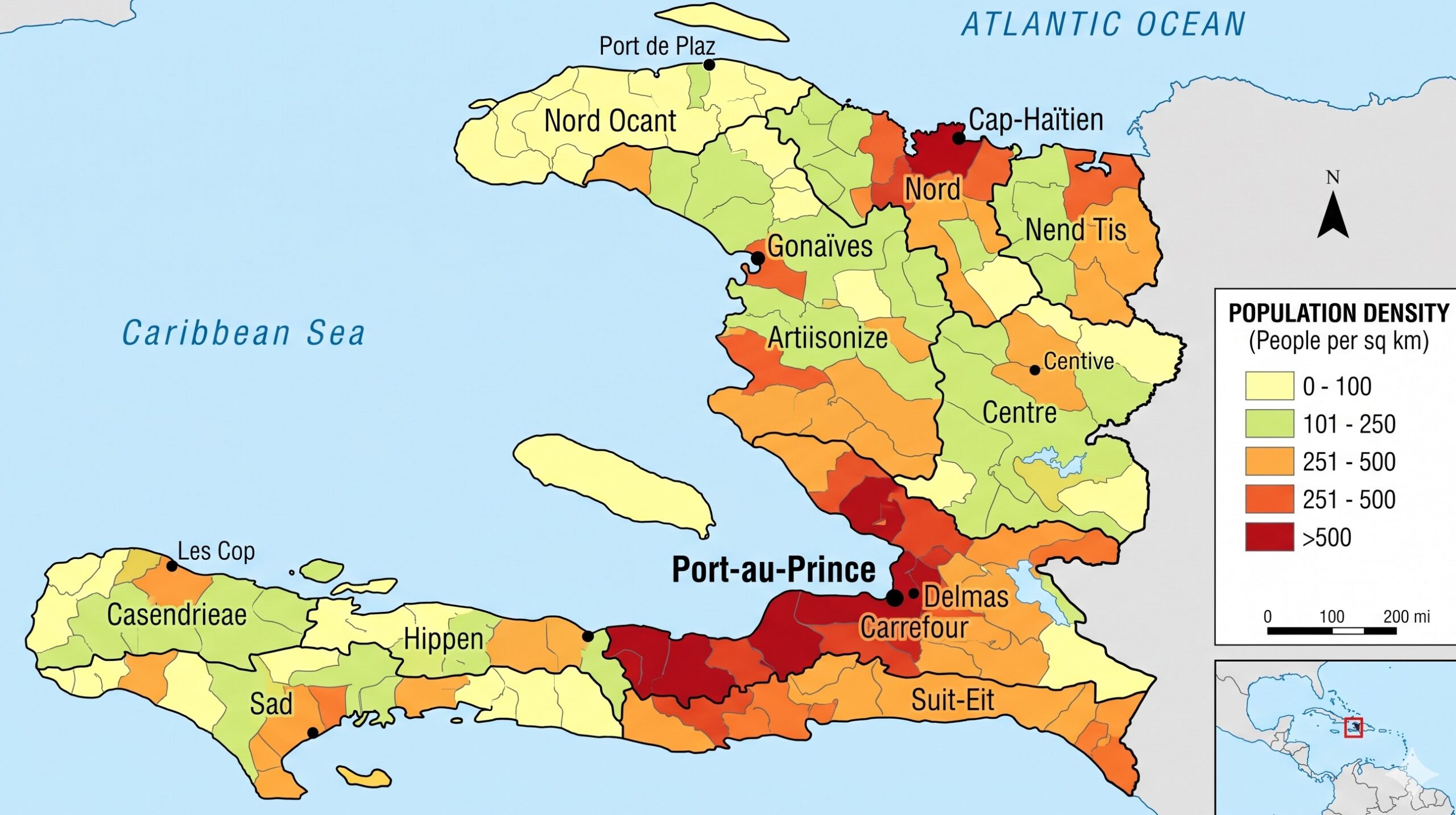
What distinguishes Haiti from other countries is the degree to which hunger is caused by gangs. Historically, gang violence in Haiti was largely concentrated in specific slums of Port-au-Prince. While devastating for those communities, the national food supply chain, which relies heavily on imports through the capital’s port, remained somewhat functional. Between October 2024 and June 2025, gang violence expanded westward into the Artibonite and Centre Departments, where 92,000 and 147,000 people were displaced respectively. By early 2025, the violence had also expanded into previously untouched areas of the country, and gangs began expanding north, south and east toward the Dominican Republic border, with the apparent goal of controlling key roads used for illegal weapons trafficking.
Gangs directly affect Haiti’s food economy. Haiti imports over 70% of its rice and wheat but gangs now control key maritime and overland routes , strangling the entire country’s supply chain. The Port of Port-au-Prince is blocked, forcing rerouting to Cap-Haïtien, raising costs.
Agricultural output in the Artibonite is down by at least 48 %, according to the technical coordinator at the Artibonite Valley Development Organization. Gangs have taken over irrigation canals that feed the valley, leaving fields barren. Agriculture has stopped entirely in areas like Petite Rivière, Verrettes, and Pont-Sondé, where fields lie fallow and are overrun by weeds. Gangs control irrigation systems (e.g., in Liancourt, Verrettes), forcing farmers to pay “taxes” for water or share their harvest. Major markets (e.g., Croix-des-Bossales) are >80% non-functional.
UN World Food Program analysis using European Space Agency satellite imagery found up to 3,000 hectares of Artibonite farmland abandoned in 2023 compared to 2018, and hunger in these areas jumped from 40% to 57% in a single year.
According to ACLED, instances of sociopolitical violence almost doubled in three years , from 455 events in 2020 to 874 in 2023. The number of violent events in January 2024 was more than 70% higher than January 2023, and more than 60% above the five-year average. As a result, over 1.4 million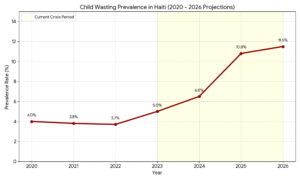 people are displaced (double the number from just a year ago), overwhelming host communities. More than 5,600 people were killed in 2024 alone. Between October 2024 and June 2025, another 4,864 people were killed.
The graph at right shows how the prevalence of child malnutrition has increased over recent years.
The International Rescue Committee (IRC) reports that 75% of households cannot afford health services, and nearly 50% of the population survives on less than $3 a day.
In this 2026 cycle, UNICEF has targeted over 129,000 children (aged 6–59 months) for treatment of Severe Acute Malnutrition. UNICEF’s estimate of the increase in the number of cases of severe malnutrition is shown in the graph below.
Aid agencies have been continuously trying to provide life-saving assistance. NGOs such as CARE, Catholic Relief Services and World Vision have led large consortia to promote nutrition in Haiti for decades, though the ability of outside agencies to operate has become constrained. Today, agencies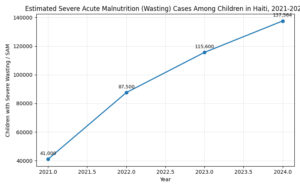 responding include:
- -Action Against Hunger US is involved in Haiti. They support populations affected by violence and displacement, delivering critical food assistance and cash support in the Nord-Ouest region. In Nord-Est and Sud, their focus is on preventing malnutrition through targeted interventions. In Port-au-Prince, they provide vocational training, treat children suffering from malnutrition, and offer primary healthcare services to over 30,000 people.
- -Catholic Relief Services (CRS) provides food assistance.
- -CARE provides food to displaced populations.
- -Compassion International provides food and voucher support through 365 church partners, helping children and caregivers.
- -GOAL is providing cash for food security.
- -Malteser International supports food security and nutrition, working with community health centers to identify and support malnourished children, pregnant women, and breastfeeding mothers.
- -Médecins Sans Frontières (MSF/Doctors Without Borders) provides mobile and maternity clinics.
- -Partners In Health (PIH/Zanmi Lasante): PIH deploys mobile food clinics staffed with medical professionals and community health workers to sites in the Artibonite region. They seek to identify malnourished children early so treatment can be delivered before health problems become fatal
- -World Vision. World Vision is active in Haiti with child-focused hunger work, including school meals and other food support. Recent World Vision materials also describe food packages and support tied to the hunger crisis in Haiti.
- -Meds & Food for Kids (MFK). This is a particularly important nutrition-focused Haiti organization. MFK produces therapeutic and supplemental foods in Haiti and works with Haitian clinics to treat malnourished infants and toddlers; it also runs school-feeding support with Vita Mamba.
-Reported by Steven Hansch, for Hunger Notes
-
 World Hunger Education
Service
P.O. Box 29015
Washington, D.C. 20017 -