



WASHINGTON — Solar panels are providing women in Yemen access to energy and a way to escape famine conditions that continue to threaten the country.
Author: Alexandrea Crockett
Food Prescription Program Sends Groceries To Pregnant Moms In Need
A local food bank has teamed up with a north St. Louis hospital to offer a “fresh-food prescription” service for low-income, pregnant mothers.
Lesotho: Acute Food Insecurity Situation December 2018 – February 2019
As projected in May/June 2018, the Food security situation is expected to deteriorate during the peak lean season between December 2018 to February 2019.
The meals that change children’s lives
I often find it a challenge in the morning to get my children to eat their breakfast quickly before we rush out of the door to get to school on time, a daily occurrence that many parents can probably relate to.
Students are Building Food Recovery Across the U.S.

On “Food Talk with Dani Nierenberg,” Executive Director of Food Recovery Network(FRN) Regina Northouse talks about the newest answers to food waste issues: simple solutions and young activists.
The Brand Agency & Foodbank Fight Hunger This Christmas With Empty Packet Of Cereal
In light of the federal government’s recent threat to reduce funding for food relief organisation Foodbank, The Brand Agency has launched an innovative new product to go on Western Australian supermarket shelves and raise funds over the Christmas period.
http://www.bandt.com.au/campaigns/brand-agency-foodbank-fight-hunger-christmas-empty-packet-cereal
How Blockchain Can Be Used to Address Food Security in India
Every night, 200 million people in India go to sleep with hungry stomachs. Ranked 105th on the 2018 hunger index, India is home to the largest undernourished population in the world. These grim statistics are counter intuitive in light of India’s significant gains in agriculture production, which have advanced the country from famines to food surplus, the paradox being hungry people and food surplus in the same place.
Sustainable Development Depends on Better Nutrition for All Nations
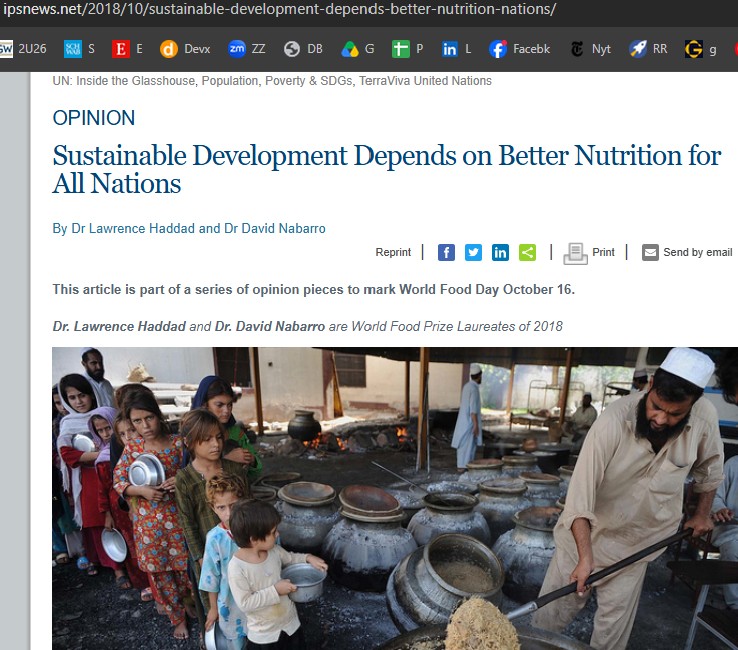
2018 Editorial by David Nabarro and Lawrence Haddad
From cold chains and blockchains – major technological revolutions are on the brink of transforming food systems. While cold chain technology can prevent losses as food travels from farm to market, blockchain technology can help digitally and accurately relay vast amounts of data between networks of farmers, traders and vendors. All this can help reduce transaction costs, reduce financial barriers to accessing markets and build trust in the provenance of food, from farm, forest and ocean to fork.
Solving Dietary Issues Through Public Private Partnerships: An Example from the Field
October 19, 2018
Every October, World Food Day is celebrated around the globe. Unfortunately, hunger is increasing, not decreasing. After a period of decline, world hunger is on the rise again. Today, over 820 million people are suffering chronic undernourishment [1]. While the reasons for the rise in hunger are complex, the role of the private sector, while acknowledged to be a key component in solving hunger-related issues, continues to be debated. This piece will present one of many personal experiences with the role of public private partnerships in addressing hunger.
Since 1979, I have been involved with the implementation of multimillion-dollar agriculture field programs around the world. They have had, as their aim, to improve food security either indirectly through income generation through agro-related activities and/or directly with farming households through improving productivity and dietary diversity for their own consumption. Private sector involvement has always been integral part of these programs. Private sector engagement in food security is nothing new. It has been around since the domestication of agricultural crops and livestock. Today’s global food supply chains impact local food systems everywhere, both positively and negatively.
In recent years the international development community of practice has focused in on the role of the private sector in improving dietary quality, especially in vulnerable populations. Data from food insecure countries show diet-related micronutrient malnutrition, especially vitamin A and iron, to be serious issues impacting maternal and child health. Many food insecure countries have limited financial and human resources to combat micronutrient malnutrition, so using their limited assets strategically is a high priority. Countries grapple with a key question around private sector engagement: How can government serve as a big picture “market enabler,” and stop taking on actions that the private sector already does?
I recently facilitated a discussion group on this very topic as part of a long-term advisory assignment in Sub-Saharan Africa. The country was in the process of developing a multi-year plan for agriculture. Our discussion group consisted of private sector actors from throughout the agriculture supply chain (small growers, input suppliers, buyers, and processors), as well as NGOs and public sector actors from the ministry of agriculture, which included a policy maker and key personnel in charge of outreach. One of the big changes the government was committed to was transitioning from their role as “market maker” to “market enabler.” This included a desire to concentrate more on how to solve dietary issues, especially micronutrient malnutrition, through the marketplace as an enabler.
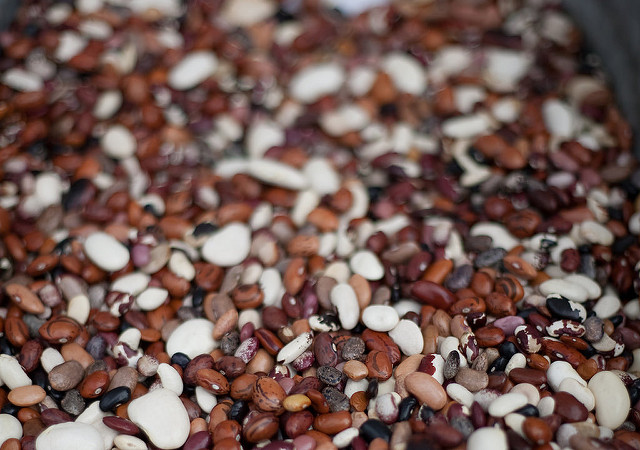
The group selected iron-fortified beans as a case study to illustrate how the enabler process could be achieved. First, we reviewed recent data that indicated women in the country who consumed iron-fortified beans significantly improved iron levels in 128 days [2]. Next, the group agreed that the type of bean tested in the consumption trial is consumed widely and is easily grown in traditional mixed cropping systems. Next, we asked the food processor about iron-fortified beans who stated his company was in the final stages of setting up a processing line for canned beans using locally grown beans. The processor could see the competitive advantage of marketing highly nutritious beans in a country where diet-related iron deficiency was so prevalent; as long as using iron-fortified beans would not cost more than conventional beans, he would consider buying them.
At that point the group turned to the public sector participants from the ministry of agriculture. The outreach/extension director stated that if the buyer was committed to buying iron-fortified beans, and since beans are traditionally grown, the extension team could come up with an outreach plan to provide skills to improve productivity throughout the supply chain to produce the quantity and quality required. NGOs attending the discussion indicated that they would support demand creation for iron-rich beans through their behavioral change communications work. Finally, the policy maker spoke. He now understood how an identified dietary gap could be used to drive an agricultural supply chain. He understood the role of the ministry as a market enabler for the private sector in creating demand for nutrient-dense foods that should have a positive impact on micronutrient malnutrition.
This example highlights how nutrition-driven value chains present opportunities in which key actors identify a common interest and then proceed to build a public–private partnership to resolve the issue.
[1] FAO 2018 State of Food Security and Nutrition in the World Report.
[2] The Journal of Nutrition, Volume 146, Issue 8, 1 August 2016.
Share Your Thoughts
What has been your experience with the role of public-private partnerships in addressing hunger-related issues? What worked? What didn’t? If you’d like to respond with an article or opinion, you can find us on Twitter @HungerNotes, or on Facebook at World Hunger Education Service – Hunger Notes.
About the Author
Since 1979, Paul Sommers has been an active proponent for the integration of agriculture and nutrition. He holds academic degrees in both agriculture and nutritional sciences, and has taught both subjects as a faculty member in the California State University system. He has promoted the market-driven link through a variety of channels including USAID, Peace Corps, NGOs, the United Nations, and the World Bank. His field activities have included on the ground technical assistance in over 55 countries, management of long-term food security projects, capacity building through community-based workshops and the publication of several field training manuals, and “how to” books on the food production nutrition linkage for community outreach staff. The author’s blog is: https://psommers92024.wordpress.com
*This is an independent article and does not necessarily reflect the views of WHES.
Urban Food Security in the Global South: Three Ideas
Until recently, it was widely thought that half of the world’s population lived in cities. The United Nations places the global number at 55 percent, with Africa at 43 percent and Asia at 50 percent.
