
A Promising Model to Predict Rates of U.S. Food Insecurity

As  covered in a September 20 Hunger Notes article, the USDA announced that they would no longer be collecting the annual data measuring household food insecurity and cancelling the Household Food Security Reports. This means that the 2024 report will be the last under the current format. However, at the same time, food insecurity has been on the rise in the U.S. for the past two decades, 17% from 2001 to 2023.  Ending this annual data collection and report will result in a critical gap in the ability to understand and address food insecurity in the U.S.

Sophie Collyer, Director of the Center on Poverty and Social Policy, at Columbia University, in a brief published Oct 22, 2025, outlines a model to predict food insecurity rates at the population level, adult, and child levels, in the absence of the USDA’s annual data set.  The model uses secondary data of poverty, unemployment, specific food inflation rates, all of which are highly correlated with food insecurity. When the model was tested against the past 14 years of historical food insecurity rates, it was shown to align closely.  The model was also used to predict food insecurity rates for 2024, which at the time the brief was published, the USDA report was still unavailable.

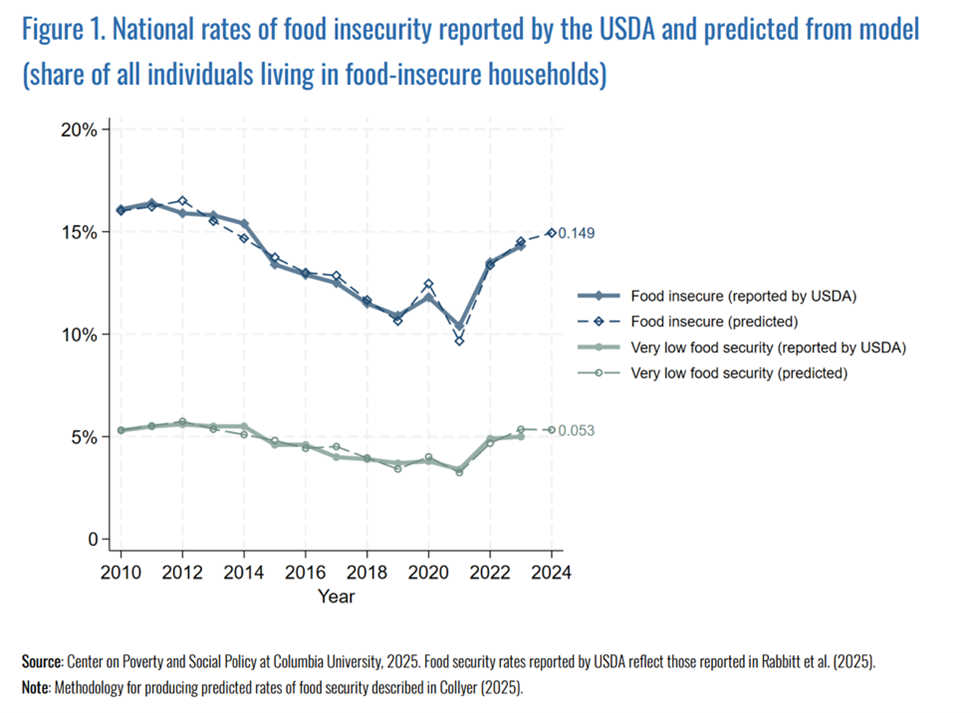
Figures 1 (above) and 2 (below) are taken from Collyer’s report and demonstrate how close the model’s predictions are to the USDA official rates among the share of all individuals, adults, and children, living in food-insecure homes.

For the results shown in Figure 1 (share of all individuals living in food-secure homes), in all but four of the years, the model was within 0.4 percentage points of the official USDA rate, with the largest difference in those four years 0.7 percentage points.

For the prediction of rates of adults, shown in Figure 2, in all but three years, the model is within 0.4 percentage points or less of the official USDA rates.

The model’s prediction of rates among children was within 0.4 percentage points in half of the years, with the largest difference 1.2 percentage points, the lowest performing among the three predictions.

Collyer indicates that the model will continue to be refined.

With the 2025 cancellation of the USDA’s historic, official household food insecurity dataset, this model offers a promising substitute for providing credible estimates of food insecurity for policy and program planning.

Reference:  https://povertycenter.columbia.edu/sites/povertycenter.columbia.edu/files/content/Publications/Predicting-National-Rates-Food-Insecurity-CPSP-2025.pdf?utm_source=chatgpt.com

https://www.ers.usda.gov/publications/pub-details?pubid=109895
CSIS Reviews Implications of the Final U.S. Hunger Report

A new Jan. 6 report from the think tank, CSIS, reviews the recent U.S. Government study about hunger in America, noting that this until-now annual food security or hunger report will no longer be conducted by the US Government which deemed it political and inducing fear.

Caitlin Welsh, the author of this review observes that “the end of the report represents a rupture in long-standing data on food security among Americans, as there is no report that provides the same information to the public and policymakers today.”  This survey had been created with bipartisan support and helped advise Congress about anti-hunger programs.

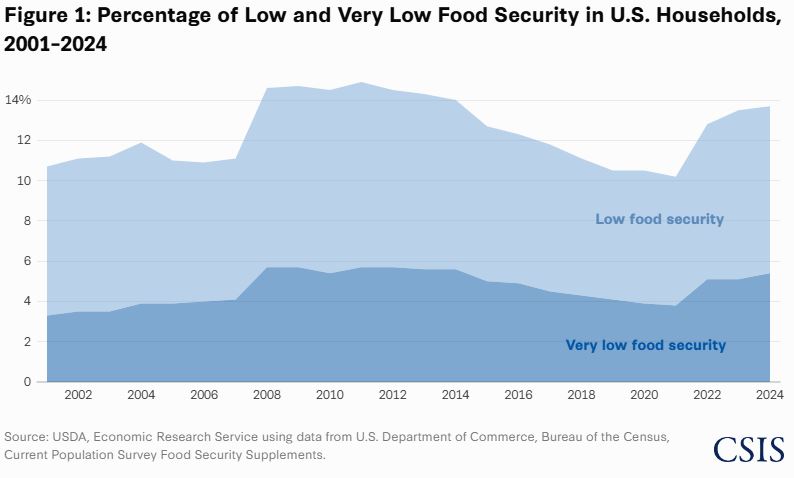
The USDA Household Food Security in the US publication looks back at 2024 found that roughly 1 in 7 Americans were food insecure, and that “5.4 percent of households experienced very low food security.”  Hunger was not uniform everywhere in the U.S.  For example, 36% of families in the Washington DC area experienced food insecurity in 2024 and “the Greater Boston Food Bank found that in 2024, 37 percent of Massachusetts households faced food insecurity in 2024.”

Welsh writes that food insecurity in the US has in the past tracked the health of the U.S. economy.  In recent years, hunger has increased, in significant part because of increasing retail food prices.  Welsh says alongside elevated food prices, experts may be right to assume a continued rise in food insecurity in 2025.  In 2026, cuts in the SNAP program enacted in the One Big Beautiful Bill Act, were estimated to eliminate SNAP assistance for millions of Americans, may further increase food insecurity among U.S. families.”

CSIS is the Center for Strategic and International Studies, an independent, non-partisan think tank based in Washington, DC.  See:  https://www.csis.org/analysis/last-us-hunger-data-what-we-lose-termination-usdas-household-food-security-united-states

For the full US Department of Agriculture report, published on Dec. 30, 2025, see:  https://ers.usda.gov/sites/default/files/_laserfiche/publications/113623/ERR-358.pdf?v=89918  authored by Matthew P. Rabbitt, Madeline Reed-Jones, Laura J. Hales, Shellye Suttles, and Michael P. Burke who are economists in the Economic Research Service of USDA.

See also, the related Hunger Notes article on this issue by Kathy Goss:  https://www.worldhunger.org/united-states-cancels-household-food-security-report/