



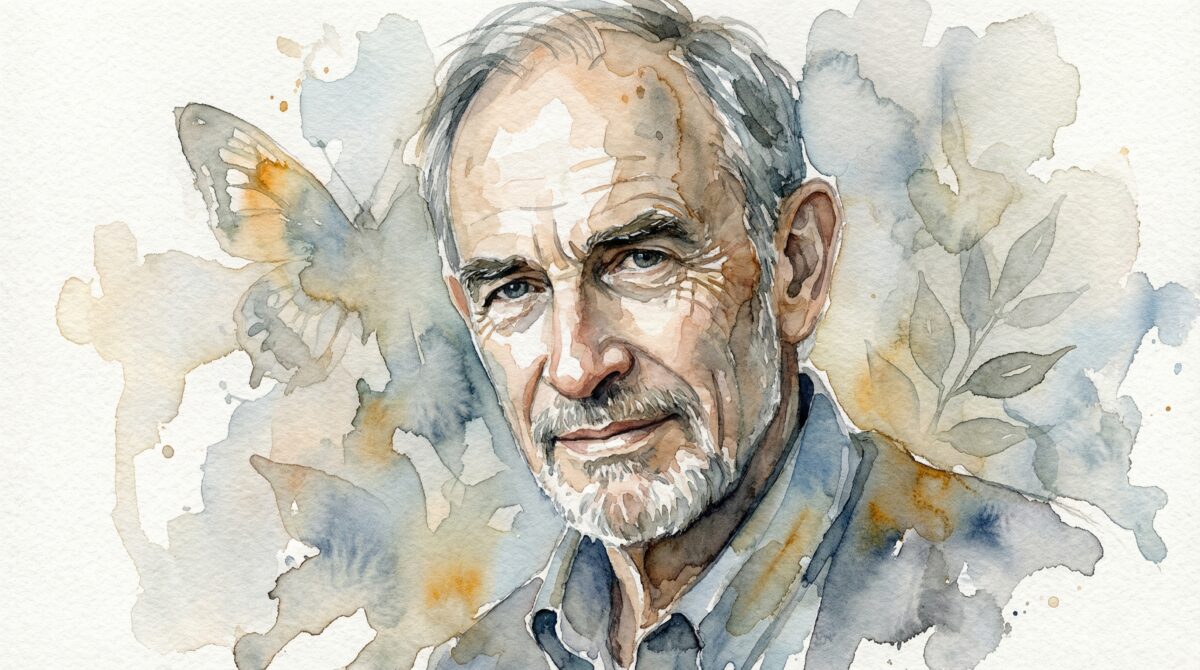
Scientist, educator and global citizen, Paul Ehrlich passed away at the age of 93 on March 13, 2026. As professor from 1959 to 2016 at Stanford University, he sponsored the first course offered about international hunger and life-saving aid, consistent with his life-long efforts to mitigate suffering from famine, food insecurity and environmental crises.
In a series of publications, Ehrlich called the general public’s attention to the reality of famines around the world. His writings, often with his wife Anne Ehrlich, emphasized the dramatic increase in the number of people exposed to food insecurity and hunger as the world population quadrupled during his lifetime, an observation largely ignored by other major analysts and politicians.
The success of their 1968 book, The Population Bomb, resonated with a public increasingly aware in the 1950s and 1960s of exponential population growth. Demand for his views was reflected in his more than 20 appearances as a guest on NBC’s The Tonight Show.
Some obituaries have denied the recurrence of famine, turning a blind eye to the hundreds of millions of people affected in recent decades by famines in Mali, Sudan, Haiti, Ethiopia, Yemen, Cambodia, India, Malawi, Zimbabwe, Zambia, Angola, and other countries since the publication of The Population Bomb which warned of the threats of future famines. Critics of Ehrlich pretend away the fact that in the decades since its population, over 300 million young children have died from malnutrition in poorer countries and that famines continue to occur in still-growing populations such as South Sudan, Nigeria, Mozambique Somalia, and Kenya. Remarkably, some obituaries about Ehrlich suggest that malnutrition has not been a problem in the world, despite the fact that an estimated four to five billion people have been seriously hungry and malnourished during the decades since Ehrlich’s warning.
Fortunately, the frequency and severity of very large famines have declined, in part because of Ehrlich’s warnings, which helped spur the U.S. government to create the Famine Early Warning System (FEWS) in the 1980s. This system has helped prevent famines through timely food and humanitarian assistance and is still used today by the U.S. Department of State.
The book also helped galvanize support for women’s reproductive rights, education, and microfinance initiatives, contributing to declines in fertility and more stable population growth in many countries. Governments, including that of the United States, increasingly supported programs to reduce child mortality, which in turn enabled women across Asia and Africa to choose smaller family sizes. For instance, in the 1960s, the average woman in Asia or Africa gave birth to seven children, whereas today the average is three to four.
Ehrlich’s environmental warnings have been less successful, however, in preventing species extinction and habitat loss. Since his book, millions of species have gone extinct at rates up to 1,000 times the natural background level, largely due to human encroachment on land and marine habitats. As Ehrlich warned decades ago, the 2024 Living Planet Report documents that monitored wildlife populations have declined by an average of 73% since 1970. This loss is often described as a “sixth mass extinction,” driven primarily by habitat destruction, followed by overharvesting, invasive species, disease, and climate change.
As Ehrlich documented, carbon dioxide emissions have increased by over 115% since 1968. To feed a growing population, humans have converted vast tracts of forests and grasslands into farmland. Over the past 50 years, agriculture and land-use change have accounted for roughly 23% of total anthropogenic greenhouse gas emissions. The world has also lost about 420 million hectares of forest since 1990 due to land conversion.
Ehrlich spent a career studying the science of population dynamics, including coevolution and population biology. In his 1964 paper “Butterflies and Plants: A Study in Coevolution” (with Peter Raven), he argued that plants and herbivorous insects drive each other’s evolution—an idea that helped launch the modern field of coevolution. He also conducted decades-long field studies on checkerspot butterflies (Euphydryas editha bayensis), examining population dynamics, genetic structure, and the effects of climate and habitat fragmentation. His work documented patterns of local extinction and recolonization, providing empirical support for the concept of meta-populations and shaping modern conservation science.
Ehrlich helped popularize the notion of ecosystem services, the benefits people receive from nature, such as pollination, water purification, and soil fertility. He used this framework to quantify how human demography and consumption threaten the functioning of ecosystems.
As the Peter Bing professor at Stanford University, Ehrlich founded Stanford’s Center for Conservation Biology and has worked on endangered‑species policy, countryside biogeography (making human‑altered landscapes hospitable to biodiversity), and cultural evolution of environmental ethics.
Over his long career he mentored scores of students at Stanford, cultivating in them the same blend of scientific rigor and moral urgency that defined his own work.
His textbook Ecoscience: Population, Resources, Environment, coauthored with Anne Ehrlich and John Holdren, is a comprehensive and still-relevant compendium. It provides a foundational overview of ecological principles, resource constraints, and environmental systems. The book explores how population growth, industrial agriculture, pesticide use, and pollution strain natural systems, and it outlines pathways for social, political, and economic adaptation. Ultimately, it frames humanity’s environmental challenges as requiring urgent and coordinated global action.
Like his publications, Ehrlich’s lectures were intellectually wide-ranging and provocative, integrating history, global trends, politics, and ecology. Unlike many academics, he was deeply committed to addressing hunger and alleviating human suffering.
Other readings:
Understanding the fragility of our planetary home: The legacy of Paul Ehrlich
Nature Journal: https://www.nature.com/articles/d41586-026-00939-5
– by Steve Hansch, board member, World Hunger Education Service

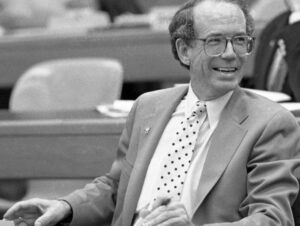 was a terrific leader because he always cared first and foremost about students, faculty and staff. Don was an important influence on me and on the way I tried to lead. I learned a lot from him.”
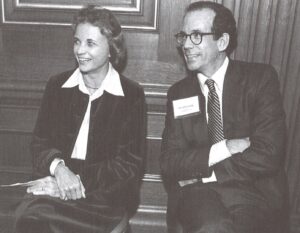 roduce best results.” Another student remembers: “I will never forget Donald Kennedy getting up on the lab table at the front of the lecture hall and assuming a quadruped position to demonstrate to us the concepts of dorsal, ventral, cephalo, and caudal. His first concern was always with teaching effectively, not preserving his dignity.”
 with him, talking about all manner of things.
  l. A day rarely passes when I