

Great Contributions: WHES’s Lane Vanderslice

November 13, 2026   Lane Vanderslice would like everyone to know:  “I got very interested in hunger, and I got very interested in the world and really tried to make some worthwhile change in it.”

Long-time editor of this publication, Lane Vanderslice, sat with us to reflect on his life and work.  After finishing college, uncertain about whether to pursue economics or psychology in graduate school, Lane instead hitchhiked around the United States, taking work as an agricultural laborer and in a cannery in Stockton. That decision put him face to face with deep rural poverty for the first time. In Fresno, he connected with an AFL-CIO effort to organize farmworkers and went to work picking cotton for three cents a pound, a wage already undercut by early mechanical harvesters.

What struck him most was who was actually doing the hardest labor. The people around him in the organizing effort were, in his words, a “marginal group,” people who had skipped parole or struggled with alcoholism, while the real workers were Mexican and Latin American braceros. That contrast planted a question that would shape his life’s work: why were so many Mexican laborers crossing into the United States for such punishing wages? The search for an answer sent him back to graduate school, where he eventually earned his Ph.D.

Student Activism and the Roots of His Commitment

As a University of Michigan student and writer for The Michigan Daily, Lane interviewed figures including Henry Kissinger and Carl Sandburg, and watched colleagues like Tom Hayden, who went on to co-found Students for a Democratic Society, push the paper toward activism. He was moved by the sight of fraternities lying about discriminatory practices dictated by national chapters and he became further radicalized further in graduate school as the Vietnam War intensified. He organized a protest against Dow Chemical’s napalm production and helped found the Union for Radical Political Economics with fellow graduate students. That combination of civil rights, anti-war organizing, and firsthand exposure to farm labor conditions convinced him that meaningful anti-poverty work required organizing, not just scholarship.

Lessons from Bolivia: Poverty, Politics, and Public Health

Determined to understand poverty firsthand, rather than theoretically, Lane took a teaching post that led him to Bolivia for three years.  He was based in La Paz, the capital city, while conducting dissertation fieldwork. It was an immersive education in how fragile institutions actually function. He recalled waking up to military coups, watching the university shut its doors, and realizing how differently power could be seized and wielded compared to the United States he thought he understood from the civil rights era. He bought a Land Rover from a British embassy staffer and traveled through rural areas, often staying with Peace Corps volunteers and talking directly with campesino families.

One encounter proved formative.  A rural friend with a child the same age as Lane’s own son lost that child, having never had access to a doctor or immunizations. Around the same time, Lane’s own son fell ill with diarrhea in Colombia, and Lane initially withheld fluids, the opposite of correct treatment, until a doctor corrected the error.  These sensitized him to the importance of oral rehydration therapy, immunization, and rural health access which would become cornerstones of US foreign aid.

Bread for the World and the Fight in Congress

After teaching stints at Rutgers and the University of Notre Dame, Lane joined Bread for the World in 1980, a national anti-hunger nonprofit.  He was hired to push the Carter administration’s tentative embrace of land reform in foreign aid, an effort that collapsed during the subsequent the Reagan administration which militarized aid policy in Central America instead. Undeterred, Lane and colleagues including Ernie Lovenson and Paul Nelson pivoted to education and advocacy for redirecting military and security-assistance funding toward “basic human needs,” most notably child survival programs.

The turning point came when UNICEF’s newly appointed director, Jim Grant, sought congressional allies to fund a global child survival push built on immunization and oral rehydration therapy.  Lane and Nelson met Grant at the Cosmos Club and helped engineer legislation, co-sponsored by Representatives Tony Hall and Jim Leach, that created a USAID child survival fund. The bill drew roughly 110 congressional co-sponsors and, for the first time in years, held military aid increases flat.   Lane later helped defend that health funding stream again in the early 1990s, when USAID sought to eliminate its functional accounts; he recruited Representative Chris Smith to introduce a preserving amendment. Over subsequent years, U.S. international health funding grew many-fold, from about $130 million  to over a billion, seeding later initiatives like the vaccine alliance Gavi.

He recalls:  “I did do a lot to increase child survival funding while at BFW and later for a bit at NCIH.  The worldwide effort by many continued over many years did make a big difference in child mortality and “hunger-related” deaths.   We did tried to shift money from ESF, but that was in the bill from the beginning.”

Twenty Years Editing Hunger Notes

After stints at the National Council for International Health (NCIH) and the Academy for Educational Development (AED), Lane became editor of WHES’ flagship publication, Hunger Notes, a role he held from 1996 through 2016.
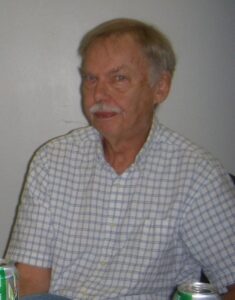
Building on the work of WHES founder Pat Kutzner, he helped transform a print publication into an online resource reaching readers around the world.

Working roughly ten hours a week alongside a day job, he built Hunger Notes into a reference point for hunger statistics and analysis, registering the domain worldhunger.org early enough to secure a durable web presence as the publication eventually dropped its print edition. At its peak, the site drew close to a million annual readers, though he later reflected that a narrower, more focused site design might have served readers better as search and social platforms reshaped web traffic.

His writing consistently emphasized the structural causes of hunger: economic inequality, political exclusion, conflict, and institutional arrangements that disadvantage poor people. He also championed the human right to food and examined how public policy, agricultural systems, and international institutions could better serve vulnerable populations.

Lane says:  “I spent a lot of time doing this in addition to my regular job and I am very pleased with all we were able to do.   Nicki Lagoudakis and I took the step of turning WHES into a purely voluntary organization.  I did work the same amount of time at WHES as Pat Kutzner (the founder), 21 years.”

As the executive editor for virtually all of this period, Lane edited nearly all articles that appeared in the publication, numbering in the thousands.  Lane also wrote many articles.

For instance, articles that Lane wrote:

Lane developed a framework analyzing how economic systems can be structured to benefit a small elite at the expense of the poor. He argued that standard economic models fail to account for “unproductive and harmful” economic activities that perpetuate hunger and poverty.  He wrote, “Standard economics has made an extremely serious mistake.”

In 2008, Lane wrote, “2.6 billion people live on $2 a day or less. … a person living on $2 a day spends $1 a day on food. When food prices go up by 100 percent, s/he must spend $2.00 a day on food or purchase less food… leading to increased hunger, and has much less left over for other necessities such as housing.”

His work on this topic examined how powerful groups maintain control of government to extract income and resist reforms.  His work covered land reform, debt forgiveness for developing nations, and the role of institutions like the World Bank in poverty alleviation.  He wrote, “If it were not for China, world malnutrition would have increased.”

He wrote extensively on the right to food as a human rights issue, particularly in the context of the 50th anniversary of the Universal Declaration of Human Rights. His work explored how human rights frameworks could be better utilized to combat hunger.  He wrote, “implementation of the human right to food has been one of the slowest.”

Conflict and Food Insecurity

Lane highlighted the bidirectional relationship between conflict and hunger, noting how food insecurity can spark violence and how conflict disrupts food production and distribution.  Lane examined the interplay between global financial crises, food crises, and hunger.  He wrote, “Armed conflict, the fight by groups for control of the government or territory (frequently possessing natural resources), has been throughout history the principal way in which harmful economic societies have been established. Its importance continues today. The results of conflict have been the domination of the winning side over the losing and the establishment of a pattern of income and resource allocation favoring the winners.”

Lane covered critical debates about:
  • * Organic vs. conventional agriculture and whether organic farming can feed the world
  • * The impact of corporate agriculture on small farmers (campesinos)
  • * Threats to biodiversity, such as the impact of avocado farming on Monarch butterflies
  • * The need to shift focus from merely feeding people to nourishing them

He analyzed U.S. food assistance programs, including reforms to PL480 (Food for Peace) and the development of strategies like USAID’s multisectoral nutrition approach focusing on the first 1,000 days of life.  He wrote, “Hunger is the major health risk globally.”

He addressed the lack of attention to poverty and hunger in political campaigns and advocated for greater policy focus on these issues.

Lane continues to advise WHES about articles for Hunger Notes.  Otherwise he says he’s “now  spending time trying to maintain my health, staying in touch with family and old friends, some  travel with my wife Paula,  trying to get my house in good shape including appearance, supporting and participating in anti-Trump activities including elections, and continuing to play the piano.”

As well, “In the earlier years of my retirement, after stepping down as editor of worldhunger.org., I became a member of the steering committee of the Union for Radical Political Economics, an organization which I helped found in the late 1960s.”

“I wrote a number of economics articles including Orthodox Economics and the Economics of Harm in the Journal of Economic Issues.  Orthodox economics understands productive activity, which obtains income by benefiting others, but does not have an adequate conception of activity which obtains income by harming others. There is a broad and important range of activities which obtain income by harming others. This article considers the analysis of some of these including conflict theory, rent-seeking, corruption, harm of workers, consumers, and nature, economic historians’ consideration of extractive political and economic institutions, and the varieties of discrimination. The omission of harm is evident in undergraduate textbooks in microeconomics and public economics. The fundamental political economic system of past and present, a productive plus harmful one, is not being taught to economics students.”

A Lasting Contribution

Lane Vanderslice’s contributions to reducing hunger span grassroots organizing, international development, congressional advocacy, and public education. His work helping to advance child survival funding demonstrated how determined advocates could influence U.S. foreign assistance priorities. His two decades leading Hunger Notes helped ensure that reliable information and critical analysis about hunger remained accessible to policymakers, researchers, students, and the public.

As World Hunger Education Service marks its 50th anniversary, Lane’s legacy illustrates a central principle of the organization: informed citizens, effective advocacy, and a commitment to understanding the underlying causes of hunger can contribute to meaningful and lasting change.


– edited by Steven Hansch of World Hunger Education Service

 

U.S. Food Aid (Part 7): Lessons of Exit & Sustainability

July 21, 2026   This is the seventh part of a Hunger Notes series that review of lessons of U.S. food aid.

The ultimate goal of aid agencies’ food aid projects is to solve hunger problems in a lasting way.  Rarely, however, are aid agencies able to come back and see what improvements persisted after the project was over.

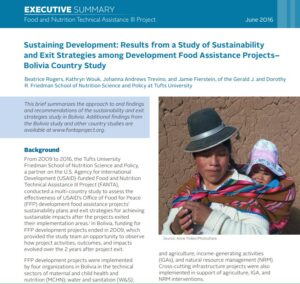
Unique and powerful research conducted by Beatrice Lorge Rogers and Jennifer Coates of Tufts University’s School of Nutrition (commissioned by the USG Food for Peace program) looked in-depth at what happens after food assistance projects ended. Their key conclusion was that project success at the moment of exit does not reliably predict long term sustainability.  (see:  synthesis report.)

The study found that many interventions that looked strong around the end of implementation weakened or collapsed once external aid resources and incentives disappeared.  As a result, the researchers argued that sustainability must be designed from the beginning of a project, not added late in the final year. They emphasized that sustained outcomes require three jointly necessary factors. These are:  1) a continuing source of resources, 2) technical and managerial capacity, and 3) motivation that does not depend on project inputs. A fourth factor, linkages to institutions, is often essential for phase over. The study stated that “endline achievement is not evidence of durability” and that “hope is not a strategy.”  In a series of reports produced by Tufts University, they demonstrated that sustainability is a trajectory that unfolds over years, not a status measured at a single point in time.

The research followed twelve NGO projects funded by the US Food for Peace program in four countries: Bolivia, Honduras, India, and Kenya. These projects had been deemed to have been generally successful at the time of their completion, and had documented sustainability plans.  Included in the study were ADRA, CARE, Save the Children, World Vision, Food for the Hungry, ACDI/VoCA, Counterpart International, and local sub-awardees.  The Tufts study used mixed methods and collected data at exit and again one to three years later. It examined whether services continued, whether practices were maintained, and whether outcomes persisted or changed. The findings challenged common assumptions in development programming.

One assumption they found NGOs too often make is that once people have been trained, they will continue the activity. But the study found that training alone was not enough. People also needed motivation, resources, linkages, and opportunities to refresh knowledge. Another assumption is that establishing contact between community actors and government services will create a durable relationship. The study found that linkages were sustainable only when responsibilities were explicit, the receiving institution valued the activity, and the institution had staff, authority, budget, and supplies.

The research also showed that abrupt exits often led to collapse, while gradual exits that allowed independent operation before departure were more promising.

Across countries, sustainability requires deliberate integration of resources, capacity, motivation, and linkages. These factors need to be built into program design from the start. The study found that the first three factors were jointly necessary. No project achieved lasting sustainability without all three functioning together. Resources refer to a continuing source of financial, material, or human capital. Capacity refers to technical and managerial skills. Motivation refers to incentives that do not rely on project inputs. Linkages refer to vertical connections to institutions that can provide supervision, supplies, or market access. The study found that projects often achieved high impact at exit because they were supplying resources and incentives; but, once those supports disappeared, outcomes could remain stable, improve, erode, or change in unexpected ways. The researchers warned that focusing exclusively on maximizing impact at exit, as is common, can undermine sustainability.

“Even evidence of continued impact at one point in time post-exit may not predict long-term sustainability.”

Case examples illustrate these findings.  In Bolivia, NGOs built piped water systems and established community water committees. Households paid monthly user fees. The systems were highly sustainable because they combined resources, capacity, and motivation. The user fees provided resources. The committees had strong managerial capacity. Households valued the benefit of piped water and were motivated to pay. In contrast, water quality testing and chlorination collapsed. NGOs had managed and paid for water testing until the final day. Committees had never practiced independent operation. Beneficiaries disliked the taste of chlorine and did not perceive the need for treatment. Motivation was absent.

“Impact and sustainability are distinct achievements, and an exclusive focus on impact at exit may jeopardize sustainability. For example, providing free resources up to the time of project exit may maximize project impact, but the withdrawal of those resources poses a bigger threat to sustainability than a gradual withdrawal with the development of substitute resources.”

In agriculture, NGOs relied on model farmers to teach improved techniques. They provided free inputs to incentivize the model farmers. When the free inputs ended, almost all model farmers stopped training others. In maternal and child health, NGOs provided free food rations to mothers as incentives to attend community growth monitoring sessions. When the free food stopped, mothers abandoned the sessions. Many volunteer community health workers lost motivation and felt their roles had diminished. Mothers shifted participation to government clinics where cash transfers and supplements were available.  See:  Bolivia synthesis.
In Honduras, abrupt withdrawal of free food rations caused a sharp decline in mothers’ participation in health monitoring. Community health workers became demotivated. Interventions that established fee for service models and gradual transitions were more sustainable. Community managed piped water systems achieved high sustainability because they secured resources through user fees, built capacity, and maintained motivation. Linking farmers directly to commercial buyers was effective. Farmers continued agricultural practices and incomes because the linkage provided market access and motivation. Phase over to government programs struggled due to national resource constraints and a political crisis. Government health systems lacked resources to supervise volunteer health workers. Without supervision and supplies, the workers’ functionality declined.

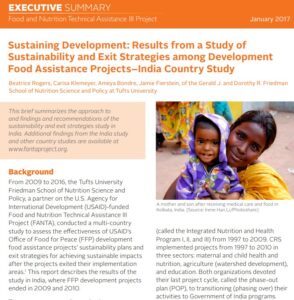
In India, the government context shaped sustainability. The Indian Supreme Court ruled that food is a basic human right, and the government banned import of genetically modified corn soy blends. Food for Peace projects devoted their final phases to transitioning food aid responsibilities to government programs. CARE transitioned the food supply chain to the Integrated Child Development Service.  Many Anganwadi Centers maintained uninterrupted food supply for preschool children after exit. Take home rations were less reliable. In Orissa, distribution dropped dramatically due to irregular deliveries. In some states, beneficiaries reported that the quality of government rations had degraded so much that some fed it to animals. Mothers continued attending health days only to receive the rations. Catholic Relief Services attempted to transition school feeding programs to the Mid Day Meals program. This largely failed because the government lacked motivation to provide free food to private religious and boarding schools.

“The study findings demonstrate that it is critical to verify the validity of a project’s underlying theory of change at the project design stage and to reassess its validity throughout project implementation.”

The most sobering lesson from India was that the projects failed to reduce child malnutrition. The assumption that combining food supplementation with health education would reduce undernutrition was not supported by evidence.   See:  Synthesis of India study.

In Kenya, gradual exit was effective. CARE’s Community Savings Mobilization project organized savings groups and provided training. CARE provided no external seed capital. All loan funds came from members’ savings. CARE graduated the groups to independent operation after one year. For the remainder of the project, CARE served only as an on call technical resource. Three years after exit, the groups were thriving and multiplying. They had high motivation and solid organizational capacity. In agriculture, CARE required basmati rice farmers to assume the cost of premium seeds before exit. This resulted in independent producer associations. In contrast, abrupt exits led to collapse. NGOs managed water quality testing until the final day. Committees had never practiced budgeting or hiring services. Beneficiaries disliked chlorine. The practice was abandoned. In maternal and child health, NGOs distributed free food rations as incentives. When the free food ended, participation collapsed. Volunteer health workers lost motivation. In livestock health, community-based animal health workers charged fees from the beginning. Livestock owners valued the benefit and paid. The fees provided resources and motivation. This intervention was highly sustainable.

Across all four countries, the study found that free handouts pose severe risks to sustainability when no alternative local source is established. Free food rations, free agricultural inputs, and free services created expectations that could not be maintained. When the free resources ended, participation and service delivery collapsed. The study found that fee for service models were more sustainable when culturally appropriate and introduced early.

Charging fees established expectations and built market viability. Attempting to impose fees at the end of a previously free project almost always failed. The study also found that linkages to institutions were often necessary but not always viable. Linkages succeeded when the partner had resources, motivation, and capacity. Linkages failed when the partner lacked budget, staff, or political will. The study stated that “government will take over is not a strategy unless the government unit has both commitment and operational capacity.”

The research also emphasized the importance of designing for context and resilience. Projects operate within environments shaped by political, economic, and environmental shocks. In Kenya, droughts devastated yields and livestock herds shortly after exit. Farmers continued applying improved techniques, but the shock wiped out yields. They lacked resources to purchase inputs for the next season. In Honduras, a constitutional crisis reduced government resources and undermined planned phase over of health services. Sustainability plans must account for predictable shocks. Projects should integrate crop insurance, promote diversified income streams, and establish drought resistant infrastructure.

RECOMMENDATIONS

  • •  Post-project sustainability needs to be designed from the start of the project. NGOs should consider embedding lasting resources, build capacity, align with intrinsic motivation, and secure viable linkages.
  • •  Donors should extend timelines when there is evidence of progress. True capacity building and phase over often require more than five years.
  • •  Donors should fund post project evaluations five to ten years after exit. Sustainability is a trajectory, not a one time status.
  • •  Projects should avoid free handouts unless a local source of resources will exist after exit. Fee for service models and business approaches are more sustainable when introduced early.
  • •  Projects should cultivate multiple layers of government ownership. Continuity should not depend on a single political stakeholder. Commitments should be incorporated into municipal plans, budgets, administrative decisions, departmental responsibilities, and civil service job descriptions.
  • •  Projects should ensure that linkages are viable. Responsibilities must be explicit. The receiving institution needs to value the activity and have staff, authority, budget, and supplies. Mechanisms for communication, supervision, and accountability must remain active.
  • •  Projects should plan gradual exits. Communities and local organizations need time to operate independently while the NGO is still present. Abrupt exits often lead to collapse.
  • •   Projects should design for resilience. They should anticipate shocks and build systems that can withstand them.

The studies’ headline conclusion is that achieving high impact at exit does not guarantee long term sustainability.  The researchers found that “even evidence of continued impact at one point in time post exit may not predict long term sustainability.” They argued that sustainability requires resources, capacity, motivation, and linkages. These factors must be deliberately integrated into program design. The study influenced USAID’s Food Assistance and Food Security Strategy. Development awards came to require explicit sustainability plans and exit strategies. The four factor vocabulary entered mainstream guidance. The research provided a blueprint for designing programs that outlive their funding cycles. It showed that lasting development success depends not on short term statistical triumphs but on long term resilience and independent operation.

These studies had a profound influence on USG planning.  FFP’s decade strategy (released October 2016) explicitly reframed the agency’s development goal around sustaining gains; it “broadens the previous goal of reducing food insecurity to one that envisions improving food security and sustaining it,” and commits FFP and partners to “strive for greater impact with greater efficiency and sustainability.” Tufts and its collaborators state the connection directly. In a Tufts Now feature (Jan 2017):  “Food for Peace has already incorporated many of the recommendations from the Tufts study in its guidance to aid organizations.” Implementing partners echoed this; ACDI/VOCA (2021) described FFP as having “incorporated many of the recommendations that arose from Tufts University research into its 2016–2025 strategy, now requiring detailed sustainability plans for all DFSAs.”

Refer to:

https://www.fantaproject.org/research/exit-strategies-ffp

https://www.fantaproject.org/sites/default/files/resources/India-Exit-Strategies-Report-Jan2017.pdf

The past FANTA project (formerly, USAID) also continues to provide summaries and links.

–  Contributed by WHES board member, Steven Hansch

y