


U.S. Food Aid (Part 1): Reflections about Food Aid by Long-Term Practitioner
July 7, 2026 by Mara Russell This is the first in a series of articles by Hunger Notes about the U.S. Food for Peace (FFP) Program. “Food for Peace Title II Non-Emergency Programs: What are they and Why are they needed?”
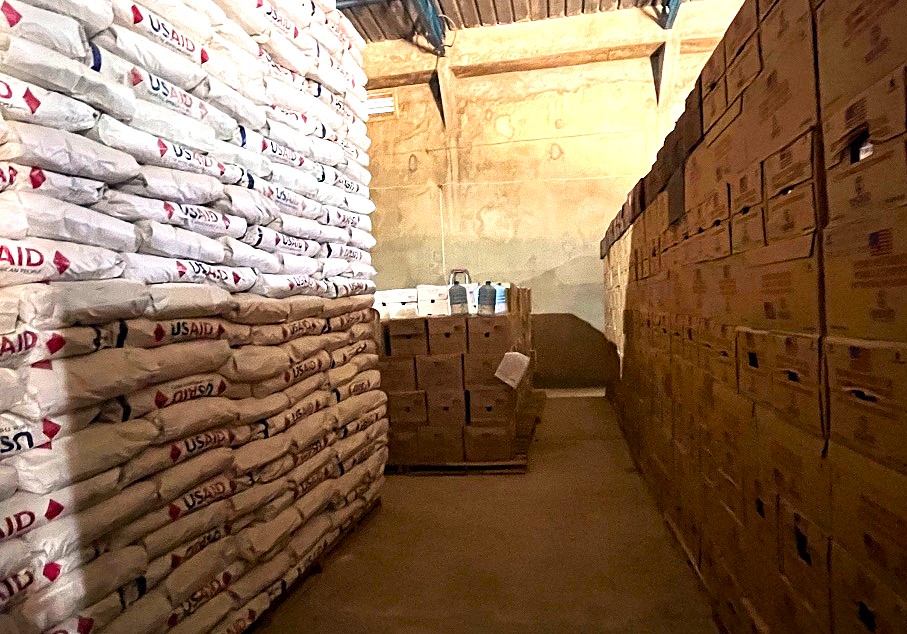
In the United States, government-funded “Food for Peace” (FFP) programs transitioned from USAID to the State Department when the former agency was dissolved in 2025. Several months later, the Food for Peace program was transferred to the United States Department of Agriculture (USDA), a large federal agency that had not managed this program previously. Soon after this transition, $452 million in FFP resources was awarded directly to the U.N. World Food Programme (WFP) for food activities in the Democratic Republic of the Congo (DRC), El Salvador, Ethiopia, Guatemala, Haiti, Kenya and Rwanda.[i]
Then, as recently reported in Hunger Notes, in 2026, USDA released a “Notice of Funding Opportunity” for nonprofits (NGOs) for new Emergency Food for Peace programs, naming the same set of countries that were eligible for food assistance. These upcoming programs are scheduled to be worth $357 million in total.[ii] Since a total of $1.2 billion was appropriated by Congress for Food for Peace in FY26,[iii], USDA is now considering how to implement the rest of the funding for “development” or non-emergency food programs, referred to during the past seven years as Resilience Food Security Activities or “RFSAs.”[iv].
One critical variable that non-emergency programs have leveraged during recent cycles of USG funding is timeframe. These NGO-administered programs are generally five years in length, while emergency programs only last for a maximum of two years. Emergency programs are designed to address the impacts of acute (wasting) malnutrition and severe food insecurity. Resources in emergency programs are provided to address short- to medium- term impacts of a severe shock. This can be due to a natural disaster such as an earthquake, a severe storm, drought, or severe conflict. The spread of an epidemic or pandemic disease can also result in such impacts, either due to a breakdown of production and markets, or due to people being at greater risk of malnutrition due to the impacts of a disease. Or shocks can result from a combination of several things.
On the other hand, non-emergency programs focus on preventing emergencies. They address the underlying causes of hunger that tend to become more serious when conditions are such that food supplies become limited, or people lose access to food due to the types of shocks outlined above. These underlying causes, such as poverty, cultivation practices that result in poor yields, inadequate services or limited safety-nets that result in food insecurity and malnutrition, lack of income earning opportunities, poor access to water for agriculture and for drinking and inadequate sanitation that can cause water-borne disease- a significant underlying cause of acute and chronic malnutrition, lack of attention to the special nutrition needs of women of childbearing age, pregnant women and young children, and lack of capacity to prepare for potential shocks that impact food security and nutrition. These are complex issues that call for a combination of access to goods and services, while adopting of behaviors and practices within households. Programs also ensure that the food consumed meets the standards of a healthy diet, prevent water-borne disease, and build resilience to unexpected shocks.
This takes time. There is a limit to what can be done in only one or two years. This is especially the case because according to the 2026 USDA Emergency funding opportunity, it takes between 45 and 90 days from the award of a program until food aid from the Food for Peace program can be exported from the United States, and then up to another 6 months for commodities to arrive in the country where they will be distributed.[v]
A second factor has to do with geography. Emergency food aid programs are in countries and locations where there is an active ongoing shock, and large concentrations of people, including refugees and internally displaced people,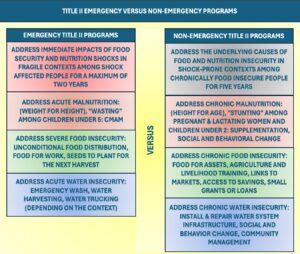 living in a situation of extreme food and nutrition insecurity that should be addressed immediately. Identification of these locations is guided by early warning systems or methodologies that classify people based on the degree to which they are currently food insecure or malnourished. The system that tends to be most respected internationally is the U.N.’s Integrated Phase Classification or IPC system. During its existence, USAID utilized this system, and now USDA is using it also as a way of designating where and among whom an emergency program should be implemented. In its recent funding request, USDA stated that a minimum of 20% of the population to be targeted with food aid should be living at IPC 3 or higher. The IPC classifies populations at levels 1 through 5 based on the severity of food insecurity as follows: 1 = None/Minimal, 2 = Stressed, 3 = Crisis, 4 = Emergency and 5 = Famine. The “shorthand” clarification used for those populations needing immediate assistance are those at IPC 3+.[vi]
However, non-emergency programs aim to reduce the likelihood that people living in a particular geographic area will experience conditions at or above IPC 3. Countries prioritized for these programs may already have sizeable populations at IPC 3+, but there may not be significant active shock conditions causing this situation. Sometimes, populations may be at IPC 3+ due to a shock that has previously increased food insecurity and malnutrition. For instance, after the Haiti earthquake in 2010, there were emergency programs that addressed food insecurity, malnutrition, reconstruction and access to food for the people impacted by this shock. However, by 2013, many of the immediate impacts of the quake, such as food insecurity and displacement were initially addressed, but there was a need to address long-term root causes of malnutrition and vulnerability. At that time USAID implemented a non-emergency program that sought to address these underlying causes and increase the ability of the country to cope with severe shocks.[vii]
Many countries where non-emergency programs are implemented experience cyclical shocks that recur on a periodic basis. They do not always exist in shock situations but may be impacted by droughts or floods during serious weather events, such as El Niño or La Niña events. During the El Niño event in 2023-2024, most of the harvest of the country of Zimbabwe was ruined due to inadequate and poorly timed rainfall.[viii] However, on-going non-emergency programs continued to increase yields, increase incomes and reduce malnutrition, while emergency programs supported households and communities as necessary with additional food and other emergency assistance. Most of these countries also experience an annual “hunger season”, which tends to occur anywhere from 3-6 months prior to the next harvest when food stocks and cash earned from the prior harvest have been depleted. Thus, while non-emergency programs are not implemented in contexts where active shocks occur, they may be targeted within fragile environments where hunger seasons make life very tenuous for people living in those geographies.
Another important element in these programs are the participants who are targeted. In emergency programs, large portions of the population are highly vulnerable due to the impacts of a disaster, such as an earthquake, a hurricane or other cyclonic storm, or severe conflict. In these cases, those targeted for assistance may have been displaced, or otherwise lost everything – including their health. In such emergency situations, it does not matter whether people were rich or poor prior to such shocks.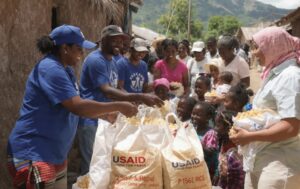
However, Title II non-emergency program participants tend to be those who are poorest, receive the fewest services, and are at greatest risk of malnutrition and food insecurity. Often the focus is on those who have the least to fall back on when shocks occur and tend to be those most impacted by annual hunger seasons and other severe shocks. A case in point is the Ethiopia Productive Safety-Net Program (PSNP), which has been supported by Title II non-emergency food aid since its inception in 2005.[ix] The PSNP targets people who are impacted by the annual hunger season through a Cash or Food for Assets (FFA) activity that creates a safety-net during the period of greatest vulnerability in normal years while developing assets that communities can use during good years and fall back on in bad years. The PSNP is supported by the Ethiopian government as well as several other donors. During normal years, a certain number of households are targeted for the program based on their chronic food insecurity and malnutrition. However, during years when poor crop yields and impacts increase the number of households needing food assistance, the number of households targeted increases to also address the needs of those who would not normally be included in the PSNP program.
In addition to selecting participants based on their food insecurity, there is a difference between how emergency and non-emergency programs select participants when it comes to malnutrition. In the case of emergency programs, care is taken to address the needs of people who are acutely malnourished, mainly children under 5 and pregnant and lactating women. In the case of emergency programs, acute malnutrition, in which the body loses weight rapidly, becomes a major risk. Moderate acute malnutrition exists when body weight for height among children under 5 falls below 2 standard deviations from the global mean, and severe acute malnutrition exists when this falls to 3 standard deviations below the mean. If the rate of wasting malnutrition in a population reaches or exceeds 10%, this is deemed a humanitarian emergency requiring immediate rehabilitation using ready to use therapeutic and supplementary foods that provide concentrations of fat, calories, protein and other nutrients all aimed at ensuring survival and rapid weight gain. Women of childbearing age, including those who are pregnant or breastfeeding as well as men also benefit from rehabilitation with RUTF or ready to use supplementary foods (RUSF), designed to also rehabilitate people in these conditions. These products are available via Title II.
However, in the case of non-emergency programs, participants are targeted based on the rate of “Stunting”, or chronic malnutrition, which exists when height-for-age among children under the age of 5 falls below 2 standard deviations under the global mean. The logic behind this is that there are milestones for linear growth that children need to reach before the age of 2 to avoid being developmentally disabled and to ensure a healthy life. Infants and young children under age 2 in this condition can recover from this and their linear growth can catch up to normal levels before they reach age 2. However, after these children reach age 2, it becomes extremely difficult for their growth to catch up. It is possible for a child to be both chronically and acutely malnourished (also known as “wasted”). It is also possible for stunted children not to be wasted and wasted children not to be stunted. However, there are certainly connections between these different types of malnutrition. Nonetheless, stunting and wasting are indicative of different situations based on how and when they occur within the population. High levels of acute malnutrition indicate the existence of an acute shock as it does not take long for children to become acutely malnourished. This occurs when children are deprived of the food they need for a period of days or weeks (at most). However, it can take a long time for a child to become stunted. Children become stunted because they lack sufficient nutrients in their diet (both macro- and micro-nutrients) to fulfill their daily requirements. It takes months for a child to become stunted, and it also takes a long time for them to overcome this problem. If there are a lot of stunted children in the population, this indicate that the population is chronically food insecure and poor.
Thus, non-emergency Title II programs target populations with high chronic malnutrition rates among children under 5 as this is a clear red flag that there is a significant poverty and food insecurity problem within these populations. Targeting participants from these areas indicates that while there may not an active shock situation, there may still be a lot of food insecurity – which left unaddressed – could lead to more serious problems. People living in these contexts are on the edge, and one missed harvest due to a storm or drought or earthquake or locust swarm or violent attack could result in them becoming part of the emergency case load of Title II programs.
Non-emergency Title II programs focus on ensuring that infants are exclusively breastfed until they are six months old, and that beyond that time their diets consist of the types of diverse foods that children of their age need to meet their linear growth milestones by age two. At the same, these programs also address the underlying causes of chronic malnutrition. They train mothers to feed their children properly, including exclusive breastfeeding, take care to prevent water-borne disease through handwashing and use of clean water. At the same time, these programs recognize that mothers will be unable to feed their children the types of food they need if they are not able to produce or purchase it throughout the year. Raising these issues among all community members can build support and solidarity to ensure that children’s and women’s dietary needs are met. In addition, creation of clean water access and sanitation – including installation of accessible working water points and household latrines – support practices such as frequent handwashing with soap, and reduction of open defecation. These practices in turn reduce water-borne disease from hindering the absorption of the nutritious food being consumed. And, integrating these practices into people’s lives takes a long time, thus the longer timeframe of these programs is critical.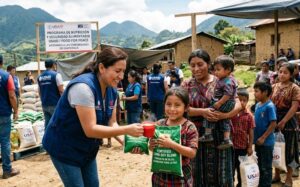
Non-emergency programs also provide a few more benefits that make them important to reduce the emergency caseload of Title II. They target countries and regions that are fragile and shock prone. They can detect changes in conditions, both positive and negative, which can reduce time lags on responses. If the number of acutely malnourished children begins to escalate – this could easily occur within the areas where populations are most food insecure. If harvests begin to fail due to weather impacts, many farmers in the geography where the program is implemented (they may or may not be participants) will experience these conditions first. The presence of an implementer (NGO) in these areas can ensure the monitoring of IPC levels, levels of acute malnutrition, impacts on harvests and prevalence of diseases – including those that are water-borne.
At the same time, these programs seek to enable participants to anticipate and cope better with the types of shocks that normally impact these geographic areas. Reviewing the history of the targeted population, it is possible to learn more about the major shocks that typically impact them, and they are sometimes cyclical. For instance, locust swarms may occur every so often in parts of East Africa. Working with communities likely to be impacted by these swarms during years when they don’t occur to prepare for when the locusts return will help participants to cope more effectively when this happens. There are now many agricultural technologies that enable farmers to adapt to drought. This could range from water-harvesting, to irrigation, to use of drought-adopted seeds, to reorienting productive systems through methods such as Resilient Design and Perma-gardening.[x] The last two types of systems prevented farmers from losing their crops during the El Niño drought event in Zimbabwe mentioned above.[xi] It was a non-emergency Title II programs that provided training to farmers to enable them to maintain their crops in the face of this severe drought.
Finally, one of the key underlying causes of food insecurity is poverty. Farmers may depend on their crops for food, but they need cash to fall back on when their crops fail, and they need to purchase food from markets. Also, for farmers to maintain their land and plant crops, they need cash for inputs and often to pay for land, either as the owner or as a renter or lease holder. It also costs money for children to attend school, and it costs money to get to markets, visit health centers, buy fertilizers and crop-protection products. Maintaining water points and latrines can also cost money because spare parts and their installation is not free. And when the program is over after five years of investment, ensuring that people not only achieve but also sustain their food security will mean that people have a secure source of cash and savings to fall back on. Otherwise, closing the program will be commensurate to a shock for those who have benefitted from it.
A methodology that has proven itself over the years, and within the past nine years in Title II non-emergency programs has been the Graduation Approach.[xii] Developed and initiated by BRAC in Bangladesh, this approach has been tested throughout the world in fragile contexts where large numbers of poor and food insecure people live.[xiii] The approach targets extremely poor people, provides them with food assistance safety-nets and then links them to a savings and loan group where they meet others in their situation and obtain peer group support. At the same time, they are provided training in a livelihood opportunity for which there is demand within their context. This livelihood training could be agricultural (crops or livestock) or non-agricultural in nature and offers people the opportunity to become employed or operate their own business. After their training is complete, participants receive small grants or assets (such as equipment or animals) that enable them to start their activities until they become viable. During this time, they continue to receive coaching and mentoring so that they can be successful within their chosen livelihood. They also receive training and support with respect to nutrition, water and sanitation and learn to anticipate and respond effectively to shocks. The Graduation Approach has been shown to ensure a high return on investment and results are sustained over time after the end of the program.[xiv]
Now that the program has moved to USDA, the leadership is reviewing the program and will likely make changes that will increase the cost of food and ocean freight versus what is provided to those in need.[xv] The recent Emergency Program set of funding opportunities stipulated that at least 50% of program budgets must be devoted to commodities and ocean freight.[xvi] This reduced the funding that could be provided to internal transportation storage and handling to distribute commodities. It also reduced the funds that could be provided for technical interventions such as monitoring of severe food insecurity and levels of acute malnutrition, training mothers about how to monitor and refer their children, and enabling technical interventions that will help people to recover from emergency situations. It is possible that the same 50% requirement may be put in place by USDA for future Non-Emergency Programs, and this could reduce the resources available to enable the sustainable improvement of food security and nutrition in extremely poor and fragile contexts as described above.
Changes in the legislation over the years made it possible to integrate international disaster assistance funds with emergency Food for Peace programs enabling the use of cash, vouchers and local, regional and international procurement to ensure that the right resources were available at the right time to address peoples’ needs. This prevented the need to wait 6 – 8 months for U.S. commodities to arrive in country to begin addressing acute malnutrition. As noted above, the impact of acute malnutrition is rapid and if not addressed quickly will lead to death.
Similarly, U.S. legislative changes enabled the coordinated use of Development Assistance funds with non-emergency Food for Peace programs, which covered the cost of the complex interventions discussed above. These resources also provided the opportunity for programs to transition people away from dependence on U.S. food aid and foreign assistance. While food aid has been important for non-emergency programs to build stability for those suffering chronic food insecurity, we will not ultimately accomplish Title II’s objectives if people remain dependent on food aid at the end of each program.
As global conditions worsened around the turn of the century, the need for emergency food aid programs increased around the world. These needs began to reduce the funds available to pay for non-emergency programs. Thus, in the 2008 U.S. Farm Bill, a Non-Emergency “Safe Box” was integrated into Title II legislation to establish minimum funding to ensure that these programs could continue to be implemented. Currently $365 million is designated for the implementation of these programs. $700 million of USG funding from FY26 and FY27 allocations may be made available soon for these programs.[xvii]
While much remains unclear about the future of U.S. Title II non-emergency food aid programs, the need for activities that reduce and prevent high levels of acute and chronic food insecurity and malnutrition has not diminished, and perhaps has increased, during the 18 months since the 2025 Executive Order to pause foreign assistance was announced.[xviii] It is also clear that addressing the underlying causes of food and nutrition insecurity is still important. Hopefully, USDA will hold true to this fundamental mandate of these programs. This will entail implementing these programs over a 5-year timeframe, in fragile geographies where shocks are frequent, among participants who are chronically poor and/or malnourished, while increasing peoples’ ability to cope with shocks, and producing outcomes that are sustainable. If these are not the Title II mandate’s parameters for non-emergency programs, they run the risk of violating legislation..
Further Reading:
Food for Peace / U.S. Food Aid
- Food for Peace (Title II) overview https://www.worldhunger.org/food-for-peace/
- U.S. International Food Aid: History and Issues https://www.worldhunger.org/us-international-food-aid/
- Hunger Notes: U.S. food aid reform debates https://www.worldhunger.org/tag/food-aid/
Global Hunger, IPC, and Malnutrition
- Global Hunger Index https://www.worldhunger.org/global-hunger-index/
- Understanding Acute vs. Chronic Hunger https://www.worldhunger.org/hunger-and-malnutrition/
- Climate shocks and food security https://www.worldhunger.org/climate-change-and-hunger/
Country-specific articles relevant to your examples (Haiti, Ethiopia, Zimbabwe, DRC, etc.)
- Haiti hunger and food insecurity https://www.worldhunger.org/haiti/
- Ethiopia hunger and PSNP context https://www.worldhunger.org/ethiopia/
- Zimbabwe food insecurity and El Niño https://www.worldhunger.org/zimbabwe/
- DRC food insecurity https://www.worldhunger.org/democratic-republic-of-congo/
REFERENCES:
[i] Miolene, Elissa, USDA takes over Food for Peace with $452M World Food Programme deal, 29 January 2026.
[ii] U.S. Department of Agriculture, Food for Peace Notice of Funding Opportunity, Fiscal Year 2025, May 13, 2026
[iii] Miolene, Elissa, House locks Food for Peace into USDA with 50% commodity requirement,1 May 2026,
[iv] These progras were known variously as Development Activity Programs (DAPs), Multi-Year Activity Programs (MYAPs), Development Food Assistance Programs (DFAPs), Development Food Security Activities (DFSAs) and Resilience Food Security Activities (RFSAs). There were differences between these programs, but those differences were not necessarily associated with the names given to them.
[v] U.S. Department of Agriculture, Food for Peace Notice of Funding Opportunity, Fiscal Year 2025, May 13, 2026, https://grants.gov/search-results-detail/362375.
[vi] Integrated Phase Classification, https://www.ipcinfo.org/ipcinfo-website/ipc-overview-and-classification-system/en/?__cf_chl_f_tk=vmmArOlbSf51oWrK_G0UqCVyP0w6jSuy9SVydqdsIlk-1783098737-1.0.1.1-XKb_PsSY1mVf1b2u8K3Udd85lbGsjDgfDcO0yyY9UrE,
[vii] https://borgenproject.org/kore-lavi-provides-food-security-in-haiti/; accessed July 3, 2026.
[viii] United Nations, UN News, Zimbabwe faces worsening food crisis due to El Niño droughts, 7 August 2024, https://news.un.org/en/story/2024/08/1152936.
[ix] IFPRI, Productive Safety-Net Program, https://essp.ifpri.info/productive-safety-net-program-psnp/, accessed July 3, 2026
[x] FANRPAN, Scaling up Resilience Design in Zimbabwe: Position Paper, https://fanrpan.org/wp-content/uploads/2025/01/Takunda_CareSlideDeck-1.pdf.
[xi] Chitsa, Tanaka, Growing Hope: Community gardens flourish amidst El Nino challenges, 27 August 2024, https://www.carezimbabwe.org/growing-hope-community-gardens-flourish-amidst-el-nino-challenges/.
[xii] AVSI, Graduating to Resilience, https://www.avsi.org/en/graduating-to-resilience
[xiii] BRAC, Graduation Out of Ultra Poverty, https://www.brac.net/solutions/development/ending-poverty/ultra-poor-graduation/
[xiv] Abrams, William, Joshua Goldstein, Larry Reed, Carine Roenen, and Jean Francois Tardif, The Business Case for Investing in Graduation, September 2017, ultra-poverty.org, https://www.ultra-poverty.org/blog-post/the-business-case-for-investing-in-graduation/#.
[xv] Miolene, Elissa, House locks Food for Peace into USDA with 50% commodity requirement, 1 May 2026,
[xvi] U.S. Department of Agriculture, Food for Peace Notice of Funding Opportunity, Fiscal Year 2025, May 13, 2026,
[xvii] Miolene, Elissa, US Dept of Agriculture to reboot Food for Peace’s ‘safe box’ programs,
[xviii] The White House, Reevaluating and Realigning United States Foreign Aid, January 20, 2025, https://www.whitehouse.gov/presidential-actions/2025/01/reevaluating-and-realigning-united-states-foreign-aid/.
Mara Russell is a career programmer of Food for Peace Title II food aid including leading Food Aid Management, and spearheading CARE’s food aid for decades.
-
 World Hunger Education
Service
P.O. Box 29015
Washington, D.C. 20017 -