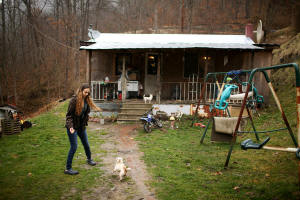
United States

Rising seas (photographs of vulnerable US and international locations)

by Coral Davenport and photographs by Kadir Van Lohuizen New York Times May 2, 2014

The low-lying islands of Kiribati, just a few feet above sea level, are on the front lines of climate change. Globally, sea levels have risen eight to 10 inches since 1880, but several studies show that trend accelerating. If carbon emissions continue unchecked, a recent survey of experts concluded,...

The case for spider conservation: They keep pests from devouring humans’ food supply

by Brian Palmer Washington Post July 21, 2014

Wildly successful species of the Cenozoic era , which began about 65 million years ago — have trouble empathizing with polar bears, tropical frogs and dolphins as those animals sink toward extinction. A better way is to appeal to a human’s unstoppable desire to forward his own self-interest. Thi...

Tammie Hagen-Noey, in her bedroom at a group home in Richmond, Va., earns $7.25 an hour at a local McDonald’s. Photo: Drew Angerer for The New York Times

Changed life of the poor: Better off but far behind

by Annie Lowerie New York Times April 30, 2014

WASHINGTON — Is a family with a car in the driveway, a flat-screen television and a computer with an Internet connection poor? Americans — even many of the poorest — enjoy a level of material abundance unthinkable just a generation or two ago. That indisputable economic fact has become a subje...

Cash crops with dividends:Financiers buying up farmland and selling it in the form of securities to investors

by Alexandra Stevenson New York Times July 21, 2014

His boots were caked with mud when Thomas S. T. Gimbel, a longtime hedge fund executive, slipped in a strawberry patch. It was the plumpness of a strawberry that had distracted him....

Workers harvest tomatoes in a field owned by Pacific Tomato Growers, a partner in the Fair Food Program.Photo: Richard Perry/The New York Times. See slide show

In Florida tomato fields, a penny buys progress

by Steven Greenhouse New York Times April 24, 2014

IMMOKALEE, Fla. — Not long ago, Angelina Velasquez trudged to a parking lot at 5 each morning so a crew leader’s bus could drop her at the tomato fields by 6. She often waited there, unpaid — while the dew dried — until 10 a.m., when the workers were told to clock in and start picking....

Anita Pointon shows where the water has to soak over to in order to reach a bed of corn seeds. Photo: Lydia DePillis/The Washington Post

Drier than the Dust Bowl: waiting for relief in rural America. As wide swaths of rural America suffer through historic drought, they’re being le...

by Lydia DePillis Washington Post July 21, 2014

Every few hours, Anita Pointon refreshes the Web site that tells when it’s coming, because the work begins as soon as they know. Her husband, Chuck, 62, will set out to walk the farm with a moisture probe to see which fields are the driest. One run of water covers only about 18 acres of their 500,...

At a huge free medical clinic in Southwest Virginia, misery that shouldn’t exist

by Petula Dvorak Washington Post July 18, 2014

A gravel parking lot deep in the green hills of Virginia coal country was packed to capacity by 4 a.m. Friday. More than 1,500 people with canes, wheelchairs, oxygen tanks, bleeding gums, black lungs and other ills had come to the Wise County Fairgrounds, camping in tents, sleeping in pickup truck b...

Maryland governor, Obama aides spar over unaccompanied immigrant children

by Jenna Johnson Washington Post July 16, 2014

See Report...

The American middle class is no longer the world’s richest, and the poor in much of Europe earn more than poor Americans

by David Leonhardt and Kevin Quealy New York Times April 22, 2014

The American middle class, long the most affluent in the world, has lost that distinction.While the wealthiest Americans are outpacing many of their global peers, a New York Times analysis shows that across the lower- and middle-income tiers, citizens of other advanced countries have received consid...

Children do work at a school in the violent Chamelecon neighborhood of San Pedro Sula in Honduras. In Chamelecon, more than 300 houses have been abandoned, and military police in body armor patrol day and night on Honda dirt bikes. The two main gangs, 18th Street and MS-13, have fought over the area for years, commandeering houses and demanding that residents pay a war tax. “They bleed you,” said Alvin Rolando Baide, 34, who grew up in the neighborhood. “They demand 80 or 90 percent of your salary.” Photo: Joshua Partlow/The Washington Post

Honduran child migrants leave home because of poverty and violence

by Joshua Partlow Washington Post July 15, 2014

SAN PEDRO SULA, Honduras — They are coming to America because a good job here means sewing underwear in a sweatshop for $47 a week.They are leaving neighborhoods where you can walk down block after block of abandoned houses spray-painted with gang graffiti, with collapsed roofs and jungle plants s...


  • World Hunger Education
    Service
    P.O. Box 29015
    Washington, D.C. 20017
  • For the past 50 years, since its founding in 1976, the mission of World Hunger Education Service is to undertake programs, including Hunger Notes, that
    • Educate the general public and target groups about the extent and causes of hunger and malnutrition in the United States and the world
    • Advance comprehension which integrates ethical, religious, social, economic, political, and scientific perspectives on the world food problem
    • Facilitate communication and networking among those who are working for solutions
    • Promote individual and collective commitments to sustainable hunger solutions.