


MrBeast and the Rockefeller Foundation Bet on Lunch
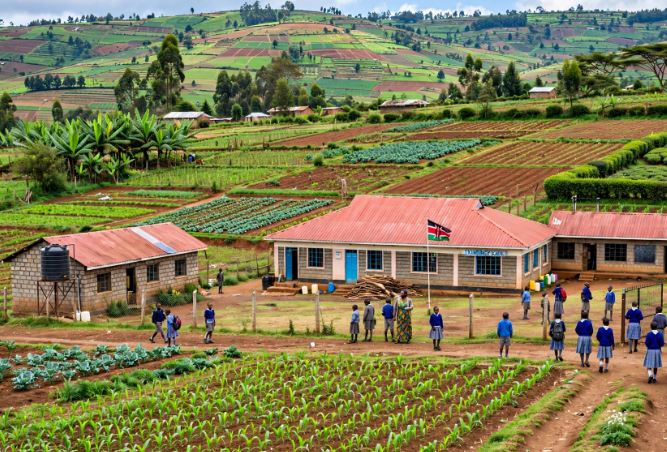
September 27, 2026 Last week, the Beast Philanthropy and the Rockefeller Foundation announced a strategic alliance for “regenerative school meals” programs in Bomet County and in Ghana’s Eastern Region, serving roughly 4,000 children a daily lunch, five school days a week, for five years.
In Kenya, the plan is to build a model its backers call scalable for the drier landscapes of the southwest. It rests on three pieces: school gardens used to teach nutrition and regenerative farming; a supply line linking local fortified-bean growers to school kitchens, drawing on Rockefeller’s existing work with AGRA; and solar-powered clean cooking. The rollout starts in three schools.
MrBeast’s Kenyan work predates this Rockefeller effort. His team drilled dozens of boreholes in 2023, rebuilt Oloirien Primary in Narok with a kitchen, farm and greenhouse in 2025, and in February 2026 added ten classrooms at Nyakichiwa Primary in Bomet, where it had been serving free lunches for a year.
In Ghana, the work begins in ten schools serving nine communities in the Eastern Region. There the emphasis is cocoa country: helping cocoa farmers intercrop food for school kitchens into their agroforestry plots, a direct link to Beast Philanthropy’s stated goal of getting children off cocoa farms and into classrooms.
Rockefeller says it had already committed more than $6.75 million over five years to school meals in the two countries before MrBeast arrived.
School meals already reach about 2.6 million Kenyan learners through the government’s own program, and Nairobi used UN week to pledge a push to 10 million by 2030. What sets this effort apart is less its size than its wager: that a meal sourced from nearby farms, cooked on clean energy and filmed for an audience of hundreds of millions, can do more than feed the children in front of it.
They are partnering with AGRA, Ecobora, CARE, BURN Manufacturing, Faitrade Africa, and the West Akyem Cooperative Cocoa Farmers and Marketing Union.
The “regenerative” label means the partners want school kitchens to act as a guaranteed buyer that pays farmers to shift toward soil-building, climate-resilient practices. In Ghana, that runs through cocoa: food crops intercropped among cocoa trees become lunch, and more stable farm income is meant to reduce the pull of child labor. It ties a nutrition program directly to the supply chain behind Donaldson’s Feastables chocolate brand.
The kitchen as an energy project: Clean cooking is usually a separate aid program but in this initiative it is built into the meal preparation from the start, with solar-electric and briquette stoves meant to cut indoor smoke, firewood cutting and the fuel costs that often fall on parents.
Including fortified beans into school menus, via AGRA, provides micronutrients.
Storytelling as the catalytic tool: Rockefeller is paying for Beast Philanthropy to film the students, families and farmers and put their stories before a global audience. The theory of change is that attention will lead to expanding private donations, volunteering and political will. Rockefeller president Rajiv Shah framed it as evidence that the vulnerable can still be reached.
Rockefeller Foundation, $100M school meals commitment, March 2025
Iowa PBS, Shah at the World Food Prize
– Contributed by Steven Hansch, WHES Board
-
 World Hunger Education
Service
P.O. Box 29015
Washington, D.C. 20017 -