


Meat: How the Next Agricultural Revolution Will Transform Humanity’s Favorite Food and Our Future

February 5, 2026 As people get wealthier, historically, they eat more meat even though it is inefficient. the new book, “Meat” by Bruce Friedrich, examines the implications of the world’s dietary choice. He lays out how six calories going into a chicken result in 1 calorie in chicken meat. He calls this “fantastically inefficient.”
Friedrich articulates why the world cannot continue its current system of animal-based meat production because it is environmentally damaging, inefficient, and risky for health and food security.
Friedrich recognizes that asking people to eat less meat has not made a difference. Instead, he says the future of meat lies in alternative proteins (plant-based and cultivated meat) that can match or exceed conventional meat in taste, cost, nutrition, and sustainability. Increasingly, the world has available new Plant-based meats (made from plants) and cultivated meats (grown from animal cells but without raising/ slaughtering animals) become indistinguishable from traditional meat.
In his interview on the PBS Newshour on television, he problems growing meat entails: 8 times the water, herbicides, pesticides, shipping, operations, gas consumption, pollution compared to plants.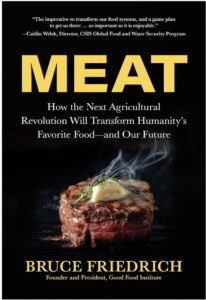
The author believes that transition to non-animal meat will occur when the taste and affordability matches the legacy meat. He advocates plant-based and cultivated meat. “Meat” quotes 30 plant-based and cell-based cultivation scientists about the rapid progress. Once parity in taste with real food is achieved, markets will rapidly shift much like with cars replacing horse-drawn travel or the adoption of smartphones.
In her review of this book, Jane Goodall wrote before she died this year: “Today billions of animals are raised to provide us with meat. This harms the environment and is often unspeakably cruel to farmed animals, yet for many the idea of a main meal without meat is unthinkable. The good news, as Meat explains, is that you can now enjoy real meat that was made without killing any animal. Please read this book: it is engaging, informative, and gives us hope for a kinder future.”
For further information, see the PBS Newshour, Feb 3, 2026
-
 World Hunger Education
Service
P.O. Box 29015
Washington, D.C. 20017 -