


Iran Malnutrition Revisited
November 20, 2026 Despite enormous pressure on households in terms of their purchasing power, Iran’s safety nets have been able to keep childhood malnutrition from famine conditions.
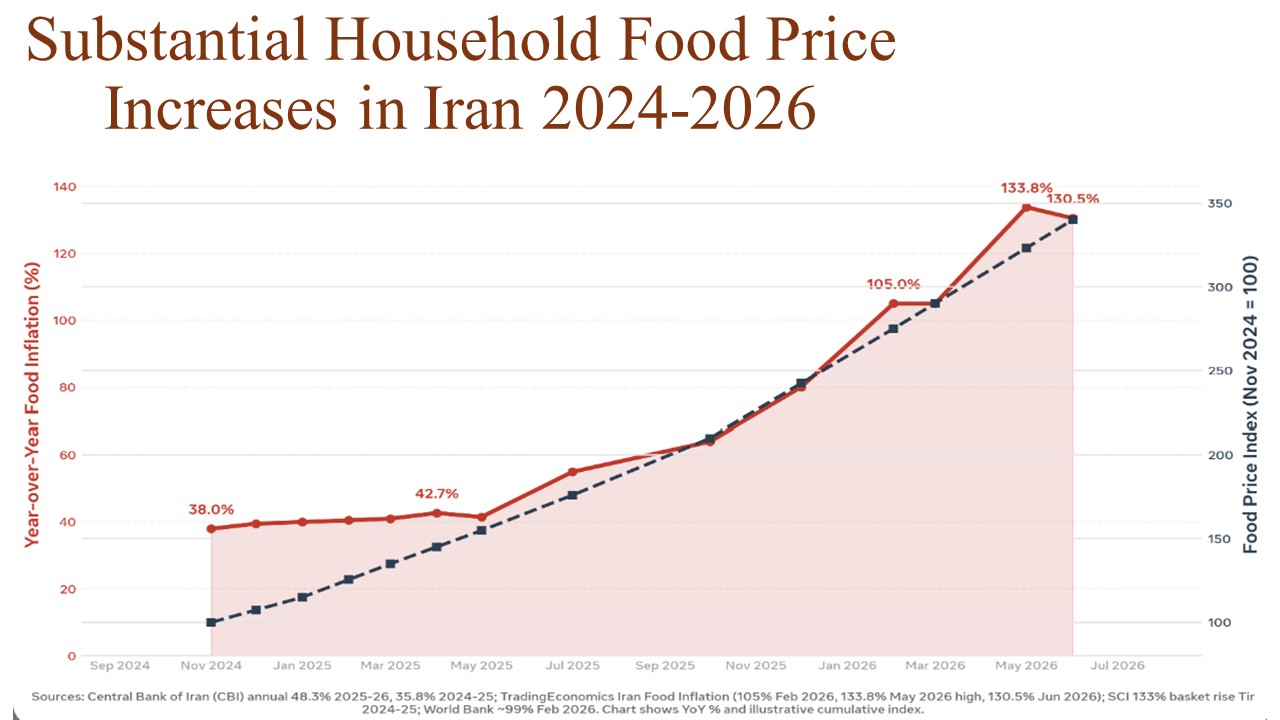
Household purchasing power among Iranians has eroded sharply, leading to reduced consumption of higher-cost nutritious foods (meat, dairy, etc.). Reports describe diets shifting toward cheaper staples such as bread and cheese. Year-on-year food price increases exceeding 50%, making quality nutrition less affordable for vulnerable groups. ACAPS 02 Sept 2026: inflation reached 84% in August 2026, up from 52% in December 2025. The IMF projects average inflation at 68.9% in 2026, the highest since 1979. The World Bank estimated food inflation at ∼99% in February 2026. ACAPS notes food prices, including bread and wheat, rising weekly, with some staples up 300%. Bread prices have doubled from a year ago in places such as Tehran.
In early November 2026, the chairman of the parliament’s social affairs committee stated that about 8 million people face extreme poverty and malnutrition, while up to 50 million more struggle to afford basic goods and meet nutritional needs. In August 2026, the Mehr News Agency, citing the Deputy Minister for Welfare, reported more than 262,000 children aged 5-59 months suffering from malnutrition.
Also durng November 2026, authorities began quietly capping subsidized bread purchases in at least three provinces (Markazi, Khuzestan, Zanjan). Once a monthly quota is exhausted, buyers face much higher free-market prices. This drew criticism even from some hard-line media.
Sistan-Baluchestan remains the hardest hit. Reports from July 2026 note up to one-third of children under five now face severe malnutrition, with many families subsisting on bread and tea and loss of school meal program. A local rural Zanjan study published Oct. 19, 2026 reports 87.1% household food insecurity, 26.8% severe FI, and child stunting/underweight/wasting of 34.2%/28.4%/18.9% among 380 women with children aged 6–59 months. But measurements were collected in four seasonal waves from April 2025 to March 2026—not during the requested interval—and the selected county sample is not national. It reports a summer vulnerability pattern.
The World Food Program (WFP) is supporting 195,000 people with food and cash assistance across Tehran, Alborz, Bushehr, Hormozgan and Sistan and Baluchestan. WFP’s August country brief also noted 35,611 refugees assisted through bakeries.
– edited by WHES board member Steven Hansch
-
 World Hunger Education
Service
P.O. Box 29015
Washington, D.C. 20017 -