
Ask an Expert
Video: Global Hunger Basics
Fight hunger with knowledge. In this short video, World Hunger Education Service’s Steve Hansch explains global hunger, discusses a few causes, and tells you how to get involved in humanitarian work.





Fight hunger with knowledge. In this short video, World Hunger Education Service’s Steve Hansch explains global hunger, discusses a few causes, and tells you how to get involved in humanitarian work.

Hunger is not having enough nutritious food. To end global hunger, nutritious food needs to be affordable and available to everyone. Learn about the meaning, causes, and solutions to global hunger.

Adequate nutrition in the first 1000 days of a child’s life is vital for proper brain development. Malnutrition can have long-term impacts on a child’s life, including their ability to learn in school and grow properly.

Are you ready to challenge your understanding and make a real impact? Each completed quiz doesn’t just boost your awareness—it also translates into tangible aid for those in need. As you uncover surprising truths about global hunger, Hunger Notes will make a donation to organizations responding to hunger.

Dive deeper into the issue of global hunger with curated resources from our trusted partners. Discover the dedicated organizations joining forces to eradicate hunger worldwide.
Read the latest news and analysis about global hunger below.

While oil spills garner much public attention and anguish, the so-called “biological spills” represent a greater long-term threat and do not have the same high public profile. ...
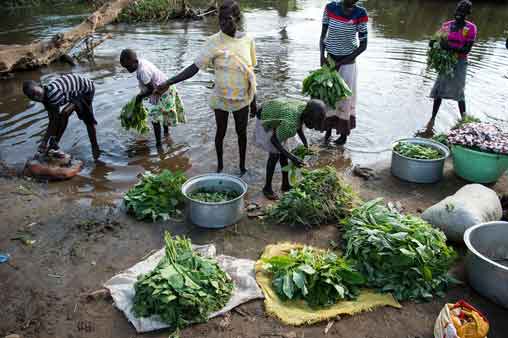
South Sudan, 2016: Girls wash foraged wild greens in a river’s unsafe waters, in the Torit region in Eastern Equatoria State, where late rains and insecurity in the region have led to failed crops and severe food insecurity, especially for the poorest. An estimated 2.8 million people in the countr...

Briefs for UN Security Council highlight how millions of people remain trapped in a vicious cycle of violence and hunger...

According to price projections from USDA Agricultural Projections to 2025 and income projections from ERS’s International Macroeconomic Data Set, food prices will drop and income levels will rise over the next decade. Under these assumptions, model results suggest improvements in food security thr...

Changes in the way the FAO measures hunger reduced the estimated number of hungry people and increased the percentage reduction in the number of hungry people. This article discusses those changes....

Ana Revenga, senior director of the Poverty and Equity Group at the World Bank, believes that the goal of ending extreme poverty can be achieved....

Scientists are predicting more than 10 percent of the world's population, a whopping 845 million people, will experience deficiencies in critically important micronutrients including zinc, iron, vitamin A, vitamin B12, and fatty-acids in the coming decades if global fish catches continue to decline....

CARACAS, Venezuela — In the darkness the warehouse looks like any other, a metal-roofed hangar next to a clattering overpass, with homeless people sleeping nearby in the shadows. But inside, workers quietly unload black plastic crates filled with merchandise...

Drs. Maria Andrade, Robert Mwanga, Jan Low and Howarth Bouis were announced as the 2016 World Food Prize Laureates during a June 28 ceremony at the U.S. State Department. Three of the 2016 laureates -- Dr. Maria Andrade, Dr. Robert Mwanga and Dr. Jan Low of the International Potato Center (CIP), whi...
The report ‘From Uniformity to Diversity: A paradigm shift from industrial agriculture to diversified agroecological systems’ written by International Panel of Experts on Sustainable Food System (IPES-FOOD) was launched at the Trondheim Conference on Biodiversity on 2 June 2016. The comprehensi...
 World Hunger Education