



Book Review: Kiss the Ground by Josh Tickell
June 6, 2026 By Jim Phillips
Published in 2017, Kiss the Ground: How the Food You Eat Can Reverse Climate Change, Heal Your Body & Ultimately Save Our World, presents a compelling case for transforming modern agriculture by focusing on building healthy, productive soils through regenerative practices such as no-till farming, elimination of synthetic chemicals, poly-cropping, and holistic pasture management. Writing largely about experiences in the United States, the author, Josh Tickell, argues that shifting away from the industrial monoculture model toward diversified, no-till production systems that integrate grazing livestock can reduce pest problems, sequester carbon, improve the soil’s water-holding capacity, mitigate hunger and food insecurity, and decrease dependence on heavy machinery, fossil fuels, and chemical inputs.
The author interviews several pioneers of the regenerative agriculture movement who have successfully implemented these practices on their own farms and are experiencing significant economic and environmental benefits. He also speaks with scientists who discuss the rapid increase in atmospheric CO₂ and the acidification of the oceans, which threatens phytoplankton, the organisms responsible for producing more than half of the Earth’s oxygen. Tickell argues that replacing industrial monoculture with regenerative agricultural practices that rebuild soil can help reverse the accumulation of atmospheric carbon.
The book describes how modern agricultural practices and land development have degraded the world’s soils. Topsoil is lost each year because fields are often left without protective plant cover. The natural water cycle is disrupted when rain falls on compacted soils or impervious surfaces, causing runoff rather than infiltration. When land is left bare, it loses the evaporative cooling provided by plant transpiration, contributing to higher surface temperatures and eventually desertification Tickell notes that more than 23 percent of the Earth’s land surface has been degraded by desertification.
The author highlights the work of the Rodale Institute, which has promoted organic agriculture for more than sevendecades. According to the Institute’s research, organic farming can produce yields comparable to, or in some cases greater than, conventional agriculture while requiring lower overall input costs. Although labor costs may be higher, Tickell argues that this is largely because today’s agricultural infrastructure has been built to support industrial monoculture, with its dependence on chemicals, specialized machinery, and fossil fuels. With its rigorous certification standards and price premiums, USDA Certified Organic represents one of the important building blocks of regenerative agriculture.
Drawing on interviews with successful regenerative farmers, Tickell concludes that practices such as holistic grazing, no-till farming, diverse crop rotations, composting, and the application of manure can create healthy soils rich in microorganisms. These biologically active soils sequester carbon, retain more water, reduce erosion, and produce abundant harvests year after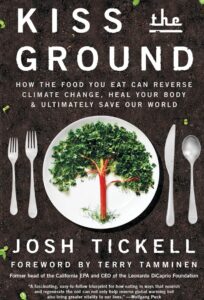 year.
year.
Among the experts interviewed is Andre Leu, Director of Regeneration International and author of Growing Life: Regenerating Farming and Ranching. Tickell also profiles several influential practitioners whose experiences illustrate the principles of regenerative farming.
Ray Archuleta, a conservation agronomist with the Natural Resources Conservation Service (NRCS), has long advocated for no-till agriculture. Through demonstrations and lectures, he illustrates how no-till practices improve soil structure, increase water infiltration and moisture retention, and reduce the oxidation of soil organic matter. One of his central messages is that intensive tillage with disk plows destroys the natural aggregates that give soil its structure. This disruption damages soil biology, increases erosion, reduces the soil’s capacity to retain water, and ultimately contributes to the degradation and desertification of farmland.
The Markegard family operates a ranch in northern California using rotational grazing and holistic rangeland management rather than concentrated animal feeding operations (CAFOs), where livestock are confined and manure accumulates in unhealthy conditions. Research cited from the Rodale Institute suggests that well-managed grazing systems can increase soil carbon, reduce erosion, and improve overall soil health. As livestock move across the landscape, they disturb the soil with their hooves, graze vegetation, deposit manure and urine, and distribute seeds before being moved to fresh pasture. These processes help stimulate plant growth and improve soil fertility.
One of the book’s most compelling examples is Gabe Brown, a North Dakota farmer widely regarded as a pioneer of regenerative agriculture and author of Dirt to Soil: One Family’s Journey into Regenerative Agriculture. Brown views his farm as a living ecosystem rather than simply a production system.
He compares soils from several different farming systems. One sample comes from a conventional farm that relies on synthetic chemicals and little crop diversity. Another comes from a farm that has practiced no-till for many years but still depends heavily on chemical inputs. In both cases, the soils are dense, compacted, and lacking healthy structure. Brown also examines soil from an organic farm that still relies on tillage. Although free of synthetic chemicals, the tilled soil crumbles into a fine powder and has limited ability to retain moisture.
Brown then contrasts these samples with soil from a four-acre section of his own farm where he grows squash, melons, peas, beans, and sweet corn. His soil is dark, rich in organic matter, filled with earthworms and mycorrhizal fungi, and remains moist despite the absence of recent rainfall. It forms stable aggregates that hold together rather than falling apart, allowing the soil to retain large amounts of water while storing significant quantities of carbon.
After harvest, Brown allows livestock to graze the remaining crop residue, naturally fertilizing the field with manure. Chickens are then brought in to spread the manure, consume insects, and contribute additional nutrients before the next crop cycle begins. This integrated system illustrates the regenerative principle of using livestock to restore soil health while reducing dependence on synthetic fertilizers and external inputs.
Overall, Kiss the Ground presents a persuasive and optimistic vision for the future of agriculture. While some of the book’s claims about the potential of regenerative agriculture to reverse climate change remain subjects of scientific debate, its central message—that healthy soils are fundamental to productive agriculture, environmental sustainability, and resilient ecosystems—is well supported. The book makes a strong case that rebuilding soil health through regenerative practices can improve farm profitability, enhance food production, conserve water, increase biodiversity, and leave the land in better condition for future generations.
Jim Phillips is on the Board of the World Hunger Education Service
-
 World Hunger Education
Service
P.O. Box 29015
Washington, D.C. 20017 -