




Study from China: Nutritional Deprivation Early in Life Has Long-term Consequences
June 20, 2026 A new Study in Social Science & Medicine, which tracks over 15,000 Chinese over many years finds that early childhood exposure to famine is associated later in life with poorer cognition, arthritis, rhemitism, job loss and early retirement.
The study by Qixin Zhu, Eleanora Fichera, Habtamu Beshir and Andrea Serna-Castano, “The Long-Term and Economic Impact of Childhood Early Life Shocks” (2026) (10.1016/j.socscimed.2026.119485) draws on longitudinal data from the China Health and Retirement Longitudinal Study (CHARLS), collected in 2014 and 2018, sampling 15,471 individuals born between 1941 and 1974.
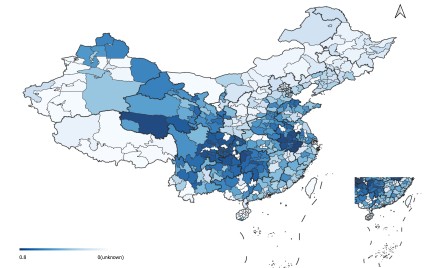
The map at left shows the intensity of famine at the preficture level.
The authors studied “the long-run consequences of nutritional shocks associated with the Great Chinese Famine—the largest famine in human history, with an estimated 30 million deaths (Smil, 1999).” They identified “individual-level starvation experience and fine-grained measures of famine intensity at the prefecture level, capturing substantial intra-provincial heterogeneity that is obscured in province-level analyses.” They examined long-term effects including “less explored economic outcomes that are closely linked to health deterioration, namely joblessness due to poor health and early retirement.”
The abstract explains: “exposure to famine represents a severe early-life shock that may shape health, cognitive, and labour-market outcomes across the life course. Yet evidence on its causal consequences in later life remains limited. This study examines whether early-life starvation during the Great Chinese Famine (1959–1961) affected later-life health, cognitive functioning, and labour-market outcomes. …We exploit prefecture-level famine intensity and famine exposure to instrument for self-reported childhood starvation, allowing for the identification of heterogeneous effects across childhood age stages. Our findings point to early childhood (ages 0–5) as a particularly sensitive period. Starvation during this stage is associated with poorer memory and a higher prevalence of arthritis and rheumatism, with more tentative evidence of adverse labour-market consequences, including health-related job discrimination and early retirement”
the Abstract continues: “Cognitive and physical outcomes are more pronounced for females, while economic penalties are concentrated among males, reflecting the gendered allocation of intra-household resources and labour pressures. Exposure during later childhood shows weaker effects. Overall, this study demonstrates that early-life nutritional shocks have long-lasting, age- and gender-specific consequences, emphasising the critical role of early childhood nutrition in shaping human capital, cognitive development, and labour-market participation in later life. These findings highlight the long-term costs of early-life deprivation and suggest that policies protecting children during periods of crisis may generate benefits across the life course.”
The authors distinguish between two “distinct forms of early-life nutritional shocks: famine exposure and childhood starvation experience. Famine exposure captures large-scale, region-wide shocks that disrupt food systems and living conditions, while childhood starvation experience reflects individual-level exposure to acute nutritional deprivation.”
They found that early-life nutritional shocks:
◊ Shape inequality even well into older age;
◊ Increase scores of mental depression and reduction in memory performance
◊ Increase by 15% the likelihood of arthritis or rhematism
◊ A lower probability of entering middle school.
◊ Affect women more than men, in terms of cognition and physical impacts,
◊ Affect men more in terms of jobs and economic penalties affect.
PDF version is available here.
The study’s authors are from the University of Bath, UK, and the Social Research Institute, UCL, UK.
– Contributed by WHES board member, Steven Hansch
-
 World Hunger Education
Service
P.O. Box 29015
Washington, D.C. 20017 -