




Famine Modelling: 12 Articles in Journal of Public Health Policy
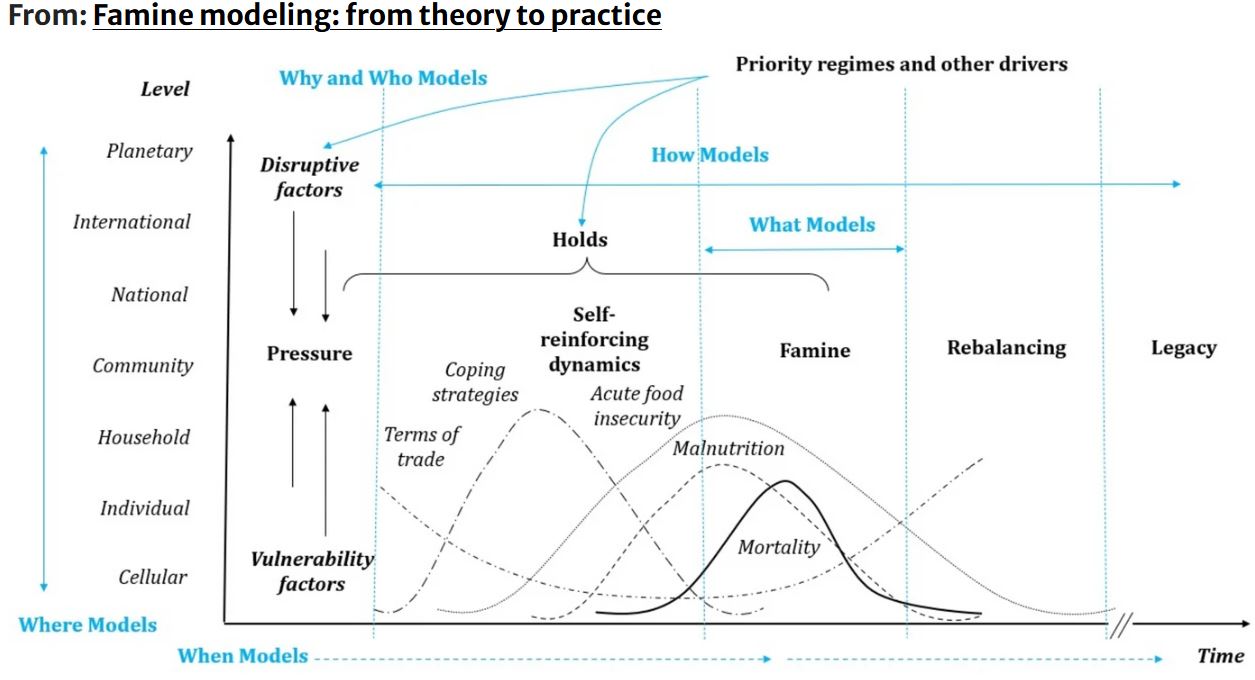
September 24, 2026. The August 2026 special edition of the Journal of Public Health Policy (Spring publisher) challenges many old views of famine. In an era characterized by real-time satellite imagery, global supply chain logistics, and predictive artificial intelligence, humanity faces an uncomfortable paradox: the persistent, devastating return of mass starvation. Historically, public policy and early warning systems viewed famine as a static, isolated event—a sudden collapse in local food production triggered by environmental drought or armed conflict, measured primarily by post-hoc mortality statistics.
These new open-access articles about famine are available at: https://link.springer.com/journal/41271
Edited by famine scholars Paul W. Howe and Elena N. Naumova, the new collection brings together computational modelers, epidemiologists, systems engineers, and public health practitioners to advance a new paradigm: conceptualizing and modeling mass starvation as a complex, dynamic, adaptive system. Spanning analytical scales from cellular metabolism and household foraging behaviors to regional market supply chains, macro-climate projections, and multi-generational trauma, these eleven articles provide a comprehensive blueprint for understanding how severe hunger escalates into systemic catastrophe.
By weaving together these multi-disciplinary insights, we can examine the key findings of this research, evaluate new tools available to policymakers, and soberly assess whether these scientific breakthroughs are enabling real progress toward the ultimate goal of famine prevention.
The Architecture of Famine: Pressures, Holds, and Systemic Escalation
At the foundation of this new analytical framework is the understanding that famines are not linear, mechanical failures. Rather, they are emergent states generated by self-reinforcing feedback loops across interconnected political, economic, and social systems. In their introductory analysis, Howe and Naumova outline a core dynamic model of crisis evolution: systemic pressures interact with political holds, triggering feedback loops that escalate into a full-blown famine system before eventually reaching a rebalancing point.
Systemic pressures represent baseline vulnerabilities combined with external shocks, such as severe droughts, pest infestations, or macroeconomic collapse. Under normal circumstances, communities deploy coping mechanisms or receive external aid to absorb these shocks. A crisis transforms into a lethal famine system only when a hold is applied—a political, military, economic, or policy barrier that prevents relief from reaching affected populations or barriers to people migrating safely.
Peter Hailey, founding director of the Centre for Humanitarian Change in Nairobi and a member of the IPC Famine Review Committee since it began in 2014, writes with Daniel Maxwell and Elena Naumova about the data those models depend on. Hailey led UNICEF’s nutrition scale-up in the 2011 Somalia famine. The paper argues that the same political sensitivity that delayed that response still shapes what gets counted.
This structural interaction is vividly demonstrated in the article “System Dynamics Modeling of the 1998 Bahr el Ghazal Famine in Sudan” by Steven Arquitt, Paul Howe, and Luka Biong Deng Kuol. Reconstructing a catastrophe that claimed over 70,000 lives, the authors used causal loop diagrams to map how environmental drought and counterinsurgency raids initially generated acute hunger pressure. The situation escalated into mass mortality due to three specific political holds: a government-imposed flight ban that grounded humanitarian relief aircraft, the diversion of food aid by local military commanders, and institutional delays within aid organizations struggling to transition from development assistance to emergency response.
Counterfactual computer simulations revealed that if these three holds had been dismantled, over 80 percent of the excess mortality could have been prevented, demonstrating how political decisions amplify hunger shocks into deadly catastrophes.
A complementary perspective on institutional holds appears in the article “Systems Thinking and the 2011–2012 Somalia Famine” by Udita Sanga. Analyzing a crisis that resulted in more than 258,000 deaths, Sanga applies systems archetypes to uncover recurring patterns of systemic failure. The study highlights an “escalation archetype”, where restrictive access policies enforced by the insurgent group Al-Shabaab clashed with stringent Western counter-terrorism sanctions, such as United States banking regulations. This political lock-in created a deadly trap that choked off humanitarian assistance precisely as severe drought struck. Sanga also identifies a Fixes that Fail dynamic, where short-term emergency cash distributions provided temporary relief but failed to rebuild eroded community safety nets, ultimately increasing long-term reliance on foreign assistance.
Micro-Dynamics: Household Masking, Starvation Biology, and Seasonal Relapse
While macro-level models map institutional failures, understanding how severe hunger impacts human lives requires examining micro-level dynamics at the household, cellular, and seasonal levels.
In the article “Simulating Household Coping Responses to Food Scarcity: The ‘Watch’ Famine Archetype,” Alexandra Thorn presents a quantitative simulation framework detailing how subsistence families adapt to food shortages. During agricultural lean seasons, households adopt coping strategies such as severe meal rationing and wild food foraging. Thorn’s model reveals a critical paradox: while these coping mechanisms sustain short-term survival, they simultaneously mask the true severity of an escalating crisis from outside humanitarian monitors. Because families appear to be surviving on paper, aid agencies may fail to trigger early interventions. Meanwhile, household members exhaust their internal metabolic reserves and deplete local ecological resources. When an additional shock arrives, household resilience abruptly collapses, leading to a sudden, catastrophic spike in mortality.
With a focus on human physiology, the article “Systems Dynamics Modeling of Human Starvation: Physiological Pathways and Environmental Stressors” by Alexandra Thorn and Merry Fitzpatrick explores the biological mechanics of acute hunger. The authors argue that mortality during famines rarely stems from a simple, linear deficit of missing calories. Instead, biological systems models track how the human body sequentially metabolizes stored glycogen, body fat, and essential muscle tissue under extreme environmental conditions. The model demonstrates that biological survival timelines are heavily dictated by compounding stressors—such as ambient hypothermia, intense physical labor, and infectious diseases like dysentery, cholera, and measles. Micronutrient deficiencies and baseline health history further alter individual physiological breakdown, proving that effective nutritional interventions must account for environmental and biological feedback rather than caloric totals alone.
The fragile nature of physiological recovery is further documented in the empirical study “Seasonal Transitions and Child Malnutrition Relapse in Mali, South Sudan, and Somalia” by Anastasia Marshak and her co-researchers. Tracking more than 2,700 children who had successfully recovered from severe acute malnutrition, the study revealed alarming relapse rates—up to 60 percent within six months—that were strictly tied to seasonal transitions. Children with a prior history of acute hunger deteriorated up to six weeks earlier during dry-to-rainy season shifts, experienced higher peak severity of illness, and remained sick significantly longer than their peers. This demonstrates that acute hunger leaves a lasting biological vulnerability, rendering young children extraordinarily susceptible to recurring environmental and economic shocks.
Macro-Forces: Climate Projections, Market Synchronization, and Data Governance
Addressing mass hunger on a global scale requires combining these biological and household insights with macro-level tools that analyze climate trends, commercial food markets, and data ecosystems.
In the study “Climate Change and the Global Threat of Famine,” Erin Coughlan de Perez and her co-authors utilize advanced climate projections and global crop yield models to evaluate future risk scenarios. Their findings draw a crucial distinction between climate-induced pressure and famine creation. Without proactive agricultural adaptation, rising temperatures and shifting precipitation patterns are projected to reduce crop yields across Sub-Saharan Africa, South Asia, Central America, and the Middle East, increasing baseline hunger pressure. However, scenarios incorporating agricultural adaptation—such as switching to heat-tolerant crop varieties, improving irrigation, and closing yield gaps—show that agricultural productivity can be sustained. The researchers conclude that while climate change adds substantial pressure to global food systems, famine itself is not an inevitable climatic outcome; it remains a human political choice determined by whether societies invest in climate adaptation and avoid conflict-driven holds.
Understanding how market dynamics transmit hunger across regions is explored in “Seasonal Patterns and Environmental Triggers of Child Malnutrition in Yemen” by Bingjie Zhou and colleagues. Utilizing non-linear time-series analysis on multi-year health and economic data, the authors identified a clear spatiotemporal synchronization. Seasonal fluctuations in environmental indicators, such as rainfall and vegetation density, trigger a predictable, multi-step cascade: rising local grain prices, adoption of severe household coping strategies, escalating food insecurity, and ultimately a sharp peak in hospital admissions for severe acute malnutrition. Quantifying these lagged, seasonal sequences enables humanitarian organizations to transform early environmental signals into predictive intervention schedules months before health crises peak.
In data-scarce settings where quantitative forecasting is hindered by missing information, descriptive mapping tools offer immense practical value. In “Applying System Mapping to Food Security and Supply Chains in Uganda,” Luc Gendre and his co-authors demonstrate how the System Pathways Toolkit was deployed in the Karamoja region. By mapping commercial supply chains, from agricultural inputs and transport routes to local grain markets—as the structural backbone of community resilience, the authors provided humanitarian, development, and peacebuilding agencies with a shared operational picture. This collective sense-making allowed multi-sectoral teams to identify critical infrastructure bottlenecks, such as transport constraints, and coordinate long-term resilience programs.
Predictive models and planning tools depend fundamentally on the quality of data. In “Data Challenges and Opportunities in Famine Modeling,” Daniel Maxwell, Peter Hailey, and Elena Naumova examine the severe obstacles facing humanitarian data ecosystems. The authors document widespread structural missingness, agency siloing, and the intentional politicization and suppression of hunger data by warring parties seeking to conceal suffering or manipulate aid delivery. To protect early warning systems from manipulation, Maxwell and his colleagues advocate for data democratization—combining advanced privacy safeguards, such as synthetic datasets and differential privacy, with open-access platforms that make food security data an uncompromised global public good.
The Long Shadow: Intergenerational Legacies of Starvation
A vital insight emerging from this special edition is that the boundary of a famine cannot be limited to the immediate period of excess mortality. In “The Aftermath of Famine: Social, Geopolitical, and Medical Repercussions of the Ukrainian Holodomor,” historian Johnathon Vsetecka examines the 1932–1933 Soviet state-engineered famine in Ukraine to establish a three-pronged framework for analyzing the long-term aftermath of mass hunger.
Vsetecka demonstrates that the reverberations of mass starvation persist across three distinct dimensions long after food supplies are restored: First, within social and cultural spheres, survivors endure deep psychological trauma, community destruction, and decades of state-enforced memory suppression. Second, within global geopolitics, international diaspora communities mobilize around historical memory, establishing transnational networks to pursue accountability and famine justice. Third, within medicine and public health, extreme hunger leaves enduring biological marks.
Epigenetic research reveals that individuals exposed to severe starvation in utero experience significantly higher rates of adult Type-2 diabetes and metabolic disorders. Furthermore, trauma coping mechanisms are transmitted across generations, permanently altering public health profiles. Vsetecka’s work emphasizes that public policy must treat famine recovery as a multi-generational commitment rather than a short-term emergency response.
From a theoretical and methodological perspective, this collection is a major step forward. Rather than relying on static, retrospective metrics that evaluate crises only after mass mortality has occurred, these researchers have operationalized complex systems science into practical, usable tools. By connecting micro-level cellular metabolism and household foraging behaviors to macro-level climate modeling, market supply chains, and political holds, the special edition replaces simplistic linear models with a dynamic, multi-scalar understanding of how hunger escalates into disaster. The development of causal loop diagrams, partial differential prototype models, non-linear time-series synchronization, and supply chain mapping tools represents a major leap forward in humanitarian diagnostics.
However, when evaluated against the practical benchmark of real-world famine prevention, the conclusion must be far more cautious. The authors themselves acknowledge that system-based famine modeling remains in a developing phase. While our diagnostic tools have never been more sophisticated, actual progress in preventing famines remains severely constrained by persistent political and structural barriers.
The fundamental bottleneck to preventing modern mass starvation is rarely a lack of early warning data or analytical modeling capacity. As these studies repeatedly demonstrate, contemporary famines are from human-made disasters caused by armed conflict, military sieges, blockades, counter-terrorism restrictions, bureaucratic aid obstruction, and deliberate data suppression.
High-resolution satellite models and system dynamics simulations can project hunger risks months in advance with remarkable precision. Yet, if political leaders and military actors choose to restrict access, block food imports, or weaponize relief, scientific models alone cannot prevent catastrophe.
In all, this special edition of the Journal of Public Health Policy delivers both a major scientific achievement and a profound policy warning. Systems science has given humanity unprecedented clarity to decode the mechanics of mass hunger, identify leverage points for intervention, and trace the inter-generational wounds of starvation. But translating this into saved lives requires political courage, strict enforcement of international humanitarian law, and an unyielding global commitment to dismantle the human-made holds that turn hunger into famine.
Edited by Steven Hansch of WHES
-
 World Hunger Education
Service
P.O. Box 29015
Washington, D.C. 20017 -